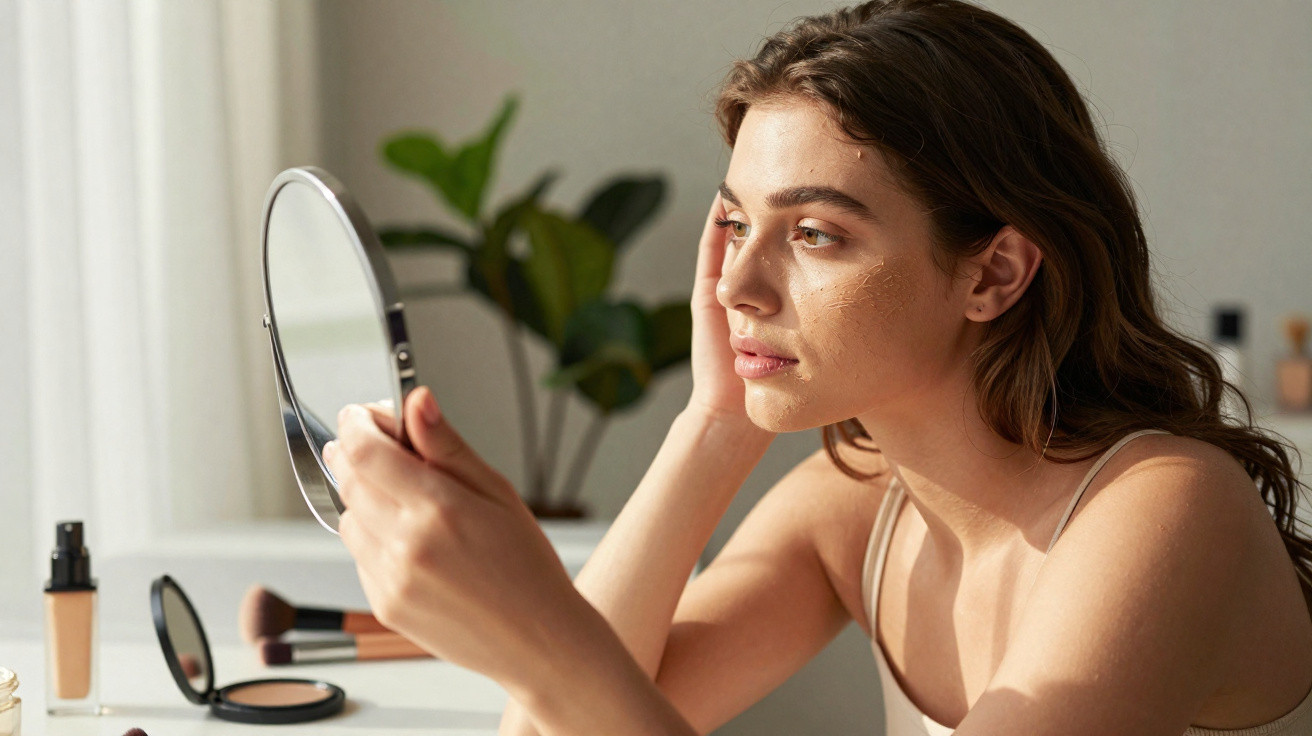
Under the unforgiving lights of a changing-room mirror, the foundation appeared flawless on the back of her hand.
But once it was on her face, everything changed. Every small bump, each dry flake she had not noticed, and every pore around her nose suddenly seemed visible in high definition. She had not altered her skincare routine, slept any less or done anything “wrong”. The only difference was swapping her usual glowy base for a fashionable, full-coverage matte formula.
On TikTok and in adverts, matte makeup often resembles a blur filter. In everyday life, it can feel more like a magnifying glass. Why can a product designed to smooth the complexion end up doing the reverse?
Why matte makeup makes texture stand out rather than fade away
A quick look along any beauty aisle makes the claims clear: “poreless matte”, “soft-focus matte”, “airbrush matte”. The pitch is enticingly straightforward: apply it and your skin will look filtered, smooth and evenly matte in the best possible sense. Yet many people leave home feeling as though their foundation has announced their pores to everyone they meet.
Matte finishes soak up light rather than reflecting it. That can work brilliantly on camera, but it is less kind to real, imperfect skin. If you have fine lines, old acne scarring or patches of dryness, the missing reflection can make every slight unevenness look more noticeable. The result may be described as “clean”, although it can look far harsher in reality than the packaging suggests.
One makeup artist I spoke to called a matte base “high definition honesty”. On a 20-year-old whose skin has almost no texture, it can indeed look immaculate. On skin with a little more life behind it, however, the finish can quickly shift from polished to stiff. That’s when people start saying, “I feel like this foundation aged me ten years.”
Spend time scrolling beauty Reddit and the same theme appears repeatedly. Someone shares a selfie wearing a new matte foundation and asks why their pores have “suddenly exploded”. Replies soon follow: “Same here”, “It clings to my dry spots”, “My forehead lines doubled overnight”. Their skin did not transform overnight; the finish did.
Beauty brands enjoy displaying matte bases on skin that is exceptionally even and almost glass-like. In practice, only a small proportion of people have such a texture-free canvas. A survey from a UK dermatology clinic chain estimated that more than 70% of patients who reported having “bad texture” were actually referring to entirely normal pores and fine lines, made more obvious by their product choices and lighting.
Picture a matt-painted wall beside one with a satin finish. On the matt surface, shadows settle into every small dent and crack. With satin paint, light travels across those same imperfections and makes them appear softer. Foundation behaves in much the same way on the face. Dewy and luminous formulas reflect light, blurring the appearance of fine lines and little bumps. Matte formulas create stronger shadows and definition instead.
There is also the fact that a genuinely matte finish often relies on extra pigment and oil-absorbing powders to last. Those powders may catch on dry areas, cling to peach fuzz and settle slightly into pores. The outcome is not simply “more coverage”; it is greater contrast between the smoother and less smooth parts of the face. Smooth areas become completely flat, while textured sections seem more prominent by comparison. That contrast is what your eye notices in the mirror.
How to wear matte makeup without making texture the main character
The simplest way to get a better result from matte makeup is to alter where you apply it. Rather than covering your whole face in matte, take a targeted approach. Use a light layer of matte foundation or powder only through the T-zone, around the sides of the nose and perhaps on the chin, then choose a more luminous finish for the rest of the face. It may sound fiddly, but in reality it takes roughly 20 extra seconds.
Begin with skin that is properly hydrated and a little tacky. A light, non-greasy moisturiser that leaves some slip helps powder adhere without gathering in dry patches. Next, apply a sheer, flexible foundation with a natural or satin finish across the face. Afterwards, use a small brush to press matte powder only onto the areas that become shiny quickly.
This keeps oil control exactly where you need it while allowing your cheeks and forehead to reflect light, which makes texture look softer. Think of it as careful editing rather than placing a heavy filter over the whole photograph.
Many people battle against their base rather than working with it. They apply more and more matte foundation to “cover” texture, without realising that they are building up product inside pores and lines. The impulse is understandable: greater coverage sounds as though it should mean more blurring. In fact, the opposite is usually true. Thick applications create edges and ridges that draw attention.
A more effective approach is to use less foundation and better tools. With a damp sponge, press the product into the skin in fine, even layers instead of dragging it around with a dry brush. If a blemish or scar needs extra coverage, conceal that particular area rather than coating the whole face in a heavier formula. Let’s be honest: nobody really does that every day, but on important days it makes all the difference.
There is an emotional element, too. Texture is not a defect; it is simply skin behaving like skin. On a difficult mirror day, it is tempting to try to smooth everything away with powders and long-wear formulas. That is often when makeup begins to appear heavy and unforgiving. Being a little kinder to your face - and using matte with a little more restraint - can make a significant difference.
“Matte isn’t the enemy,” says London-based makeup artist Karina Lai. “The problem is when we try to use matte formulas as a cure for texture. They’re better as tools for balance, not as texture erasers.”
A helpful mental adjustment is to stop aiming for “poreless” and start looking for “soft-focus”. That modest shift removes some pressure and makes it easier to combine different finishes. A small dot of liquid highlighter on the high points of the cheekbones, satin concealer beneath the eyes and a cream blush instead of a powder one all create pockets of light that take attention away from areas with more texture.
- Apply matte only where you genuinely become shiny, rather than automatically using it everywhere.
- Keep each layer light and build coverage only on individual areas.
- Avoid extremely flat, full-coverage matte formulas if your skin is dry or peeling.
- On rougher areas, blend a drop of moisturiser or glow primer into matte foundation.
- Check your makeup in gentle natural light, not solely beneath harsh bathroom bulbs.
Rethinking what “good skin” really looks like
Something changes when you recognise that the finish - rather than your face - is the bully in the mirror. Matte can look beautiful on the appropriate day, in the right setting and at the right level. Dewy makeup can also become overly greasy or highlight pores in its own way. The key is remembering that “flawless” constantly shifts; it is not a quality you either possess or lack.
All of us have pores, fine lines, faint scars and tiny bumps along the jawline. That is not a failure; it is human. On a stressful morning or during a week of breakouts, a thick matte formula can be very tempting when you want to “erase” it all. On a gentler day, a sheer wash of luminous tint may feel bolder, lighter and more like you. Neither option is wrong. They are simply different moods of the same face.
On screen, beauty frequently looks like an absence of both reflection and texture. In real life, the faces we find most compelling tend to have both brightness and shadow, glow and detail. Texture that moves when someone laughs. Skin that has a slight sheen on the journey home. That is the point of matte makeup: when used to erase, it can leave you feeling masked. When used to balance, in small areas and subtle flashes, it can quietly support the story your skin is already telling.
| Key point | Detail | Why it matters to the reader |
|---|---|---|
| Matte shows more texture | It absorbs light, creating shadows in pores, lines and bumps | It helps explain why your skin can look “worse” in certain foundations |
| Placement beats full coverage | Use matte only on oilier areas and combine it with satin elsewhere | It offers a practical way to manage shine without a harsh finish |
| Less product, smarter tools | Use thin layers, a damp sponge and spot concealing instead of piling products on | It reduces cakiness and stops texture becoming the focal point |








Comments
No comments yet. Be the first to comment!
Leave a Comment