
Mr Klein, 72, sits in the waiting room wearing smart corduroy trousers. He has a good sense of humour, though there is a hint of tiredness in his eyes. The doctor invites him into the consultation room, places a plain wooden chair without armrests in the centre, smiles and says: “Right, we’re going to do a quick test.” There is no blood-pressure monitor or high-tech machine involved. Just the chair and his legs. Mr Klein looks briefly puzzled, then interested. He is asked to sit down, stand up, sit down again – as quickly and as many times as possible. For just 30 seconds.
What may seem like a harmless fitness novelty has become one of the most serious early warning signs for a question many of us prefer to put off: how independent will we remain in later life? And how much can one simple chair reveal about it?
The chair that knows more about your age than the mirror
We have all seen it: an older person struggling to rise from the sofa, gripping the coffee table first and then reaching for a shelf. It can look as though they have merely become “a bit stiff”, but it is often far more significant: a quiet sign that the leg muscles are gradually weakening. This is precisely where the chair test comes in.
Its principle is disarmingly straightforward. Someone who can repeatedly rise powerfully from a sitting position within a short period still has reserves. Someone who hesitates, wobbles or has to stop early is showing just how vulnerable their independence may already be. The chair becomes a mirror of the future, not the past.
I once watched a group completing the test at a rehabilitation clinic on the edge of town. One woman, 68 and a former secretary, laughed at first: “But I walk the dog every day.” After 15 seconds, the laughter had disappeared. Her thighs began to burn, her upper body tipped forwards and her hands instinctively searched for support on her thighs. A nurse gently stopped her. Later, she said she had never imagined that such “child’s play” could push her to her limits.
Research shows a clear pattern: people who perform poorly in the chair test face a markedly greater risk of falls, hospital admissions and needing care. The number of repetitions achieved in 30 seconds is closely linked to strength, balance and coordination. And, at times, to the willingness to make an effort. The sober reality is that most of us notice declining muscle strength far too late – often only after something has happened.
Physiologists explain it this way: as we age, the body first loses its fast-twitch muscle fibres. These are exactly the fibres we need to get up from a chair quickly or lift a foot in time when we trip. If you rise only slowly in the test or feel unsteady on the very first attempt, it suggests these fibres are already in considerable retreat. A seemingly ordinary everyday movement test can therefore expose what no perfectly lit selfie can show: the true state of our physical reserve. Let us be honest: hardly anyone does it every day, even though it takes only seconds.
How the 30-second chair test works and what the results mean
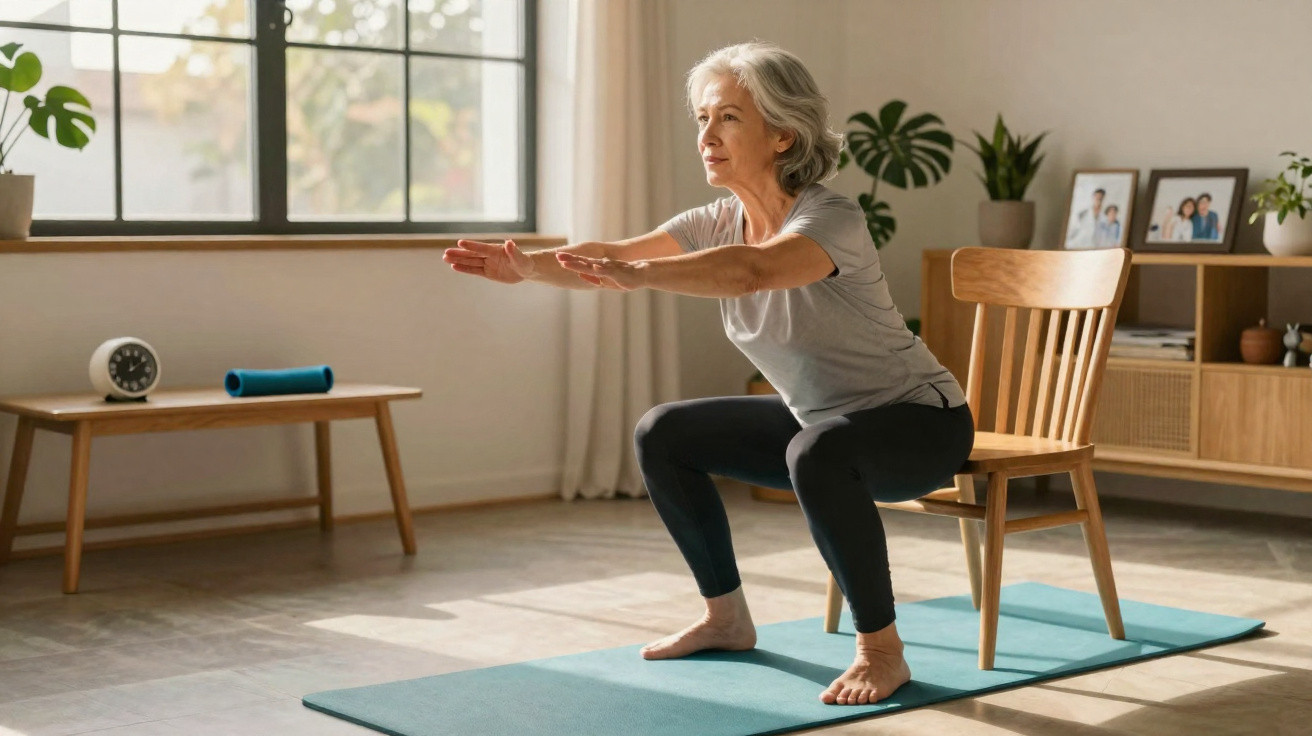
The standard chair test used by many geriatricians is called the “30-second chair stand test”. You need only a sturdy chair without armrests, a stopwatch and a little space. Sit upright with your feet flat on the floor and hip-width apart, and fold your arms across your chest. Then start the timer. Your task is to stand up fully and sit back down as many times as possible within 30 seconds. Each complete standing movement counts. It sounds easy, but it can feel surprisingly demanding very quickly.
It is important not to use your hands to help yourself. If you cannot manage without them, that alone is a strong signal. Many people are surprised by how breathless they become or how sharply their pulse rises. One doctor once told me: “After ten seconds, you can already see whether someone is at risk of falling in everyday life or not.”
The biggest misconception is that many people compare themselves with how fit they feel, rather than with figures. Yet there are broad guide values. As a guide, women aged 60–64 are generally considered to be within the normal range at around 12–17 repetitions, while for men it is 14–19. From age 70, the range drops slightly. Anyone well below these figures should take notice. Conversely, anyone above the upper end of the range has a genuine advantage. A physiotherapist put it bluntly: “Every extra repetition is a little more independence in old age.”
What is rarely mentioned is that the test can also be used to track your own progress. There is no need for a gym or a complicated programme. Repeat it every few weeks, under the same conditions and for the same time. If 8 repetitions suddenly become 11, that is not coincidence: it is practical preparation for the future, carried out on an ordinary kitchen chair.
How to train your legs for an independent old age – without a gym
The good news is that the leg strength revealed by this test can be improved at any age. And it is much simpler than most people think. One tried-and-tested mini routine is to choose a permanent chair at home as your “training chair”. Position it where you can hold on to something if necessary. Then, two to three times a week, complete two to three sets of 8–10 controlled standing movements. Rise slowly, pause briefly at the top, then lower yourself slowly back down.
The aim is not to punish yourself. It is to give your muscles a clear message: “You are still needed.” Over time, you can rely less on your arms, choose a slightly lower seat or increase the speed a little. The chair changes from a quiet piece of furniture into a daily ally. Suddenly, that item in the living room has a purpose that goes well beyond sitting.
The most common training mistake is starting with huge enthusiasm, doing far too much for three days and then giving up in frustration once everything hurts. The truth is less dramatic: small, consistent steps beat heroic bursts of effort. If you feel unsteady while practising, create safety measures: keep a solid table within reach, wear non-slip shoes and avoid rugs that can bunch up. Another classic error is dropping down too quickly. Many people simply fall back into the chair. Yet the controlled downward movement is especially valuable because it makes the muscles work particularly hard.
People who are already afraid of falling often feel insecure even when simply standing up. A handrail, the kitchen worktop or someone familiar can help here. This is not about heroics; it is about routine. Your legs can learn again that getting up is not dangerous, but completely normal.
A 79-year-old patient once told me: “Every day while brushing my teeth, I stood up from my stool and sat back down five times. After three months, I could get up from the deep armchair in the living room without any effort. That was when I realised how much I had been holding myself back before.”
A small mental checklist pinned to the fridge can help many people:
- Do the 30-second chair test once a week – always at the same time of day.
- Use every television advert break for 5–10 slow standing repetitions.
- Walk up stairs that are already part of daily life deliberately and briskly, rather than shuffling.
- At least once a day, stand up from a slightly lower chair or sofa without pulling yourself up.
- Start a “stand-up challenge” with friends or your partner – a shared routine lasts longer.
Even just a few of these building blocks can make the difference between “only just” and “I can still do this on my own”.
What this small chair test has to do with dignity and freedom
We rarely discuss it openly, but many people fear dependence more than ageing itself. The moment you have to ask someone, “Could you help me stand up, please?”, can undermine how you see yourself. A chair is then no longer merely a piece of furniture, but a symbol of whether your body can still do what your mind asks of it. Seen this way, the chair test is an honest, and sometimes uncomfortable, look at that quiet fear.
People who take the test often feel very directly where they currently stand. At times that can hurt; at others, it can create unexpected pride. Both can be useful. From a practical perspective, the test is an invitation to take responsibility – not some day in the future, but now. It shows that ageing is not only about wrinkles, but also about having the strength to lift yourself from the ground through your own muscular effort. And it shows that this ability can be trained as unremarkably as making morning coffee.
Perhaps today, simply out of curiosity, you will stand up from your chair and try the test. Perhaps you will send this article to your parents, neighbours or the friend who is “actually quite fit” but might still be surprised. In a life often shaped by screens and appointments, a small physical check like this can seem almost old-fashioned. Yet this very moment – you, a chair, 30 seconds – could become a turning point. A quiet, invisible beginning to later life in which you can say: “I can still get up by myself.”
| Key point | Detail | Benefit for the reader |
|---|---|---|
| Chair test as an early warning sign | A simple 30-second standing exercise reveals leg strength and fall risk | The reader can identify early whether their own independence could be at risk |
| Trainable leg strength | Regular standing exercises using a “training chair” measurably improve the test result | A practical, easy-to-follow strategy for actively supporting an independent old age |
| Everyday integration rather than a gym | Standing up while brushing teeth, during advert breaks and on stairs | The barrier is lower because training is possible without extra effort or equipment |
FAQ
Question 1: How often should I do the 30-second chair test?
Every two to four weeks is entirely sufficient to notice changes. Testing too frequently is more likely to measure how you feel that day than genuine progress.Question 2: How many repetitions count as “good”?
Guide values vary according to age and sex. Broadly speaking, anyone of retirement age who can manage 10 or more clean repetitions has a solid foundation; anything above that is a bonus.Question 3: What if I need to use my arms for support during the test?
The test then indicates that strength or confidence is currently lacking. Use your arms at first, practise regularly and later try to depend on them less.Question 4: Is the test suitable if I have knee problems?
Yes, with medical advice, often using an adapted technique: a slightly higher chair, slower movements and respect for your pain threshold. Seek medical advice first if you have acute symptoms.Question 5: Can this training really prevent falls?
No method offers a guarantee, but stronger legs and controlled standing movements have been shown to reduce the risk of falls. The chair therefore becomes a simple but effective protective factor in everyday life.













Comments
No comments yet. Be the first to comment!
Leave a Comment