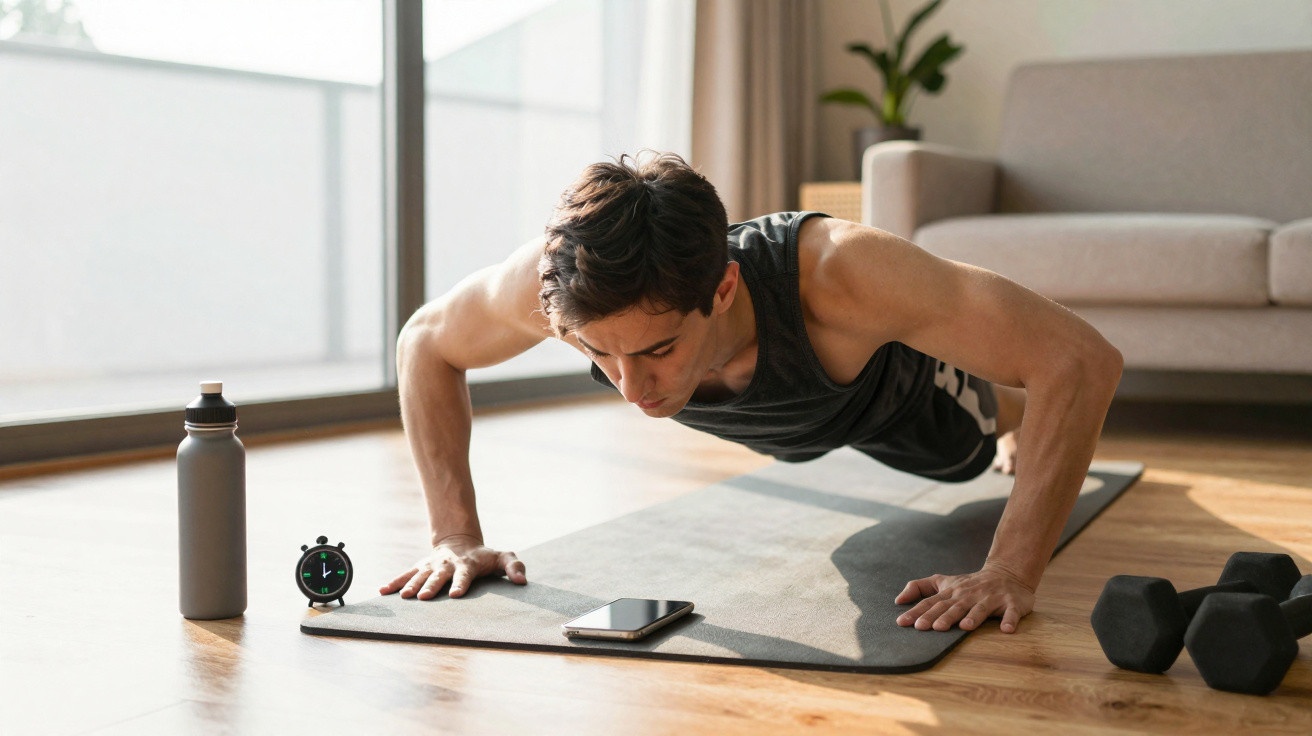
Home exercise is often treated as another name for press-ups, yet anyone aiming for more defined arms at home does not always need to repeat the same pushing pattern. When the emphasis is on elbow extension, scapular control and loading the triceps, an often-overlooked variation - the diamond press-up - can provide a more targeted stimulus for muscle definition within a few weeks.
Why are standard press-ups not always best for defining the arms?
A conventional press-up spreads the effort effectively across the chest, front deltoids, core and triceps. While this is excellent for overall strength, it is not necessarily ideal for people who want to emphasise the shape of the back of the arm. In practice, range of motion and hand placement substantially affect muscle recruitment, which changes the visible outcome over the course of training.
In the arms, muscle definition becomes more apparent when training consistently provides volume, mechanical tension and clean technique. If the torso collapses, the elbows flare too far out or each repetition relies on momentum, some of the load is taken away from the triceps. This is why many people complete dozens of repetitions yet feel their chest more than their arms the following day.
Which home exercise places more emphasis on the triceps?
For most people, the most plausible answer is the diamond press-up, also known as a close-grip press-up. Bringing the hands together beneath the chest demands greater elbow extension, reduces the comfortable leverage of the standard version and increases triceps involvement on the way up.
This straightforward adjustment generally works better for the arms because it changes the direction of effort without requiring dumbbells, resistance bands or a bench. At home, it makes progression and weekly training frequency easier. It also helps keep training efficient, with fewer exercises and a more precise stimulus.
What does research show about muscle activation in diamond press-ups?
The sense that a close hand position places more load on the triceps is not simply a training impression. According to the study Comparison of muscle activation using various hand positions during the push-up exercise, published in the Journal of Strength and Conditioning Research, a narrow hand position produced greater muscle activation than a wide stance, particularly in the triceps brachii. This helps explain why the closer variation is often more effective for those looking to refine the appearance of their arms.
This finding aligns with a more recent systematic review, Kinetic analysis of push-up exercises: a systematic review with practical recommendations, published in Sports Biomechanics, which shows that small changes to press-up variations alter loading, mechanics and exercise prescription. In home training, this difference in execution matters more than increasing repetitions without a clear purpose.
How can you add this adjustment to your routine without losing technique?
To make the diamond press-up a genuine stimulus for muscle definition, several details matter from the first week:
- Keep the hands close together beneath the sternum, with the thumbs and index fingers almost touching.
- Point the elbows backwards rather than allowing them to flare fully to the sides.
- Brace the abdominals and glutes to prevent the lower back from dipping.
- Lower in a controlled manner, bringing the chest towards the hands without losing alignment.
- Press all the way up, extending the elbows without shortening the repetition.
If the load is still too demanding, begin with the knees on the floor or the hands raised on a firm sofa, low bed or stable worktop. The key is to retain the movement mechanics. Completing fewer high-quality repetitions produces better results for the arms than long sets filled with compensation.
Which mistakes delay muscle definition at home?
The biggest mistake is replacing tension with speed. During home exercise, many people rush the upward phase, shorten the descent and count empty repetitions. Another frequent issue is training the arms every day without recovery, which reduces performance and makes it harder to progress the load using body weight.
It is also worth watching for these signs of poor technique:
- shoulders rising towards the ears during the set
- hips dropping before the chest
- elbows flaring excessively on every repetition
- a shortened range, without the torso genuinely moving closer
- loss of rhythm within the first few repetitions
How do the arms respond in the first few weeks?
Arms respond quickly when training combines frequency, proximity to failure and straightforward progression. Rather than doing one hundred scattered press-ups throughout the day, it is generally more productive to arrange three to four weekly sessions, with three to five sets of well-executed diamond press-ups and enough rest to maintain quality.
Muscle definition shows more clearly when the muscle receives consistent stimulation and body-fat percentage does not mask its outline. For this reason, hydration, protein intake, sleep and consistency matter as much as the sets themselves. At home, the advantage lies in convenience: with a firm floor, good range of motion and a close hand position, triceps development becomes more noticeable than with automatic repetitions of standard press-ups.










Comments
No comments yet. Be the first to comment!
Leave a Comment