In brief
- 🔍 A rediscovered 1964 haircut diagram uses canonical angles (0°, 22.5°, 45°, 67.5°, 90°) that correspond closely with modern face-mapping algorithms, connecting analogue expertise with digital inference.
- 🧠 Its angle planes correspond to facial landmarks, reducing segmentation flicker and mesh clipping in AR try-ons through more predictable silhouettes and movement.
- 🧪 Trials with London salons and app teams found quicker consultations, fewer alterations, more stable masks during movement, and cleaner synthetic data labelling.
- ⚖️ Pros vs. Cons: Pros-common terminology, repeatable outcomes, stronger simulation-to-scissor parity; Cons-Eurocentric bias, texture limitations; Mitigations-texture-aware elevations and varied, inclusive datasets.
- 🚀 Implications: a shared headform framework for AR mirrors, robotic cutters and virtual stylists, transforming established mid-century geometry into a contemporary product model.
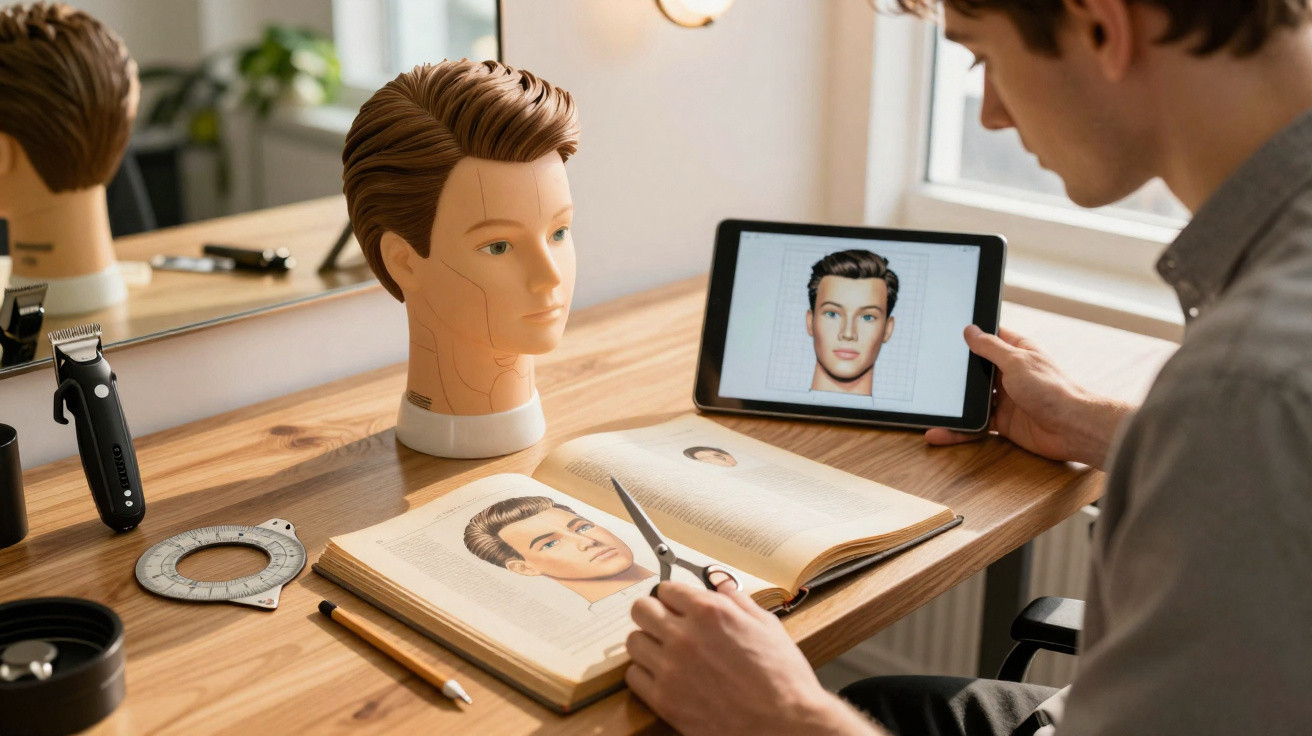
A recovered 1964 haircut diagram is generating interest far beyond hairdressing, with computer-vision researchers suggesting that its precisely defined angles map remarkably well to present-day face-mapping algorithms. Unearthed from a trainer’s folder before being circulated among stylists and engineers, the document sets out elevations, graduations and radial guides which, decades on, appear to reflect the landmark geometry behind AR try-on platforms and virtual fitting rooms. This is a rare moment when analogue craft meets digital inference without translation loss. In a sector focused on innovation, the understated usefulness of mid-century geometry prompts a challenging thought: had earlier masters already been refining the mathematics now handled automatically?
The Diagram That Time Forgot: Origins and Rediscovery
The item is a British training chart dating from 1964, describing established sectioning and elevation methods: placements of 0°, 45° and 90°, alongside intermediate positions such as 22.5° and 67.5° to shape the headform more precisely. Stylists historically memorised these principles when creating bobs, uniform layers and graduated styles that followed the skull’s contours. What reads like artful intuition was, in fact, disciplined geometry. Archivists who have indexed comparable material say these charts were used in colleges and brand academies, where learners were taught to “read” bone structure before making a single cut.
A salon educator rediscovered the chart while digitising teaching plans during lockdown. After it was posted in a research Slack channel used by AR developers, its angles were immediately familiar: they resembled the symmetry lines and vectors used to secure jawline, cheekbone and temple landmarks in 2D-to-3D modelling. That interdisciplinary recognition turned the sheet from a nostalgic artefact into a practical tool. What if legacy salon geometry could serve as a universal pre-vis language for hair in software?
To explore that idea, several UK stylists and two start-ups rebuilt the diagram as a standard “headform” overlay. Their initial notes recorded speedier consultations and tidier AR overlays, particularly in cases where uneven hairlines had previously unsettled camera rigs. Its appeal lies in its simplicity: no unfamiliar element is introduced; it merely codifies where, why and how direction should shift around the curves of the head.
Why 1964 Angles Fit Today’s Face-Mapping Algorithms
Contemporary face mapping depends on reliable anchor points-often 68 or more facial landmarks-to determine pose and depth. The 1964 diagram’s specified 0°, 45° and 90° cuts align usefully with changing surface normals across the forehead, parietal ridge and occipital curves. In use, these angles make edges less uncertain where hair rises away from skin, an area that routinely challenges segmentation models. By synchronising cut planes with landmark vectors, the algorithm “expects” the silhouette it actually sees. This reduces temporal flicker in AR and limits mesh clipping during real-time compositing.
Engineers observe that the smaller intermediate angles-22.5° and 67.5°-also correspond closely with secondary ridges and temple arcs, helping to hold features steady through yaw and pitch. That same degree of precision enables stylists to preserve head balance outside the digital environment. It is an unusual isomorphism: the guides that maintain the integrity of a bob also provide machine vision with dependable contours to follow. This produces fewer visual artefacts and more convincing movement as hair swings or is compressed.
| Legacy Angle | Diagram Label | Approx. Landmark Span | Modern Use Case |
|---|---|---|---|
| 0° | Contour | Hairline to jawline | Stable edge for segmentation masks |
| 22.5° | Temple Line | Brows to temples | Reduce flicker on sideburn/temple transitions |
| 45° | Graduation | Cheekbone ridge | Natural occlusion over zygomatic arc |
| 67.5° | Crown Build | Parietal to crown | Improved volume tracking at vertex |
| 90° | Uniform Layer | Vertex normal | Predictable lift for physics solvers |
Case Studies and Field Tests: Salons, Apps, and Synthetic Data
During a three-week pilot at two London salons, educators taught junior staff to use a digital version of the 1964 chart in consultations. The reported results included faster agreement on length and weight placement, along with fewer revisions. Clients described the diagrams as “x-ray specs for hair” that made abstract choices legible. Meanwhile, an AR try-on team reconstructed its hair mesh using these elevations; its internal logs recorded fewer alignment errors when users moved their heads quickly in inconsistent lighting.
The angles also strengthened synthetic-data production. When virtual hair was seeded using cut planes based on the diagram, teams created training datasets with clearer edge labels around temple and occipital boundaries. Stylists identified a further advantage: when software displayed a 45° graduation, the scissors in the salon followed almost an identical route. This alignment reduced the distance between simulation and delivery, so pre-vis consultations appeared credible rather than performative.
- Salon impact: More precise consultations; more accessible language for juniors; stronger client memory of available options.
- App performance: Reduced mask jitter around temple and ear areas; a smoother silhouette in motion.
- Data quality: Clearer annotations; fewer ambiguous edges; more evenly balanced training splits.
- Human factor: A shared reference point lessened friction between stylists and PMs during design sprints.
Pros vs. Cons: What Stylists and Engineers Should Know
Why “new” isn’t always better: mid-century geometry can outperform ad-hoc modern heuristics because it was distilled from countless heads, not cherry-picked photos. The benefits for teams are clear from the outset: one language for cut planning, edge prediction and motion management. By restricting the system to a small group of canonical angles, the diagram limits state-space expansion in training and consultations alike, making results more reproducible. It also encourages AR tools to prioritise technical fidelity over novelty-depicting hair that moves, compresses and exposes bone structure persuasively.
There are important limitations. As a 1964 chart, it carries Eurocentric training assumptions, with textures, densities and protective styles receiving limited representation. Engineers should not tune segmentation solely to silhouettes associated with straight or wavy hair. Equally, stylists should avoid treating any chart as definitive: curls contract, coils expand, and cultural approaches require different distributions of weight. The smartest workflow pairs the diagram with inclusive datasets and adaptive elevation rules.
- Pros: Shared vocabulary; cleaner masks; faster consultations; improved simulation-to-scissor parity.
- Cons: Possible bias towards particular textures; the danger of inflexible templates; underestimated volume behaviour in humid conditions.
- Mitigations: Texture-aware elevation offsets; diverse fit panels; physics parameters linked to strand diameter and porosity.
The recovered 1964 haircut diagram demonstrates that sound geometry can travel effectively, from acetate overlays to neural networks. At a time of rapid product releases, its measured clarity provides a framework for both product teams and salon staff: establish shared angles, respect the headform and allow the finer details to follow. Perhaps innovation is less about invention than disciplined reuse of what already works. With AR mirrors, robotic cutters and virtual stylists becoming more widespread, how could this analogue knowledge inform your next digital build-or your next client appointment?
















Comments
No comments yet. Be the first to comment!
Leave a Comment