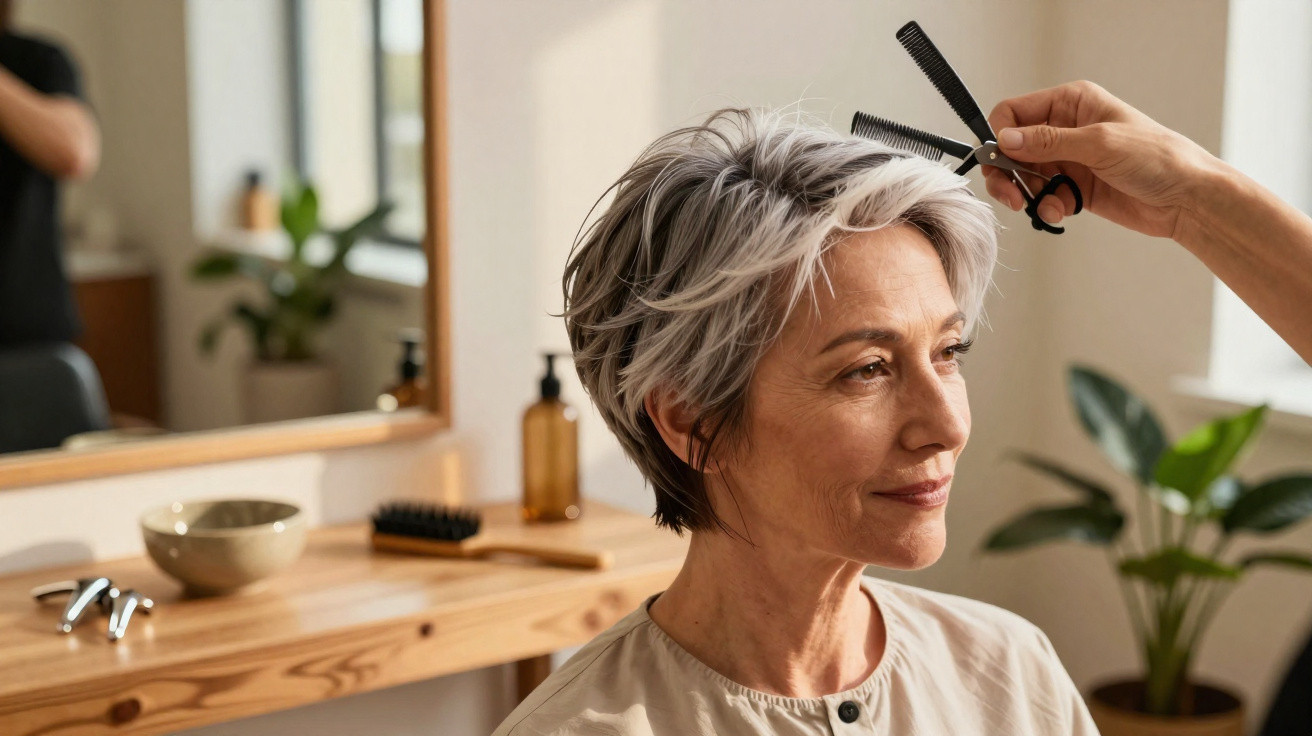
Short grey bob, tidy coat, and a slight pause at the door that only the most observant would spot. She runs her fingers through her salt and pepper hair as though excusing it. On the other side of the salon, her hairdresser brightens. “We can do something stunning with this,” she says, moving around the chair like an artist assessing a canvas.
The woman laughs, partly pleased and partly doubtful. “Stunning? At my age?” The stylist fastens a black cape at her neck, bends closer and says quietly: “After 60, gray isn’t a problem. It’s raw material.” The scissors begin to snip. A handful of strands fall away, exposing cheekbones concealed for years. She studies the mirror and blinks twice. Her face is more defined. Younger-looking, without appearing to make an effort. Leaning in, she is almost nervous to say it.
“How did I not know my hair could do this?”
The most flattering salt and pepper cuts after 60
Once hair becomes silver, the shape matters more than the shade. Any skilled hairdresser will tell you that grey behaves like light: it bounces on to the skin, eyes and facial contours. An unsuitable cut can make every feature appear lower, whereas the right one lifts, defines and revitalises.
For many women over 60, the pivotal moment comes with the first genuinely considered haircut for their natural grey. It is not a compromise of “let’s just trim it”, but a confident decision. It might be a softly layered bob moving around the jawline, a cropped pixie exposing the neck, or a longer, flowing style with curtain fringe that softens lines across the forehead. The principle is straightforward: build movement that draws attention before the white strands do.
Hairdressers are often surprised by how swiftly a few carefully positioned layers transform a face. A weighty, one-length style can leave grey hair looking dull and weary. Introduce texture at the temples, lightly refine the ends and open up the eye area, and salt and pepper hair suddenly appears purposeful, radiant and effortlessly chic. This is the understated effect of a properly planned cut after 60.
At her small city salon, Emma, who has worked as a hairdresser for 25 years, encounters the same situation every week. A woman comes in with her hair tied back, usually through habit. Grey roots, faded colour through the lengths and a bun “for practicality”. She does not dislike her hair; she simply no longer knows what to do with it. “My daughter says I’d look good if I left it gray,” she says, normally both persuaded and frightened.
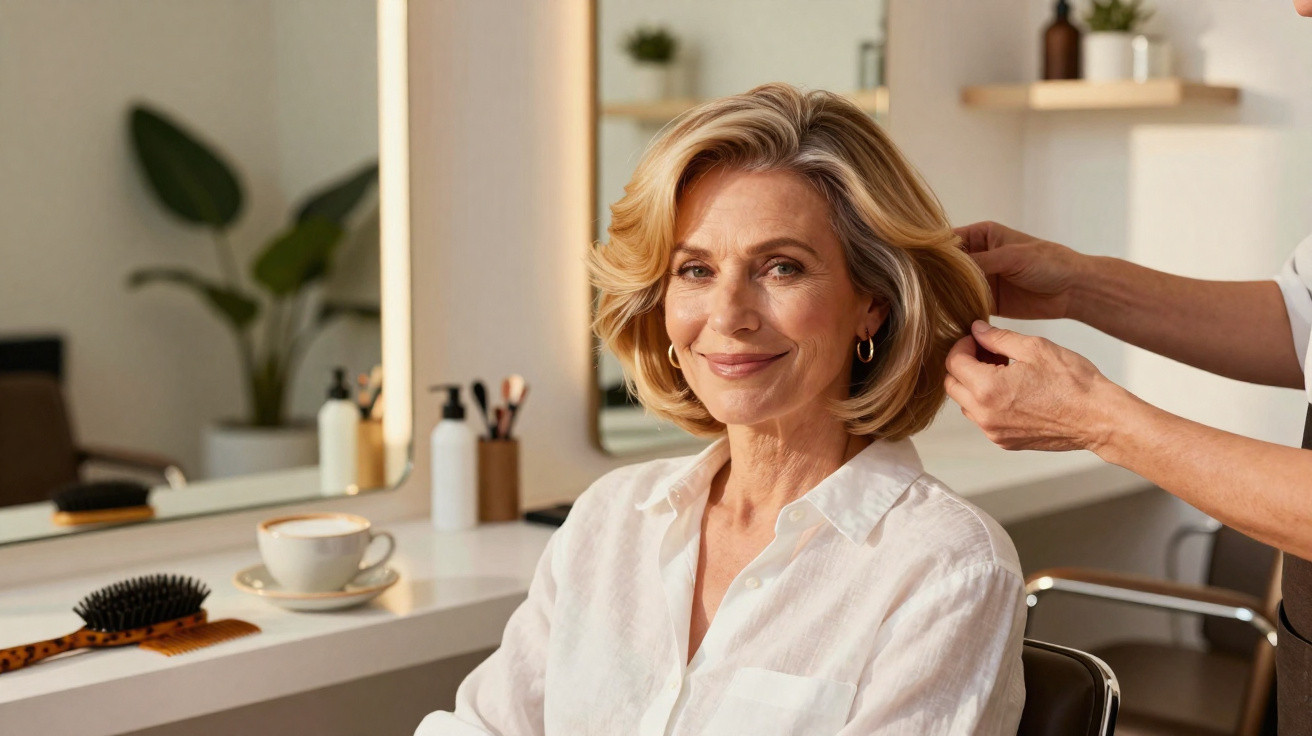
Emma recommends a transitional style: a medium-length bob sitting at the collarbone, with gentle layers and an imperceptible graduation that makes regrowth less noticeable. The worn, previously coloured ends are cut away. The client leaves with a blended salt and pepper finish that resembles balayage. Three months afterwards, she returns. Nearly all the dye has disappeared, the grey has taken over and the haircut still retains its form. “Everyone tells me I look more ‘me’,” she says, astonished, as though it is an unfamiliar kind of compliment.
The figures support what stylists witness in the mirror. More than half of women over 55 in the UK say they are considering embracing grey hair rather than concealing it. The decisive point is not the first white strand, but seeing a hairstyle that makes grey appear deliberate and fashionable. Think of a precise pixie with slightly longer, feathered pieces at the front; a blunt bob skimming the chin to emphasise cheekbones; or long, layered waves with brighter silver around the face, acting almost as natural contouring. Once women understand that grey can be shaped rather than merely put up with, the entire perspective shifts.
How a hairdresser enhances grey: real-life tricks that work
When Emma meets a new salt and pepper client, she does not begin with the scissors. First, she observes the face. Where does attention naturally land? Are the features gentle, angular or fine? She rotates the chair, examines the profile and nape, and watches how the hair sits on its own. Then comes a seemingly simple question: “How do you actually wear your hair on a normal day?”
From there, the transformation is largely about construction. On fine grey hair, she favours a cropped shape with soft layers through the top for lift, while avoiding overly thinned ends that would make the whole style collapse. With thick, wavy grey hair, she takes out internal bulk but maintains a neat outline, so the texture looks considered rather than untidy. The distribution of salt and pepper also counts: if the front has more white, she may create a fringe or soft curtain fringe to highlight it rather than disguise it.
Women over 60 often assume they “have” to cut their hair short as soon as grey appears. Emma disagrees every time. What grey hair truly does not suit is stiffness. Exceptionally straight, blunt styles can seem severe unless they suit the wearer’s personality. She opts instead for softened, broken lines, airy ends and discreet layers that move when the head turns. A few face-framing pieces also sit beautifully alongside laughter lines, bringing brightness where foundation cannot.
There is also an uncomfortable fact that few people say aloud: grey hair changes in texture. It can become drier, coarser and, at times, curlier. If a haircut ignores this, styling becomes a daily struggle. A medium-length shag with light, purposeful layers can be brilliant for naturally wavy salt and pepper hair. It allows curls to exist instead of battling them with straighteners each morning. Let’s be honest: nobody really does that every day.
Emma also stresses the importance of the neckline. A short cut ending at the widest part of the neck may make it look shorter and broader. A pixie that reveals a refined nape, or a bob that ends just above or beneath that point, lengthens the overall silhouette and makes grey hair appear polished rather than austere. Small choices can have a substantial effect.
The biggest error with salt and pepper hair after 60 is fear: fear of removing too much length, fear of looking “old”, and fear of regretting a dramatic change. As a result, women request “just a trim” repeatedly. The silhouette disappears, the hair grows heavier and the grey appears more prominent. Ironically, retaining supposedly safe length often ages the look more than a well-structured contemporary cut would.
In practical terms, the same pitfalls recur. Layers cut too short on top stand up and refuse to settle. Fringes made overly straight and dense can harden the eyes instead of softening them. Bobs ending at the middle of the neck create a square shape. Emma’s guidance is kind but clear: discuss lifestyle before hair. If blow-drying is something you dislike, a sleek stacked bob will simply become frustrating. If your hair is always tied up, cutting it precisely at ponytail level is likely to irritate you.
She also sees many women holding on to the final remnants of old colour at their ends. Faded brown or blonde lengths can make grey roots look dirty and uneven. Removing those lengths, even if it means only five or six centimetres, immediately clarifies the salt and pepper pattern. The eye sees a deliberate decision rather than a compromise. It is not about going extremely short; it is about making the colour transition look like a style rather than an accident.
Emma likes to put it plainly:
“Gray hair doesn’t age you. A tired cut does. After 60, every centimetre needs a reason to be there.”
Her essential routine for clients hoping to enhance salt and pepper hair is remarkably uncomplicated: a haircut every 6 to 8 weeks to preserve a clean shape; a light gloss or clear toner every few months for shine and to counter yellow tones without altering the natural colour; and a mild purple shampoo used sparingly to maintain bright silver. She also recommends one styling step that fits real life, whether that is using a round brush on the front only, quickly scrunching in mousse, or simply tucking one side behind the ear to reveal the jawline and earrings.
- Choose a cut that matches your grey pattern: allow the brightest strands to frame the face.
- Work with your texture: embrace waves or curls rather than forcing them flat.
- Experiment with length positions: just above the jaw, at the collarbone or at the nape can completely alter your silhouette.
- Keep the ends light and airy rather than frayed, so silver looks crisp instead of fuzzy.
- Choose shine-enhancing products rather than weighty serums, allowing salt and pepper hair to sparkle in daylight.
Living with salt and pepper hair: beyond the mirror
Something understated changes when a woman finally embraces her grey. It is not merely about looking “good for her age”; it is about ending the battle with the mirror every four weeks. The haircut becomes a form of armour, gentle yet strong. With the right shape, hair stops demanding attention. It frames the face, then recedes to let the individual come through.
Most of us have experienced a relative joking, “You’ve let yourself go,” simply because roots are visible. Growing out grey with purpose reverses that message. A suitable salt and pepper haircut after 60 communicates the opposite: I am not giving up; I am refining. Women tell Emma that they feel unexpectedly lighter after the cut, even when only a few centimetres have gone. It is as if the burden of concealing something has finally fallen to the floor alongside the old strands.
There is a social consequence nobody warns you about: people notice and comment. Initially, it is not always kind. “Are you sure about this?” “Won’t it age you?” Gradually, though, the remarks shift. “Your eyes look so blue with this cut.” “You look… rested.” “You look like yourself again.” This is the quiet revolution of attractive salt and pepper hair: it redirects the conversation from age to presence. A strong haircut does not make you younger; it makes age less central to the discussion.
For some women, the grey journey unfolds slowly and privately over years. For others, one particular event sets it in motion: retirement, divorce, a diagnosis or a new grandchild. It can be the point at which pretending becomes more exhausting than showing oneself. This is where a hairdresser’s job extends beyond technical skill. Emma spends as much time listening as she does cutting. She understands that a small fringe or one extra centimetre removed from the nape can represent much more than a styling decision. It marks a boundary: this is who I am, now.
That may be why salt and pepper hair, enhanced by the right cut, feels unexpectedly modern. It does not attempt to erase passing years; it arranges them. It poses one simple question: what do you want people to notice first when they see you? The answer is almost never “my gray hair”. More often, it is “my eyes”, “my smile” or “my energy”. A beautiful haircut for silver hair is simply a technical means of delivering that wish.
| Key point | Detail | Benefit for the reader |
|---|---|---|
| Adapt the cut to your grey pattern | Use brighter silver around the face and avoid severe one-length shapes | Draws attention to your features rather than your roots |
| Respect texture and lifestyle | Select layers, length and styling that fit your genuine routines | Makes salt and pepper hair easy to manage day to day |
| Keep the structure fresh | Have regular trims, use light toning and prioritise shine over heavy colouring | Creates a neat, modern finish without continual upkeep |














Comments
No comments yet. Be the first to comment!
Leave a Comment