
There is a moment somewhere between excitement and mild panic: a lock of hair lands on the floor and you start wondering whether you have made a dreadful mistake. She was 67, with silver hair and immaculate lipstick, and had just asked her hairdresser for “a classic bob, like I used to wear in my forties”.
From the front, the result was lovely: a neat outline, gentle volume and light reflecting off her cheekbones. But when she turned to inspect the back with the mirror, she saw it. Her nape had been cut in a straight, weighty, flat line. You could almost watch her expression drop. It felt overly severe and too retro - and not in an appealing way.
The stylist gave a quiet sigh. “We need to fix the nape. That’s what’s making it look old.”
That small, largely unseen area can alter the entire haircut.
Why the classic bob can suddenly age women over 60
On a youthful jawline, a traditional blunt bob can have striking graphic appeal. Yet on a woman over 60, that same firmness can become harsh remarkably quickly. At the back, the hair can form a solid block that pulls the whole shape downwards. The nape - a feature magazines rarely discuss - often becomes the problem area.
As the neck naturally becomes softer with age, a hard horizontal hairline in precisely that place creates a visual “cut” through the figure. Rather than lifting the face, the bob can emphasise every curve of the neck and shoulders. This is why so many women say, “I don’t know why, but short hair makes me look older,” when the actual issue is the uncompromising nape area.
It is a familiar sight. A woman in her sixties leaves the salon with a textbook bob: identical length throughout, a sharp edge and dense weight at the bottom. In front-facing Instagram photographs, it looks perfectly acceptable. In everyday life, however, the back starts to gather as soon as she moves, clinging to the neck and producing a boxy outline.
A London stylist told me that she began asking clients over 60 to turn around before she made a single cut. “The face lies sometimes,” she laughed. “The back of the head tells the truth.” After she started softening the nape of every bob, those clients began receiving compliments again. Not simply “nice cut”, but “you look rested” and “have you done something different?” That is the real success.
The reasoning is brutally straightforward. Hair changes with age: it becomes finer, loses fullness at the crown and grows more slowly around the temples. The neck changes as well. A one-length classic bob takes none of this into account, insisting instead on a rigid geometry suited to a younger bone structure. When the back is cut bluntly at the nape, attention is drawn immediately to the very place where gravity is already doing its work.
The haircut and the body then seem to be in conflict. Rather than producing upward movement, the bob can sit like a helmet. The answer is not to give up on a bob, but to reshape the back so it works with a 60-plus neck instead of against it.
The nape adjustment that makes a classic bob feel modern again
The crucial change is specific: lighten and lift the nape. Rather than leaving a straight, heavy edge across the back, the nape should be softly stacked or tapered, with a small amount of graduation to remove bulk from the lowest section. Think of it as creating “air underneath”, rather than a “brick of hair”.
Hairdressers experienced in cutting mature hair often describe creating a “soft pedestal” at the nape. The hair is made a little shorter at the very base of the neck, then gradually and subtly longer as it travels up the back of the head. This minute incline prevents the bottom edge from crashing into the neck. Instead, it sits just above it, allowing the line to curve inwards and then out again. That curve conveys vitality rather than stiffness.
There is another advantage too. Fine hair at the crown can appear flat with a simple, unlayered bob. Lifting the nape and adding a little under-layer graduation allows the stylist to create a discreet boost of volume higher on the back of the head. The eye suddenly moves upwards instead of downwards. This is why a woman over 60 with a well-cut nape can look as though she is standing taller, even while seated.
The technique is fairly technical, but the request itself is easy to make: “I’d like my bob slightly graduated at the nape, so it doesn’t sit heavy on my neck.” A capable stylist will understand how much graduation suits your hair type and daily routine. Straight hair may benefit from exceptionally precise, clean graduation. Wavy or curly hair may work better with a more feathered, tapered nape and soft texturising that leaves the curl room to breathe.
This is also where things regularly go wrong. Many women arrive at the salon holding a Pinterest photograph of a flawlessly smooth classic bob worn by a 25-year-old model. Eager to satisfy them, the stylist reproduces it precisely. There is no adjustment for neck length, posture, hair density, glasses or clothing style. The result may be technically accurate, but it can look oddly wrong in real life.
There is often anxiety about exposing the neck, too. Some women say: “Don’t cut it too high at the back, I want it to cover everything.” That feeling is understandable. On a difficult day, the nape can seem like the one place you most want to conceal. Yet a long, heavy back usually sticks to those exact areas, drawing attention towards them. A slightly shorter, neater nape almost always looks more polished and less “on display” than a mass of hair pressed against the skin.
Let’s be honest: nobody really does that every day. No one is blow-drying the back of their head using a round brush and three mirrors at 7 am - not at 30, and certainly not at 65. That is why the nape shape must look good with very little styling. You need a cut that still curves attractively when you shake your head and allow it to air-dry, or give it a quick blast with the hairdryer, rather than one that collapses into a straight shelf.
One Paris stylist in her fifties described it this way:
“A bob at 25 shows off the haircut. A bob at 65 should show off the woman. The nape is where you decide which one you care about.”
She now sketches the side profile of each client’s head and draws two alternatives: one with a blocky, horizontal nape and one with a lighter, raised finish. Most women instantly indicate the softer version and say, “That one looks slimmer.” Nothing else in the drawing has altered - only that slight angle at the back.
A modernised nape commonly includes:
- A slightly shorter length at the lowest point of the neck
- Soft graduation moving upwards along the back of the head
- Some internal weight removal to avoid a “ledge” effect
- A line that curves gently instead of ending in a dead-straight edge
How to discuss your bob with your stylist - and your mirror
All of this theory only has value if it reaches the person holding the scissors. The most useful step is to stop bringing only front-facing reference photographs. Take or show side and back views of bobs you like on women nearer to your own age. Say plainly: “I want a bob that’s soft at the nape, not a hard line that sits on my neck.” That single sentence changes the discussion.
Once you are in the chair, explain your habits in honest, practical terms. Say how frequently you have trims, how much styling you genuinely do, whether your neck gets warm easily, and whether you wear high necklines and scarves. These details help your stylist decide how short and light the nape can be. Ask to see the back with a hand mirror halfway through the appointment, rather than only at the end when there is less opportunity to make changes.
The most common pitfalls are surprisingly universal. Cutting it too short too quickly is one of them. If you have worn your hair below your shoulders for decades, going immediately for an ultra-short stacked bob can be a shock every time you catch yourself in a shop window. Another is holding on to the exact bob you loved 20 years ago without revising the back. Hair and faces change, and that is not failure; it is simply information.
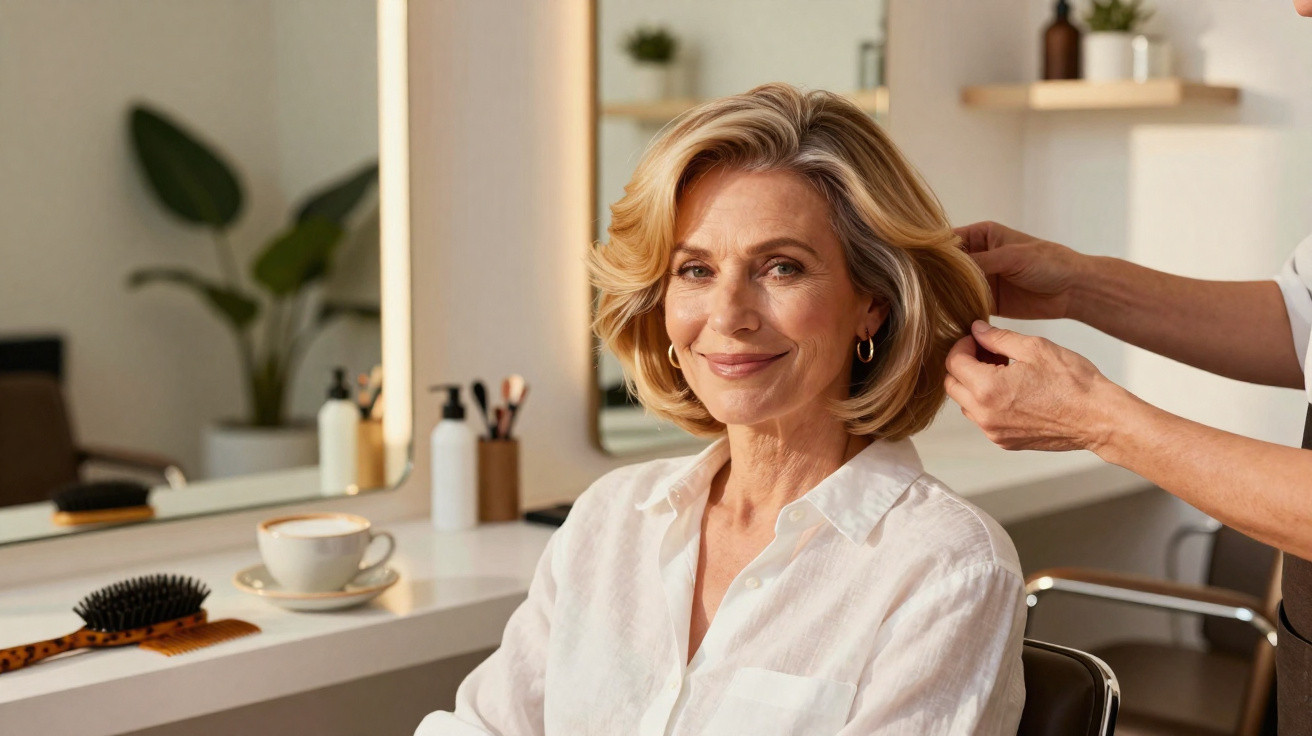
On a bad day, the mirror can tell cruel stories. On a good day, a nape cut with care softens the entire look. When you are tired, that slight lift at the back prevents your profile from disappearing into your cardigan. When you feel bold, the very same shape allows your earrings, jawline and smile to take centre stage, instead of letting the haircut itself demand attention.
One point many women overlook is that a bob does not have to be “all or nothing”. You can retain bob length around the face and ears while asking for a more sculpted, nearly invisible undercut at the nape if your hair is thick. That tiny hidden section removes excess weight without changing your appearance from the front. It is rather like tailoring the lining of a jacket instead of its lapels.
As one client told me after her appointment:
“I thought I needed long hair to hide my neck. Turns out I just needed the right short hair at the back.”
Her stylist had made three small but effective changes: lifted the nape by half an inch, added graduation so the back followed the head rather than the neck, and softened the final two centimetres using point-cutting. She left the salon not feeling “brave enough for short hair”, but simply more like herself again.
To keep these ideas in mind before your next appointment, it can help to run through a mental checklist:
- What does the back look like when I tip my head slightly forwards?
- Where does the lowest hairline meet my neck or collar?
- Can I see a solid straight block, or a soft curve that follows my head?
- Does the bob appear heavier at the bottom than at the top?
- When I move my shoulders, does the hair gather up or swing freely?
The bob as a subtle act of self-editing after 60
At a certain point, hair becomes more than fashion: it turns into a kind of personal editing tool. By the time you are over 60, you have probably worn it long, short, layered, permed, ironed straight and everything between. The classic bob has survived all of these fashions because it is clean and uncomplicated. But that simplicity becomes unforgiving if the back is not adapted to who you are now, rather than who you once were.
The nape adjustment may be minor, but it carries symbolic weight. It says: I am not trying to recreate the haircut I wore at 35. I am retaining a shape I love and adapting it to the woman I am today. The change is subtle externally and enormous internally. The line at the back stops announcing “classic” and begins quietly suggesting “current”. People may not be able to identify what has changed. They simply say that you look fresher, lighter and more present.
On a hectic morning, when you pull a comb through your hair and catch a glimpse of yourself from the side in the bathroom mirror, that gentle slope at the nape tells a very different story from a rigid horizontal edge. It does not battle your neck or criticise your posture. It quietly works with you as you go about your day. We have all experienced the moment when a small change in the mirror suddenly reflects how we feel inside. For many women over 60, that change begins at the back of the head - precisely where they never thought to look.
| Key point | Detail | Benefit for the reader |
|---|---|---|
| Adapt the nape | Use light graduation or tapering at the nape rather than a heavy, straight line | Prevents the ageing “block” effect and visually streamlines the silhouette |
| Consider the side and back view | Assess the bob from the side and back, rather than only from the front | Makes it easier to identify what is genuinely weighing down the neck and posture |
| Discuss your lifestyle | Tell the stylist about your realistic styling time, haircut frequency and clothing habits | Helps achieve a modern bob that remains flattering without daily blow-drying |













Comments
No comments yet. Be the first to comment!
Leave a Comment