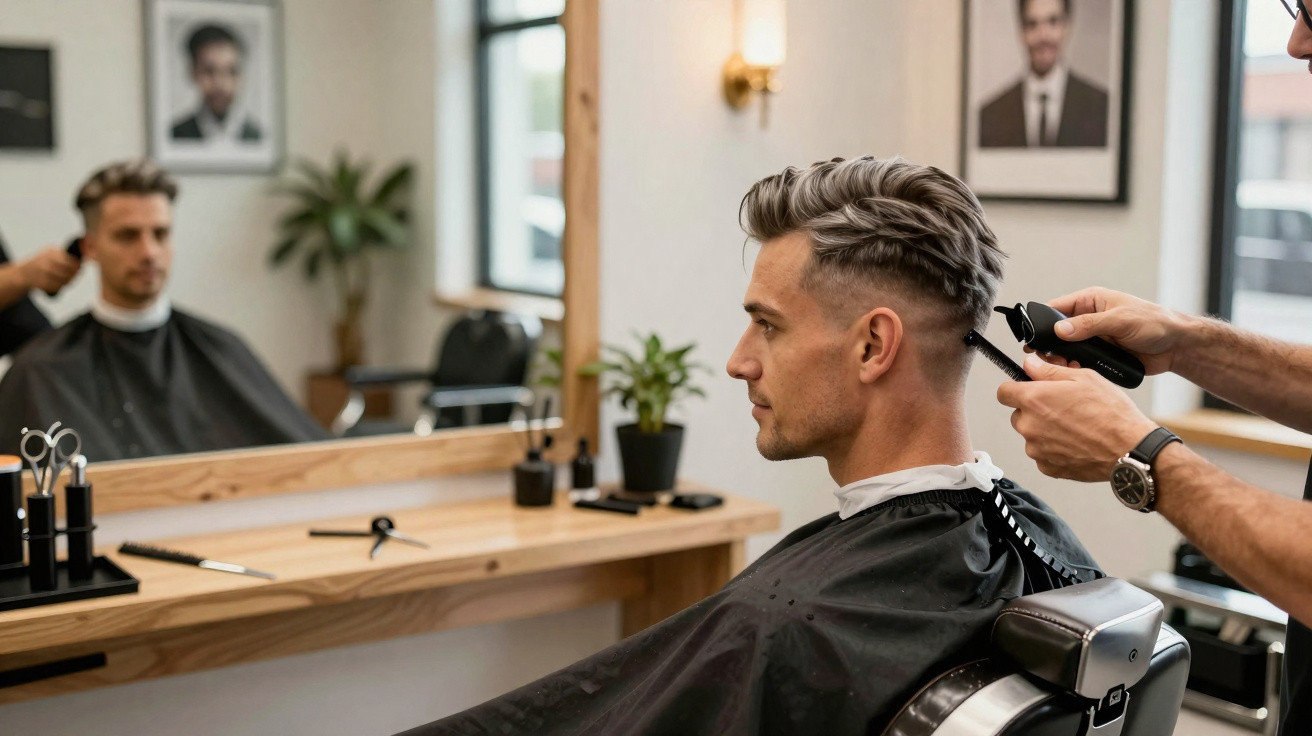
Saturday morning, with my first client booked in for 8:15.
He comes through the door at an unhurried pace, his jacket draped over one arm - as men over 50 often do when they have come in for more than simply a haircut; they want a reset.
Settling into the chair, he brushes a hand across his scalp and says something I hear at least twice daily: “My hair’s getting thinner… maybe it’s time to just buzz it all off?”
I study him in the mirror: fine, soft hair, scalp catching the neon light slightly, and lines around his eyes that carry years of experience. He is not someone who is ready to give in.
The clippers on the shelf behind me give off a quiet hum. I already know the approach.
We are not cutting everything shorter. We are cutting it more intelligently.
A properly executed classic fade can make fine hair after 50 appear denser, cleaner and more youthful - without trying to pass you off as 25.
This is the cut that can subtly transform the whole picture.
The classic fade that flatters fine hair after 50
I have tested every fashionable look on clients: skin fades, undercuts and textured crops with titles that could be cocktail names.
Yet most men over 50 with fine hair have no need for those styles. What they need is a neat, traditional fade that works with the hair’s natural tendencies.
My preferred option is a low to mid fade, never taken excessively high, with additional weight retained on the top and around the crown.
The hair is kept short and smart around the ears, blended more softly above the temples, with length preserved where the hair is naturally less strong. That is what creates the impression of density.
With a gentle blend and understated lines, attention moves away from sparse areas and towards the overall shape.
That is the real technique: not concealing age, but guiding the eye elsewhere.
Consider Mark, a 56-year-old accountant who always wears a navy blazer. At his first appointment, he showed me an old photograph from his thirties, when his hair was thick and heavy.
His current style was a straightforward “same length everywhere” cut, causing his scalp to catch the light like a spotlight wherever he went.
I recommended a traditional low fade: a grade 1.5 right at the base, smoothly worked into a 3, while leaving a useful amount of length on top - not long, but sufficient for movement.
We cleared the hair around the sides of his neck, defined the neckline and softened the blend at the parietal ridge to prevent a pronounced step.
When I turned the chair towards the mirror, he looked at the result, lifted an eyebrow and said, “It looks like I have more hair.”
He did not; the shape built around it was doing the work. Three weeks later, his wife sent him back with precisely the same instruction: “Whatever you did, do it again.”
There is a straightforward reason why a classic fade suits fine hair over 50 so well. Shorter sides provide contrast, making the hair on top appear fuller.
When every section is left at a medium length, fine hair falls flat and looks thin, removing any feeling of structure.
Keeping the fade low or mid also prevents the crown and thinner sections on top from being exposed.
Rather than seeing a sharp divide between scalp and hair, the eye sees a gradual shadow. Beyond 50, that shadow is your greatest ally.
The top section then needs careful balance. Cut it too short and every gap becomes visible; leave it too long and it separates on its own, revealing the scalp.
The ideal middle ground allows the hair to be lightly swept back or to one side, with texture creating small shadows between individual hairs that suggest greater thickness.
How I cut this fade step by step (and what you should ask for)
When a man over 50 with fine hair takes a seat in my chair, I do not begin with the clippers. I begin by assessing the scalp.
I check the crown swirl, the growth direction and the precise points where the scalp is a little more visible.
From there, I shape the fade around what is actually present, rather than copying an Instagram photograph.
I generally begin with a 1.5 or 2 at the lowest part of the sides, keeping the first 1.25 cm above the ear marginally longer than many barbers would on a younger client.
I work upwards through small guard changes - from 1.5 to 3 or 4 - without sudden jumps. The blend line remains low, beneath the broadest area of the head.
For the top, I move to scissors, creating layers and point-cutting rather than making blunt, straight cuts, so the hair does not divide into clearly defined rows.
If you are visiting your barber, put it simply like this:
“Low to mid fade, not too high, keep more length on top for texture. I want it to look fuller, not like a skin fade.”
That single sentence should establish the right direction for the cut.
I regularly see several errors when men over 50 attempt to deal with fine hair.
The first is cutting it too short all over on the basis that “less hair, less problem”. This can suit certain head shapes, but fine hair with patchy areas is often made to look weaker by it.
The reverse error is treating length as a comfort blanket. Long, thin hair over receding temples has a tendency to split apart and separate.
A breeze, perspiration or even an awkward night’s sleep can leave you back where you started, with an unwanted visible parting.
Styling choices matter too. Heavy gels and waxes turn fine hair into clumps, spikes or strings, leaving glossy strips of scalp between them.
Light creams, matte clays and a little sea salt spray are much more forgiving options.
On a personal level, I understand why a new haircut after 50 can feel like acknowledging that something is being lost.
Technically, though, a classic fade is the complete opposite of giving up: it is a strategy.
We have all had that experience of catching our reflection in a shop window and not quite recognising the man staring back.
That brief jolt can affect the rest of the day.
“A good fade on fine hair after 50 doesn’t scream ‘I’m fighting age’. It just quietly says: ‘I still care’.”
- Keep the fade low or mid – taking it too high reveals thinning sections and makes the silhouette flatter.
- Ask for a scissor-finished top – this produces softer texture and avoids severe lines that expose the scalp.
- Use a lightweight product with a matte finish – glossy gels split fine strands apart and can make hair appear thinner.
- Avoid washing it every day – rinsing with water and shampooing 2–3 times weekly may help preserve natural volume.
- Book in every 3–5 weeks – leaving cuts too long allows fine hair to flatten and lose its form.
The mindset shift: from chasing youth to refining style
After 50, the biggest change is not solely your hair; it is the relationship you have with the mirror.
Men share things while sitting in that chair that they tell nobody else: difficult diagnoses, divorces, new roles at work and grandchildren. Hair can become one way to regain a little control.
A classic fade is modest. It does not attempt to remove the passing years; it gives them a frame.
When the sides are tidy, the neckline is crisp and the top is balanced, the face seems more open. The eyes appear clearer and the jawline more defined, even though nothing else has altered.
The haircut in question is not a “trend”. It was effective in the 1980s, remains effective in 2025 and will still be effective in ten years.
That sense of permanence is comforting when everything else appears to move ever faster.
Let’s be honest: nobody truly does this every day. Nobody styles their hair as they do in an advert, under perfect lighting with six products arranged along the counter.
Most men work something between their palms, run it through their hair and hope it does the job.
That is exactly why this cut is important. A good fade on fine hair over 50 ought to look respectable even on a difficult morning.
There is no elaborate blow-dry or five-minute routine required - just a swift pass with a comb or your fingers, then out of the door.
You do not need to resemble the “after” image in a makeover programme. You simply want to stop feeling older than you really are.
At times, the difference between those two places is no more than a carefully positioned blend from a 1.5 to a 3.
The more often I create this classic fade on fine hair, the more I notice the same outcome.
Clients return not only for the outline of the cut, but because they feel a little more like themselves again.
They leave with a different walk: shoulders held slightly higher, a hand passing through their hair as they take one last look in the mirror.
It is not vanity, only a quiet reassurance that they still like the person they see.
Perhaps that is the true secret of this haircut.
It does not promise to return twenty years to you. It offers today, just with a better frame.
| Key point | Detail | Benefit for the reader |
|---|---|---|
| Ideal fade type | Low to mid fade, never excessively high, with length retained on top | Creates the illusion of density while avoiding emphasis on sparse areas |
| Cutting technique | Clippers at the bottom, soft transitions and a scissor finish on top | Produces natural texture and shadows that make fine hair look visually thicker |
| Routine and products | Lightweight products, matte finish, limited washing and a trim every 3–5 weeks | Delivers a straightforward, realistic style that is easy to maintain after 50 |





Comments
No comments yet. Be the first to comment!
Leave a Comment