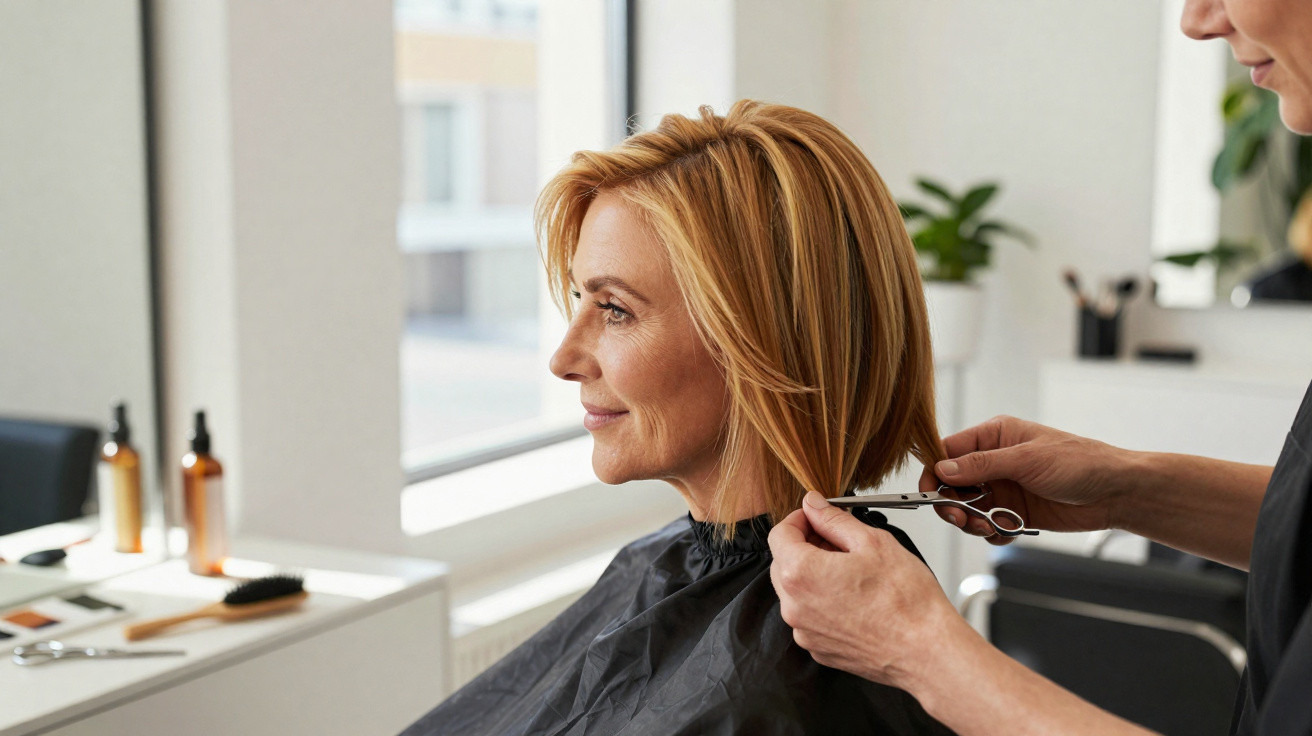
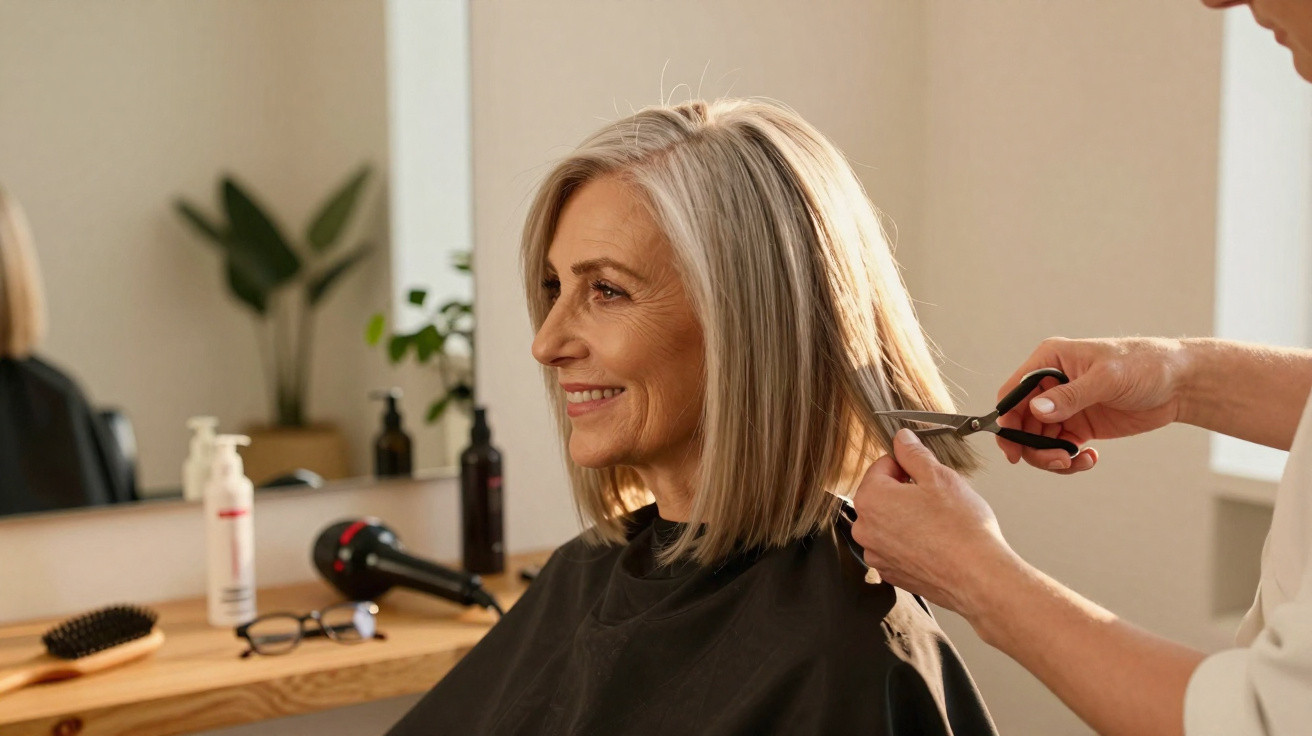
The woman in the salon chair wore an expression that mixed anticipation with restrained alarm. At 62, with silver regrowth visible, she kept her lips tightly closed as the hairdresser raised the weary layers of hair, marked by too many at-home colour jobs and hesitant trims. Nearby, women in their twenties flicked through their phones, their hair shiny and freshly finished. She looked at them in the mirror before returning to her own reflection, almost recoiling. “I don’t want to look younger,” she said, then paused. “Actually… maybe I do. Just not ridiculous.”
The stylist smiled, already tracing an imagined shape around her jawline with her fingers. The scissors caught the light as the muted drone of several hairdryers filled the salon. The atmosphere changed, as though a small, private act of rebellion had just begun.
Ten minutes later, the first section of hair dropped to the floor and people nearby looked over.
This is the haircut that makes hairstylists murmur: that’s the most youthful look after 60.
The most youthful haircut after 60? It’s not what you think
Ask three people over 60 to describe a “young” haircut and you will probably get the same answer: long, flowing hair with plenty of fullness. It is the image we absorbed from old shampoo adverts. Yet in everyday salon life, many hairstylists quietly favour something else.
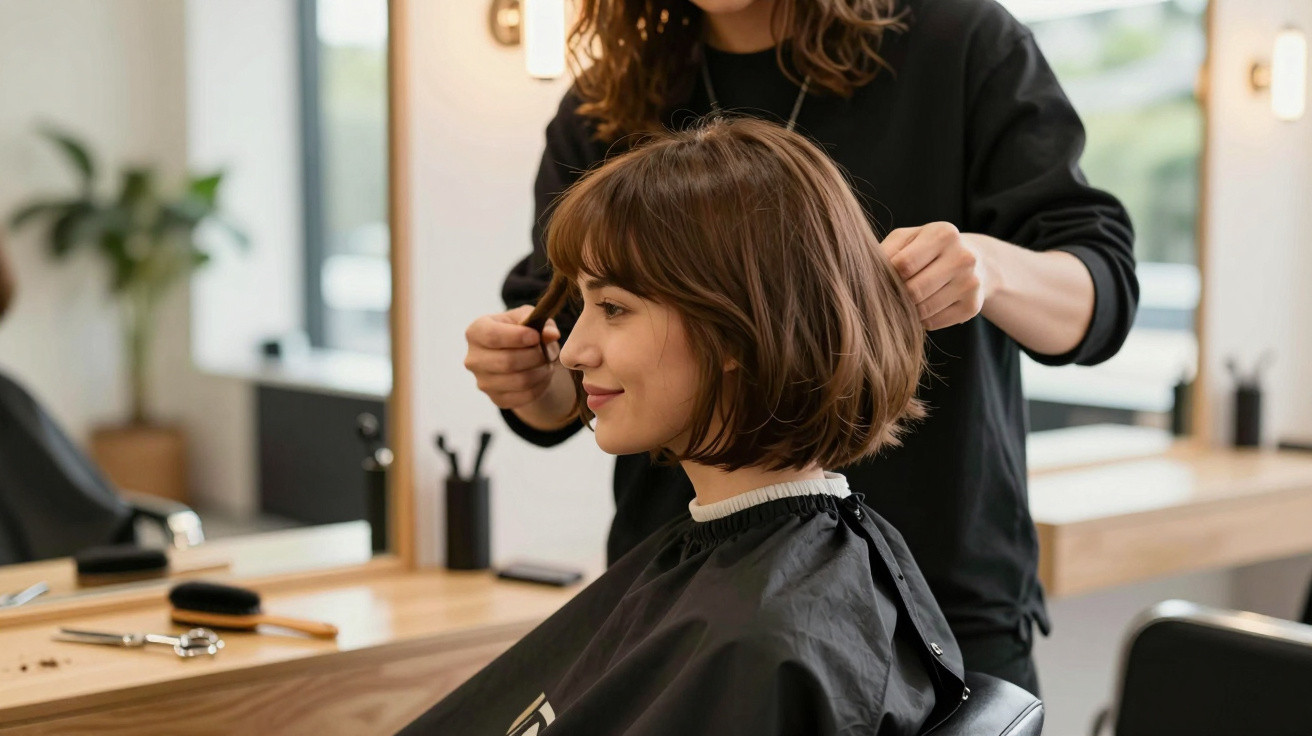
They repeatedly recommend a contemporary, gently tousled bob, either sitting at the jaw or grazing the collarbone. It should not be harsh or helmet-shaped. Instead, it needs softness around the face and natural movement.
Rather than announcing that you are making an effort, this style subtly elevates the whole look: the jawline, cheekbones and even the way you carry yourself. For that reason, many professionals regard it as the most youthful haircut after 60, whatever your wrinkles, body shape or clothing choices.
A London stylist once told me about a 68-year-old client who had kept the same below-the-shoulder layers since the 1980s. Her hair had become finer, flatter and shapeless, yet she held on to the length “because long hair is younger, right?”
They settled on a middle ground: an easy, textured bob at jaw level with a side parting. At first sight, it was not a dramatic change. She still looked like herself, only more defined and lighter.
When she returned the following month, she seemed almost bewildered. Colleagues had asked whether she had “done something” to her face. Her granddaughter said she resembled herself “in old photos.” Everyone noticed a difference without identifying the haircut, which is precisely what a well-cut bob after 60 can achieve.
There is a practical reason this look works so effectively at this stage of life. With age, hair density often reduces around the temples and along the parting. Long, weighty hair pulls those finer sections down and can leave the entire face looking weary.
A contemporary bob reduces those visual lines, shifting focus towards the eyes and cheekbones rather than the ends of the hair. Slight layers or an undercut at the nape create lift without relying on rigid volumising sprays.
Add a gentle fringe or face-framing sections and forehead lines are softened while strong jaw angles appear less pronounced, without a single injection. The result is understated: more brightness, more presence and more “alive”. This is why hairstylists so often steer clients towards this middle length, neither truly short nor truly long.
How to ask for the “youthful after 60” bob - and actually get it
The key is not simply asking for a bob; it is having one tailored to your hair texture and daily routine. When you take the chair, avoid broad descriptions such as “chic” or “modern”. Bring two or three reference images, ideally of women near your age whose hair appeals to you rather than celebrities aged 25.
Explain how short you are happy to go: at the jaw, just below the chin or touching the collarbone. Request softness through the face and movement at the ends instead of a blunt, schoolgirl-style line. Be honest, too, about whether you need wash-and-go hair or are willing to spend ten minutes styling with a brush.
The most youthful bob after 60 will not look the same on every person. It is the version that you can wear each morning without battling against it.
Few people say this aloud, but cutting hair shorter after 60 can feel like giving in. Many women worry that a bob marks the first move towards the dreaded “old lady cut.” That concern can lead them to keep long, exhausted lengths well beyond the point when they flatter them.
If you feel a knot in your stomach as the scissors appear, that does not make you vain or superficial. It makes you human. Take it gradually: ask your stylist to shorten the hair across two or three appointments. Remove two or three centimetres at a time, adjust the shape and see how it sits.
You may find that, as the hair gains lift, your face appears brighter. Gradually, “Will I look older?” becomes “Why didn’t I do this sooner?”
One Paris colourist described it this way:
“After 60, the most youthful haircut isn’t the one that hides your age. It’s the one that stops hiding you.”
Hair can carry a great deal of emotion at this point in life: memories of divorce, retirement, illness, new relationships and grandchildren. You hear every version of those stories on a salon floor. On the right day, choosing that bob is more than a style decision; it is a line drawn in the sand.
Instead of viewing it as a complete transformation, make the choice feel more manageable with a few straightforward steps:
- Gradually move the length towards the jaw or collarbone.
- Introduce subtle layers for movement, rather than helmet-like volume.
- Go one or two shades lighter and avoid a flat black colour.
- Make the parting softer: a slightly off-centre parting is often gentler on the face.
- Try a light, airy fringe before committing to a full fringe.
Living with your new cut: daily reality, not Instagram fantasy
After the salon lighting and attention disappear, it is just you, a damp towel and the bathroom mirror. What makes this youthful bob work after 60 is not flawless styling but simplicity: hair that suits your actual life.
Dry it gently with a towel, apply a pea-sized amount of lightweight mousse or cream only through the mid-lengths and ends, then roughly dry it using your fingers. Use a round brush only around the front to open up the face. It takes five minutes, perhaps eight. No more than that.
The secret is controlled imperfection. Ends with a slightly undone finish appear fresher than stiff styling. A little movement conveys energy rather than effort. Let’s be honest: nobody really does this perfectly every day, down to the millimetre.
Women over 60 commonly encounter two pitfalls with this haircut. The first is attempting to recreate the salon blow-dry exactly, every day, then becoming frustrated. The second is abandoning it altogether and allowing it to grow into a shapeless in-between length that once again pulls everything down.
Treat your bob as a shape that evolves. It needs small corrections rather than anything dramatic. A soft curve made with a medium curling brush, or a quick glide of straighteners, can revive it. On a flat day, a root-lifting spray concentrated at the crown can restore volume in thirty seconds.
Salon-standard perfection is not the aim. The aim is to meet your reflection and think, Yes, that looks like me on a good day - without a hidden team of stylists in the bathroom.
When speaking with hairstylists whose clients are mainly over 55, one theme comes up repeatedly. They often say the greatest transformation is mental rather than technical.
“The real glow-up,” one Italian stylist told me, “is when a woman stops apologizing for her age and starts choosing hair that matches her energy, not her birth year.”
That is where this haircut excels. A carefully shaped bob after 60 can express reinvention, quiet self-assurance and even defiance. On a busy bus, at a family meal or in a Zoom call where no filter can conceal a bad hair day, it quietly communicates: I’m still here, and I’ve edited out the excess.
- You are not trying to reclaim your 30s; you are improving your 60s.
- The cut raises the face without claiming to remove the passing of time.
- It requires regular upkeep, but it is not draining.
- Colour can complement grey rather than constantly fighting it.
- The style works around your routine, not an influencer’s.
A cut that respects your age - and breaks the rules a little
After 60, a particular kind of freedom can emerge. You have watched enough trends arrive and disappear to know that hair will not transform your life, although it can still improve your days. The modern bob exists in that space: unassuming in principle, yet quietly bold in reality.
You are not attempting to be mistaken for 40. You are selecting a shape that frames the face, brightens your expression and makes room for silver strands, freckles and laughter lines together. Hairstylists describe it as “youthful” not because it imitates youth, but because it conveys movement, curiosity and the opposite of giving up.
You spot it immediately on another woman on the bus, in a queue or in a waiting room, and almost automatically think, “That looks good on her. I could maybe pull that off.” That small maybe is where change starts.
| Key point | Detail | Benefit for the reader |
|---|---|---|
| Ideal length | Between the jaw and collarbone, with soft contours | Helps refine the face without making features appear harsher |
| Texture and movement | Light layers with a blurred or slightly undone effect | Creates an impression of energy and freshness |
| Realistic maintenance | Trims every 6–8 weeks, with 5–10 minutes of styling | Maintains a modern look without an exhausting routine |







Comments
No comments yet. Be the first to comment!
Leave a Comment