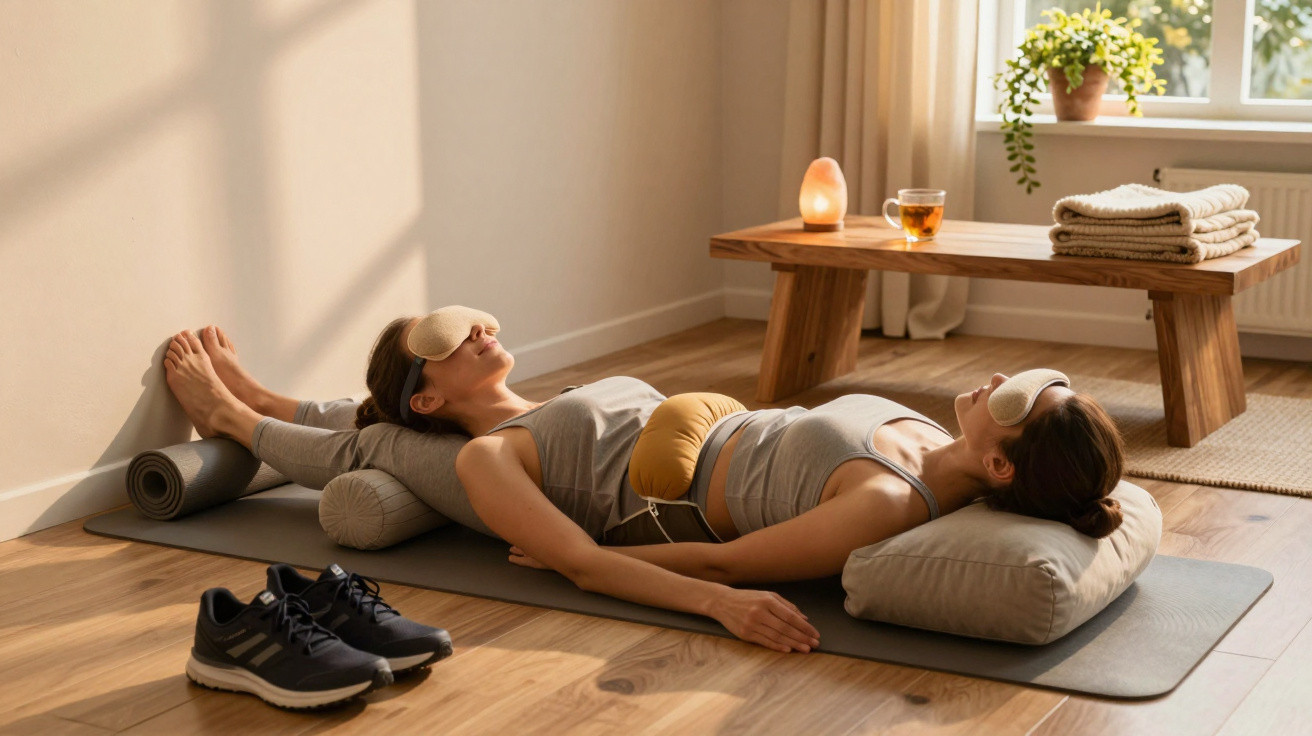
After training, my legs used to buzz, my shoulders would stay clenched and my thoughts remained stuck on the final set. The lights felt harsh, every notification sounded intrusive, and the fridge seemed to challenge me from across the room. On some evenings, I would sink into the sofa and scroll until midnight, then wake as though I had spent the night sleeping in a rucksack. Eventually, I tested something tiny, almost ridiculous: I unrolled a mat beside the coffee table and spent ten minutes doing restorative yoga. It did not erase the soreness, but it took away its sharpest edge. My muscles seemed acknowledged. The evening became gentler, longer and, oddly, more useful. I continued because it felt like a hidden entrance to recovery, and the following morning confirmed it.
1) Make a “landing strip” for your evening to arrive in
The few minutes between unlocking the door and making dinner can decide how the whole evening unfolds. When the mat is hidden in a cupboard and the blocks are shoved beneath the bed, they are unlikely to be used. I began keeping one part of the living room prepared: the mat already down, a blanket folded over, one or two pillows nearby, plus a scarf that could work as a strap. It looked welcoming, and a tired body responds far better to an invitation than a negotiation.
The more often you practise ease, the simpler it becomes to select it. Lower a lamp, put the kettle on and let its soft hiss become the background noise. Give your shoes a place to go, and give your breath one too. You are not “doing a practice”; you are arranging a gentle landing after a demanding effort.
2) Ease out the day with Legs Up the Wall
Following hill sprints, my calves pulse like a bassline heard from far away. I sit alongside a wall, swing my legs upwards and keep my tailbone roughly a hand’s breadth from it, adding a folded blanket beneath my hips if my hamstrings object. Gravity achieves what determination cannot: it persuades instead of insisting. My ankles become quieter, my feet no longer feel like blocks, and the room seems to settle over me like a cold sheet.
Even five quiet minutes with your legs up the wall can change the entire mood of a night. Allow your eyelids to lower, breathing in slowly for four and out for six. If your lower back needs an adjustment, bend your knees and bring the soles of your feet together, or cross your shins and swap their position halfway through. Once the timer ends, roll onto one side and wait briefly before getting up, so the world does not come flooding back.
3) Soften the shoulders in a supported Child’s Pose
A pull session leaves me feeling both longer and more closed in: chest lifted, heart protected. I kneel with a pillow tucked between my thighs and calves, place another beneath my ribs, then allow my forearms to settle heavily down. The back of my body is finally able to expand, with the rear ribs opening and closing like an accordion. Keep the neck lengthened, release the jaw and rest the tongue quietly behind the teeth.
Usually, there is a sensation that barely counts as a stretch; it feels more like the sigh my shoulders have been storing. Keep the big toes together and widen the knees if your hips like that, or separate the toes if your ankles complain. The hallway clock keeps ticking, which feels unexpectedly reassuring: the ordinary world can continue while you let go. Remain there until you notice the first proper exhale, the kind that seems borrowed from sleep.
4) Rest on your front and broaden the breath
For years, I avoided poses on my stomach, until I tried crocodile after an unforgiving interval run. With my forehead resting on piled-up hands and my feet slightly apart, the cool mat anchors the front of my body. My breath spreads through the back and sides of my ribs, as though a window has opened behind me. Everyone knows the feeling of a buzzing body paired with a mind that will not quieten.
In this position, make an agreement with your nervous system: extend the exhale, soften the jaw and abandon all heroics. Use a gentle count if it helps-inhale for four and exhale for eight-then let the boundaries soften. The blanket carries a brief smell of fresh laundry before it fades, taking the racing thoughts with it. Do not pursue stillness; simply leave the door open and allow it to arrive when it is ready.
5) Use warm weight to reassure your body
On certain evenings, sore muscles seem more than tender; they appear wary. I heat a rice pack in the microwave, wrap it in a towel and lay it across my shins or pelvis while I rest constructively, with bent knees supported by a strap or two blocks. That mild weight feels surprisingly personal, as though the world has placed a hand on your shoulder and said, “It’s okay now.” My heart rate drops without needing an explanation.
Why weight calms you
Pressure communicates in a way the mind instantly recognises: you are present, and you are supported. Put a folded blanket over your chest in a supported bridge, or rest it across your thighs in a reclined position, then observe how the breath becomes fuller. The lower-back muscles stop holding on because the floor no longer feels like a trampoline. Recovery starts as soon as your body trusts that it no longer needs to protect itself.
6) Release lingering adrenaline with a twist
After a tough leg session, my lower back tries to do everything, then complains about the job afterwards. A reclined twist offers the quiet apology it has been waiting for. Lie on your back, draw your knees towards your chest and let them fall to one side, placing a pillow between the thighs and another beneath the lower knee. Let the other arm extend wide and heavy, like an unhurried starfish on the bed.
This is not about twisting yourself like a towel; it is about reminding the spine that it is not a lamppost. As the ribs turn, the breath takes on a different shape and the sounds in the room shift too-the kettle completing its sigh, a bus droning outside. When a shoulder hovers above the floor, put a cushion underneath so the pose adapts to where you really are. Recovery isn’t only muscles knitting back together; it’s your nervous system deciding you’re safe again.
7) Have a short Yoga Nidra session before sleep
On some nights, the most helpful form of yoga is not moving at all. I choose a 12-minute Yoga Nidra or NSDR recording, lie down with a bolster below my knees and allow somebody else to do the counting. The voice takes me through body scans and imagery, while the outlines of soreness dissolve like chalk beneath rain. It can genuinely feel as if my heartbeat travels from my ankles to my ribs, before settling again behind my sternum.
To be realistic, nobody manages this daily. Yet when it happens, the next morning feels strangely generous, as if the body has repaired itself on fast-forward while the mind enjoyed a brief break. Keep the lighting subdued and turn your phone face-down, so its glow cannot pull you alert again. If you fall asleep sooner than expected, that is not failure; it is exactly the aim.
8) Finish with a small ritual so your body knows it is “done”
I prepare a mug of peppermint or chamomile tea and hold it until its warmth seems to mark my palms. Then I write one sentence in a notebook: something I appreciated about that day’s training, and something I will alter tomorrow. The phone is switched to aeroplane mode as a small gesture of defiance. The mat remains where it is, quietly waiting for the following evening.
When you end the evening gently, tomorrow’s training starts stronger. DOMS still arrives, but with less drama, more like a friend ringing the bell than forcing their way in. Joints seem better lubricated, breathing feels less restricted, and there is greater space between exertion and recovery. The goal is not an immaculate routine; it is the confidence that your evenings can support your days.
How restorative yoga fits into ordinary weeks
One Tuesday, I forgot my shoes, sprinted anyway and returned home grouchy enough to frighten the cat. I gave myself a 10-minute rule: after Legs Up the Wall and a twist, I was allowed to keep sulking if I still wanted to. I did not. My mood changed not because I had deserved it, but because my body recognised the familiar route back to itself.
During another week, I did virtually nothing beyond crocodile breathing on the carpet as the oven clicked while heating up. The following day, my lifts felt smoother, with less instability when coming out of the bottom position and less noise in my head. Small, frequent and unglamorous: that appears to be the formula. The recovery work after your workout may be the kindest set you record.
Small adjustments when it feels uncomfortable
If the floor feels hostile
Build up your props in the same way you add layers in winter. Use two blankets under the hips during forward folds, a pillow under each knee and a scarf looped around the soles of your feet. Depth is not the objective; conversation is. When your breathing catches, you have moved too far, too quickly-so retreat a fraction and pay attention again.
If stillness makes you restless
Repeat a wordless song and set a timer, so you are not negotiating with eternity. Gently rock in Child’s Pose, move your legs like windscreen wipers before a twist, or wiggle your jaw until it releases. Movement opens the entrance, while stillness arrives in its own time. For now, you can meet halfway.
The subtle science you can sense without opening a paper
Lengthy exhales activate the parasympathetic brake, reducing heart rate and helping to clear the day’s remaining cortisol. Passive positions alter the tension in tight tissues without forcing them, creating less conflict around sensitive joints. Raising your calves up the wall can help fluid make its way back through sluggish veins. Gentle twists and breathing on your front give the diaphragm fresh positions, potentially changing a shallow sip of air into a fuller drink.
The results appear in modest victories: stairs feel less punishing, hips make fewer noises and the 5 a.m. alarm resembles an invitation rather than a threat. You are adding small yeses for the muscles, fascia and mind. The satisfying part is that no laboratory is needed to establish it. Every morning, your body provides the evidence through how you move and feel.
A night that works out well
Imagine arriving home soaked after a ride, with shoes squeaking near the door and a faint mixture of rain and washing-up liquid in the house. The mat is ready. You spend ten minutes in Legs Up the Wall, followed by five in Child’s Pose, with a sigh that feels like a concealed doorway opening somewhere around the shoulder blades. Then comes a twist, a mug warming your hands and a phone that has, for once, chosen not to exist.
There is no grand achievement to announce and no medal for staying on the floor slightly longer. There is simply the quiet feeling of a body trusting you again. The next morning, running strides feel easier, the squat bar seems more welcoming and the face in the mirror looks less like a warrior and more like a human being. On some evenings, that is the only win that matters-and it reaches further than you might expect.












Comments
No comments yet. Be the first to comment!
Leave a Comment