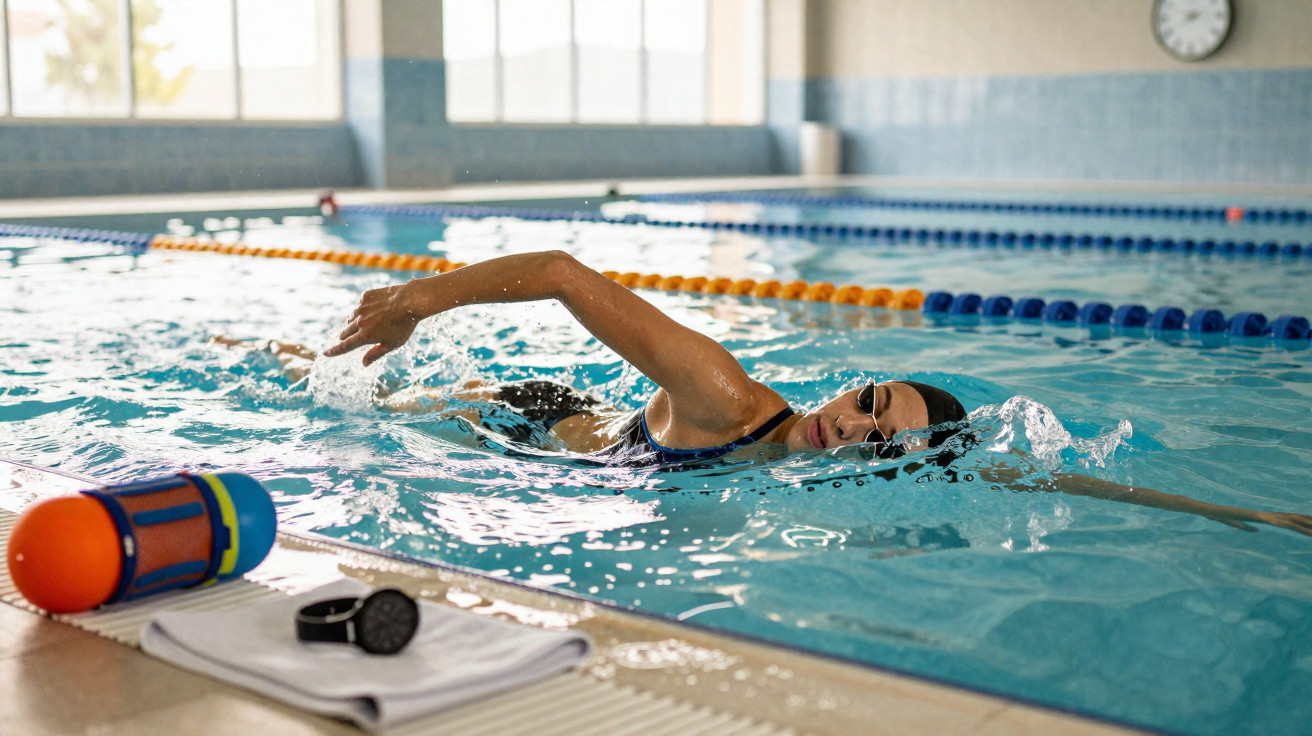
The beach holiday is getting closer, your trousers feel tight and your T-shirt is pulling around the stomach: by spring at the latest, many people head to the pool hoping that regular swimming will specifically reduce their belly. A sports coach explains how long you realistically need to train in the water, how to manage your pace and which exercises particularly challenge the waist.
Why swimming noticeably firms the stomach
Swimming works the heart, circulation and muscles at the same time. That makes it particularly appealing when excess fat around the stomach is bothering you. Every movement of the arms and legs has to push against the resistance of the water, while the core must constantly keep the body stable. Your abdominal muscles are working throughout – even when you are not consciously thinking about “ab training”.
Water also supports your body weight. This substantially reduces the strain on the joints, spinal discs and back. Many people with back problems struggle to manage longer cardio sessions on land, yet can suddenly do so comfortably in a pool. That allows you to build up more active minutes, which ultimately supports fat loss.
It is important, however, to be realistic: nobody can decide where their body will lose fat first. You cannot simply “swim away belly fat”. The body draws on its energy reserves as a whole. If you regularly burn calories while strengthening your abdominal muscles, your midsection will gradually look more defined and firmer.
Swimming burns calories, shapes the core muscles at the same time and takes pressure off the back and joints – ideal for anyone wanting to target their stomach.
The ideal swimming session length, according to a coach
The sports coach makes the key point clearly: if you want to reduce your stomach, cardio is what matters most. It should feel like endurance training, not a leisurely splash about. You should therefore be breathing noticeably harder, while still being able to say a few sentences without becoming completely breathless.
As a guide, the coach recommends at least 45 minutes per session. This gives your heart rate enough time to remain elevated and makes calorie expenditure genuinely significant. Shorter sessions can still stimulate the circulation, but will have a much smaller effect on your waist measurement.
To complete those 45 minutes comfortably, alternate between easier and more intense periods. This keeps you in the cardio zone without leaving you exhausted after ten minutes.
How many calories different swimming strokes burn
The exact figure depends on body weight, technique and pace. The coach gives the following approximate values for half an hour:
- Breaststroke: around 340 kilocalories per 30 minutes
- Butterfly: around 380 kilocalories per 30 minutes
Front crawl and backstroke usually sit between these figures, often slightly above relaxed breaststroke. Anyone who swims efficiently and at a brisk pace can easily burn several hundred kilocalories in 45 minutes – while also strengthening their core.
A 45-minute swimming workout for a firmer waist
The coach recommends a clearly structured session that is suitable even for committed beginners. It consists of three parts: a warm-up, the main set and a short abdominal circuit in the water.
1. An easy start: warm up without pressure
Begin with 10 to 15 minutes at a gentle pace. The aim is to raise your breathing rate and pulse gradually:
- Swim several lengths of breaststroke at a steady, unhurried rhythm.
- Alternate with backstroke or relaxed back swimming to relieve tension in the neck.
Focus on long strokes and calm breathing. There is no need to push yourself to the limit yet.
2. The main set: varying intensity for the greatest effect
The main section is where the real stomach-focused work begins. Allow around 20 to 25 minutes:
- Swim front crawl or backstroke briskly for 4–6 minutes; your pulse can rise considerably.
- Follow with 2–3 minutes of easy swimming or leg exercises using a kickboard, allowing yourself a brief recovery.
- Repeat this alternation between faster and recovery phases several times.
During the faster sections, use powerful arm pulls and maintain a stable body line. Keep your core engaged and do not allow your hips to drop – that is precisely what challenges the abdominal muscles.
3. An abdominal circuit in the water to finish
At the end of the session, the coach uses targeted exercises for the midsection. Ten to 15 minutes is enough here, but the work can be intense:
- Kickboard leg kicks: Complete three rounds of 2 minutes of strong leg kicks in a prone position, with 30 seconds of rest between rounds. Your lower abs work continuously against the water resistance.
- Front crawl with emphasised core rotation: Swim four slow lengths. Deliberately rotate your shoulder and hip as your arm enters the water. This particularly activates the oblique abdominal muscles.
- “Plank hold” at the pool edge: Hold the edge with straight arms while your body remains in the water, then bring your knees towards your chest either alternately or together. Do three sets of 15 repetitions.
This combination of endurance work and abdominal exercises can create visible changes around the waist and stomach within a few weeks – provided the sessions take place regularly.
How often a week produces real progress?
Swimming “a little” once a week is unlikely to be enough if you want to see a clear difference in the mirror. The coach advises aiming for two to three sessions per week. This provides enough training stimulus while still giving your body time to recover.
If you have previously done very little exercise, begin with two sessions a week and gradually build up to 45 minutes. As your fitness and technique improve, you can steadily increase both pace and intensity.
Diet and daily activity: why your stomach only shrinks as part of a team
Even the best swimming workout loses its impact if the calorie surplus immediately returns on your plate afterwards. The coach stresses that a balanced diet can speed up the process considerably. This does not mean you need to go hungry. However, fizzy drinks, large amounts of alcohol and constant evening snacking can seriously slow your progress.
A practical approach is to drink more water, include protein in every meal – for example from fish, eggs or pulses – and reduce refined carbohydrates such as white bread. Moving more in daily life, by taking the stairs rather than the lift or walking short journeys, further boosts the benefits of swimming.
Managing swimming properly: heart rate, breathing and technique
For fat loss, your heart rate needs to stay raised over a longer period. A useful general guide is that you can still speak, but cannot comfortably deliver long sentences. If you want greater precision, use a watch with heart-rate monitoring and aim for a moderate to moderately hard range according to your fitness level.
Your breathing controls your pace. If you are gasping for air with every stroke, you are swimming too quickly. A steadier breathing pattern is better, such as breathing every three arm strokes during front crawl. This maintains a consistent oxygen supply and helps you keep going for the full 45 minutes.
Technique is another aspect many people underestimate. If you are struggling through the water but not gliding efficiently, you will use energy but reach your limit quickly. A few technique lessons or videos can make a huge difference to your stroke – helping you work more effectively on both your stomach and endurance.
Who benefits most from abdominal training in the water?
Swimming is particularly well suited to people who:
- are overweight and do not want to overload their joints;
- have back or knee problems;
- want to return to exercise after a break;
- quickly feel overwhelmed by conventional jogging.
In the pool, you can challenge yourself intensely without impact and jarring forces. The risk of typical running injuries is significantly lower, while core stability improves at the same time – an important protective factor for the lower back.
How long does it take before the stomach looks visibly slimmer?
Anyone who swims consistently two to three times a week, follows the 45-minute guideline and does not regularly overindulge with food can notice initial changes after four to eight weeks: waistbands sit more loosely, the abdominal wall feels firmer and posture becomes more upright.
The precise timeframe depends on starting weight, age, hormone levels and stress levels. Taking a realistic approach to tracking progress helps you stay consistent: measure your stomach and waist every two weeks, for instance, instead of focusing only on a number on the scales. Photos taken in the same lighting and wearing the same clothes often show changes more clearly.
The message is straightforward: if you want to noticeably reduce your stomach before summer, do not settle for a gentle pace in the pool. Regular swimming sessions of around 45 minutes, with intelligently varied intensity and a short abdominal circuit, achieve far more than occasional splashing about. Combined with sensible eating, the swimming pool can become an exceptionally effective ally against those stubborn centimetres around the waist.

















Comments
No comments yet. Be the first to comment!
Leave a Comment