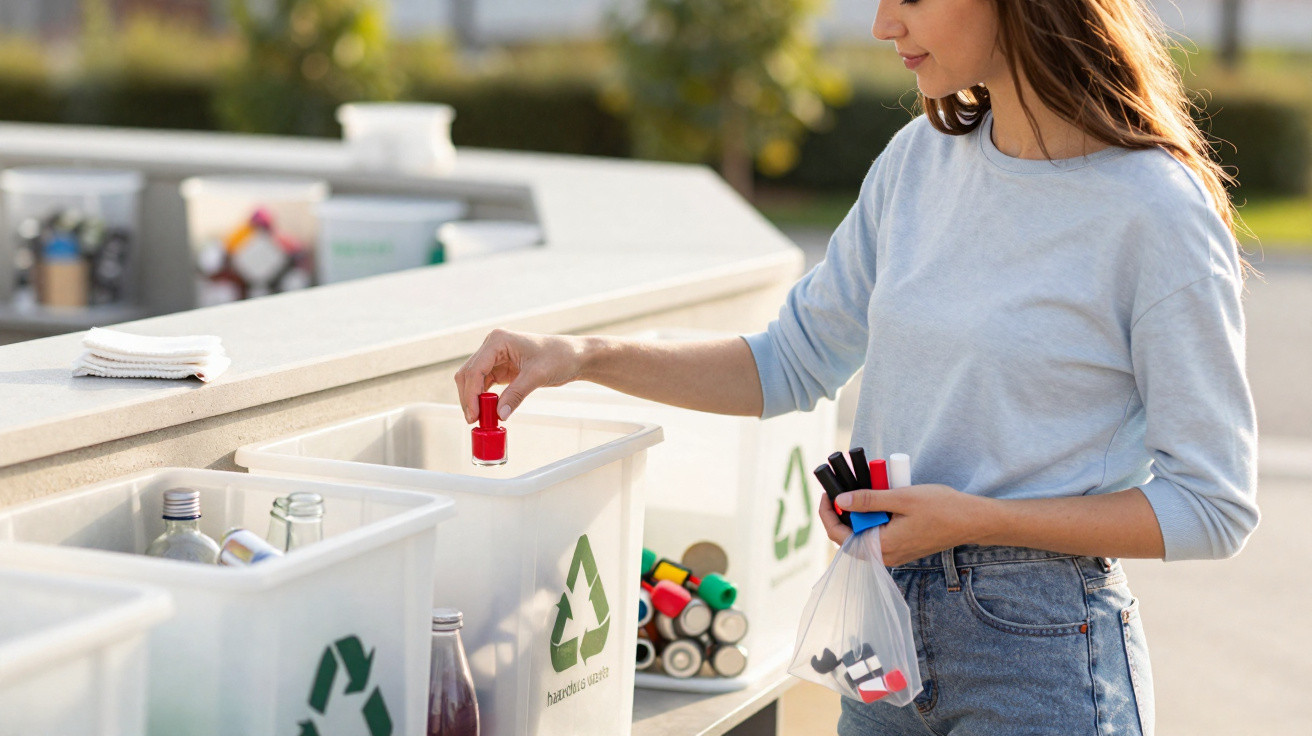
When tidying the bathroom, a bottle of dried-up red nail polish is often simply thrown into the nearest bin. The focus tends to be on freeing up cupboard space rather than on chemicals, fire hazards and environmental regulations. That is precisely where the issue starts: legally, nail polish is not treated like an ordinary cosmetic leftover, but as problematic waste subject to special disposal rules.
Why nail polish does not belong in an ordinary bin
At first glance, the little bottle seems harmless: a bit of glass, a brush and some remaining colour. For refuse collectors and waste processors, however, this combination creates a genuine problem, whether it goes into the bathroom bin, a recycling bin or a glass recycling bank.
The misconception about glass recycling banks
Many people put empty or nearly empty nail-polish bottles into the glass recycling bank because the container itself is made of glass. It sounds reasonable, but it does not fit the processes used at recycling facilities.
“Nail-polish bottles are not standard packaging glass and disrupt the entire recycling chain.”
There are several reasons for this:
- Glass used for cosmetic products often has a different composition from bottles and preserving jars.
- These bottles are very small, so they can easily fall through conveyor belts or pass unnoticed by sensors.
- The plastic brush, metal parts in the cap and chemical residue inside contaminate the recycled glass.
In the worst case, a single small nail-polish bottle can render entire batches of waste glass unsuitable for further processing.
Why recycling bins and general waste are also risky
Using a recycling bin or ordinary general-waste bin is equally problematic. What remains in the bottle is not merely a coloured mixture; it is a cocktail of substances requiring complex treatment during disposal.
If the polish reaches an incinerator along with normal household waste, it alters the flue gases and residues produced. Plants can technically manage this, but doing so demands additional energy and filtration capacity. That increases both costs and environmental impact.
What nail polish contains – and why it is so hazardous
A miniature chemical cocktail
Behind appealing colour names are usually blends of solvents, plasticisers and resins. Many traditional formulations contain, or once contained, substances such as toluene, formaldehyde or certain phthalates. Even modern options marketed with “free” claims still contain components that can be problematic.
“One bottle may seem harmless – but millions of them each year place a permanent additional burden on waste systems and the environment.”
Burning this mixture releases gases that can only be captured using sophisticated filtration technology. If nail polish ends up uncontrolled in landfill or the natural environment, its ingredients may contaminate soil and groundwater over the long term.
Fire risk in refuse lorries
Nail polish and the remover used with it are highly flammable. At home, people know not to paint their nails beside an open flame, yet this consideration is often forgotten once the product is in the bin.
Waste is heavily compacted inside refuse vehicles. Should a bottle break during this process, its contents can mix with other chemicals or combustible materials. Sparks, heat or friction may then be enough to start a fire.
Such smouldering fires are not merely unpleasant; they put refuse workers in direct danger. Every incorrectly discarded bottle adds a little to that risk.
Does the amount left in the bottle matter?
The theoretical exception: a completely empty, clean bottle
A bottle is considered unproblematic only in the very rare situation where it is genuinely empty, clean and free from all traces of product. In reality, this almost never happens. The bottle neck is narrow, while nail polish is sticky and stubborn. Removing every last trace would require a large amount of remover, creating additional hazardous waste elsewhere.
In practice, some residue nearly always remains. That small amount is exactly what determines the disposal category.
The usual case: dried residue in the glass bottle
Nail polish is most often discarded because it has become too thick, the shade is no longer liked or only sediment remains at the bottom. As soon as any material is left in the bottle – whether liquid, viscous or dried out – the contents are classed as hazardous waste.
“As soon as nail polish remains in the bottle, it is no longer simple packaging but chemical waste.”
Nail polish therefore falls into the same category as, for example, leftover paint, varnish, solvents or certain cleaning products.
What penalties can result from incorrect disposal?
Fines can apply even for incorrect sorting
Many towns and districts are tightening checks on household waste because the workload caused by poor sorting is increasing. If a general-waste bin contains a noticeable quantity of problematic materials, the consequences can be costly.
When inspectors find chemicals, solvents or comparable substances in ordinary household waste, fines may be imposed. Amounts of around 35 euros for incorrect sorting are not unusual – even for a product long considered unusable.
When the cost becomes much higher
If the penalty is not paid on time, or if fly-tipping is involved as well, the amount can rise quickly. Depending on the area, 75 euros and considerably more may be charged, especially where varnish-containing waste is dumped in nature or on public land.
Anyone who simply leaves old nail polish somewhere therefore risks costs that could comfortably pay for several professional manicures. What began as a cosmetic issue can suddenly become a financial one purely through convenience.
The only correct destination for old nail polish
What the term “hazardous waste” means
Old varnishes, paints, certain adhesives and pesticides are waste materials requiring special treatment. They must be handled by specialist facilities that incinerate them at high temperatures using dedicated equipment. This helps ensure that as few harmful substances as possible reach the environment.
This system is funded in part through charges paid by manufacturers. Anyone buying nail polish therefore contributes indirectly to the safe disposal of its contents later on – provided the bottle reaches the right place.
Where you should actually take your bottles
The best solution is to take them to the nearest recycling centre or waste collection site. Almost every local authority has a designated area for chemical products. These facilities use secure cupboards or locked containers, often overseen by trained staff.
Many towns also arrange mobile collection points, such as collection vehicles at markets or central public spaces. Residents can conveniently hand in leftover nail polish, solvents and similar products there.
- Check the town or local authority website for the address of the local collection point.
- Take old nail polish, remover and similar products together in one bag.
- Ask staff exactly where cosmetics containing solvents should be placed.
Taking the bottles there reduces the burden on refuse workers, air and water, while also avoiding trouble over fines.
How to use nail polish for longer and reduce waste
Rescue thickened nail polish instead of throwing it away
Before a bottle finally goes into the hazardous-waste box, it can often still be saved. Special nail-polish thinners can make thickened products fluid again. Standard nail-polish remover is unsuitable for this purpose because it breaks down the formulation and makes the polish unstable.
“A few drops of suitable thinner and a little patience can give a favourite shade months of additional life.”
It is important to roll the bottle between your hands rather than shaking it vigorously. This distributes the thinner evenly without creating air bubbles that can later leave streaks and bubbles on the nail.
When you no longer like the colour
Some shades simply no longer suit you, have gone out of fashion or bring back memories of an unsuccessful purchase. If the nail polish is still in good condition, it does not need to go in the bin:
- Give it away to friends or family.
- Offer it through local swapping platforms or neighbourhood groups.
- Use it for creative projects, such as marking keys, decorating stones or adding coloured accents to tools.
For craft work in particular, nail polish works almost like enamel paint: it provides good coverage, dries relatively quickly and adheres to many surfaces.
Practical everyday tips for nail polish
Thinking ahead while shopping can reduce disposal work later. Small bottles are generally used up before their contents become thick. Neutral or classic colours tend to be used more frequently than extreme shades, so they are less likely to be left in a cupboard.
It is also sensible to keep a dedicated place in the bathroom for “problem products”. This is where old nail polish, remover, hairspray, certain cleaners and leftover hair tint can be stored. Once the box is full, take everything to the collection point in one trip. That means only one journey, and the barrier to disposing of items correctly becomes much lower.
Anyone who starts viewing nail polish more as a chemical product and less as a harmless accessory will naturally make better choices. In the end, the environment, the health of waste workers and your own wallet all benefit equally.

















Comments
No comments yet. Be the first to comment!
Leave a Comment