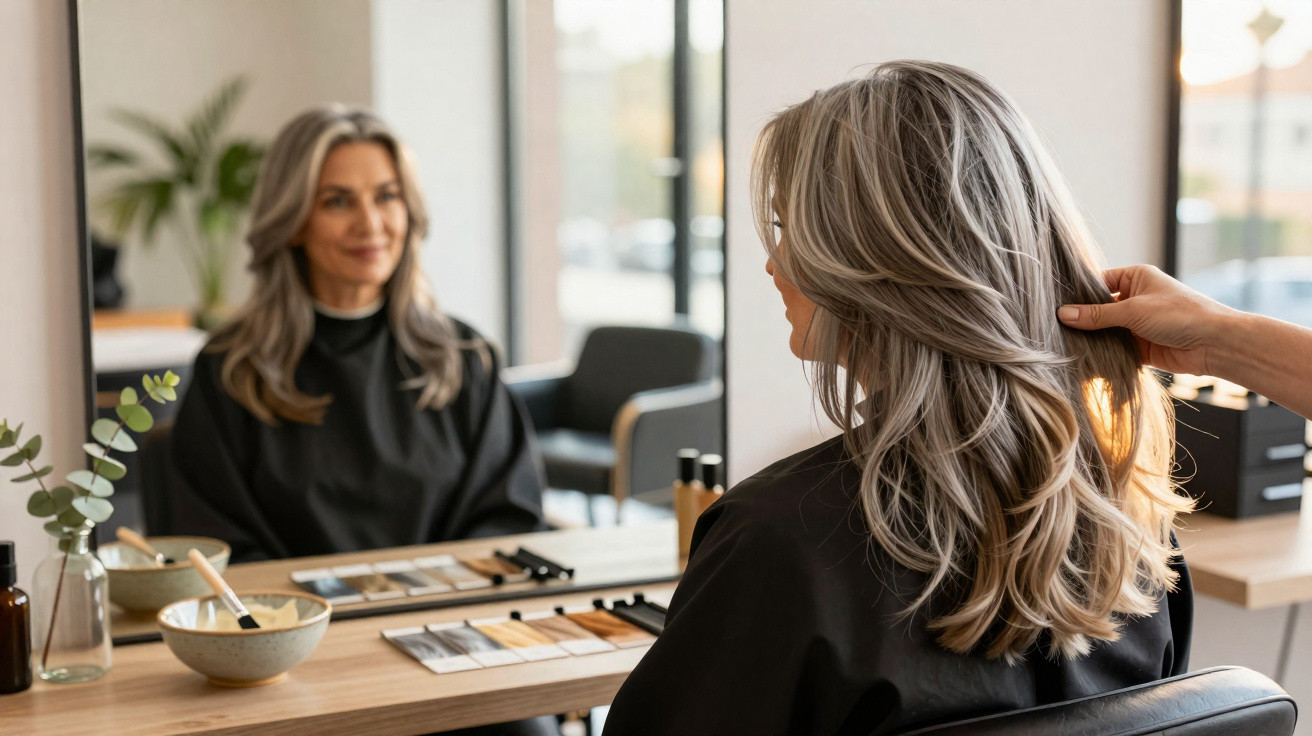
At 8.30 on a Tuesday morning, the salon is already alive with activity when she arrives. In her mid-forties, she wears a crisp blazer and has the guarded expression of someone who has practised the words beforehand: “I need to cover these grays, they make me look tired.” Her hair combines brown box dye with cool silver strands at the temples, a contrast made sharper beneath the fluorescent lights. More than tired, she appears under strain.
The colourist listens and nods before offering a gentle suggestion that lingers in the room: “What if we don’t fight them this time?”
There is a brief pause.
Then comes the phrase that changes the whole conversation: herringbone highlights.
Why aggressively covering gray can make your face appear harsher
Most women do not truly dislike gray hair itself. What they dislike is what it appears to imply under unforgiving bathroom lighting or in an unplanned selfie. The familiar response is an all-over, single shade intended to “cover everything”. For the first week or two, that solution can feel reassuring: the roots disappear and the reflection seems more forgiving.
Before long, however, a quieter change can emerge. Fine lines around the eyes may look more pronounced, the jaw can seem weightier and the overall result can become unexpectedly severe-as though a soft face has been framed by a helmet. This is often what happens when every gray strand is treated as something to eliminate.
A London colourist recalls a client who had coloured her hair the same rich chocolate brown for fifteen years. Her natural base had become cooler, her skin had softened over time, and gray hairs had begun to gather around her hairline.
After every colour appointment, she would send the same message: “Why do I still look so drawn?” Her photographs from her thirties and her current photographs showed the same hair shade, but they did not have the same gentleness. At the salon, they pinned back her coloured lengths and allowed the shimmering roots to show. The effect was unexpected: her eyes looked brighter, her cheekbones appeared more defined and her skin seemed warmer. The problem had been the block colour, not the gray hair.
There is a straightforward explanation for this. Natural hair is never a single uniform shade. It contains a mixture of warm and cool notes, along with lighter and darker sections that create visual balance around the face. When gray begins to appear, it effectively increases the brightness in selected parts of that natural blend.
A flat, single-process colour removes this natural dimension. It takes away the lighter strands that once reflected light around the face, just as the skin may be losing some of its radiance with age. The harshness people notice is therefore often caused by two things happening at once: overly dense colour beside more delicate skin. That contrast can make a person look older more quickly than gray hair would have done.
How herringbone highlights blend with gray rather than battling it
Herringbone highlights take the opposite approach. Rather than blanketing gray, the colourist weaves extremely fine highlights and lowlights between the existing gray hairs in an interlaced, criss-cross arrangement. To an untrained eye it can seem incidental, but the placement is highly considered.
The intention is not to conceal every gray strand. It is to make gray one element within a broader, understated composition of colour. Think of a tweed jacket: individual threads do not dominate, yet together they produce a rich and purposeful fabric. Herringbone highlights create a similar effect in the hair.
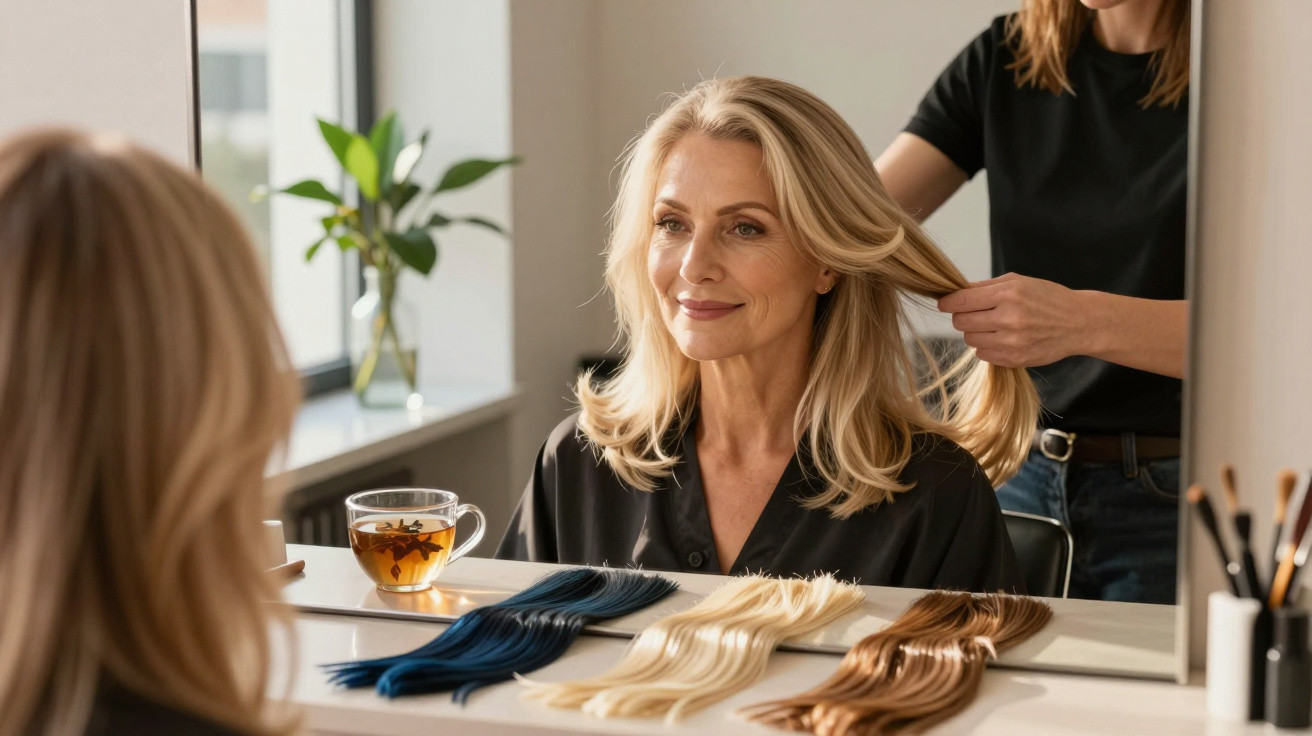
In practical terms, consider a woman in her early fifties with naturally dark-blonde hair. She arrives convinced that the silver showing through means she “has to” become entirely blonde or entirely brunette. Instead of applying an opaque base shade, her colourist sections the hair and places ultra-fine foils at different angles, deliberately leaving certain gray hairs untouched.
Two hours later, she looks neither simply “blonde” nor simply “gray”. Instead, her hair appears to have naturally developed into a multi-tonal combination of sandy, beige and soft-silver ribbons. The formerly stark divide between coloured hair and gray roots has gone. In the light, it becomes difficult to tell where a gray strand finishes and a highlight begins. Released from the contrast of one solid shade, her complexion suddenly looks calmer, almost as if it has been softly filtered.
The reasoning is fundamentally visual. Gray hair is very reflective. When it sits against a heavily saturated colour job, that reflection stands out from the roots, creating conspicuous regrowth and a weary-looking halo around the face. Interlacing highlights and lowlights in a herringbone pattern allows the colourist to diffuse that reflection rather than oppose it.
The eye sees the overall design rather than every separate gray hair. This softens the shape of the face, reduces hard lines around the temples and parting, and brings focus back to the features that matter: the eyes, cheekbones and expression. Paradoxically, allowing some gray to remain visible can make the complexion appear warmer and better rested.
Making herringbone highlights suit your face and everyday life
The real starting point for herringbone highlights is a consultation, not a colour swatch. A skilled colourist will first assess the face: whether you flush easily, whether your undertones are warm or cool, where the gray is concentrated and how you part your hair naturally when you are not making an effort.
They can then position slightly lighter pieces where daylight would naturally fall-around the eyes, across the top of the fringe and close to the cheekbones-while allowing some gray hairs to become the brightest elements of the blend. Lowlights, slightly deeper than the base shade, are threaded between them to give the result structure. This creates a pattern that looks naturally developed rather than painted on, keeping the features soft instead of enclosing them in a block of colour.
There is also an emotional element alongside the technical work. Many people sit in the salon chair already expecting criticism: “I let my roots go too far,” “I look like my mother,” “I left it too late.” On a difficult day, that anxiety can become a desire for the most intense colour possible, as though strength of shade alone might erase the feeling.
The understated reality is that very dark colour on hair prone to gray rarely looks soft around the face. Opting for herringbone highlights is not surrender; it is a different approach. You can retain refinement and control without the heavy helmet effect or the panic every fortnight when the roots emerge. And, honestly, nobody really does that every day.
Many women say they experience an unusual relief after trying this method. The bathroom mirror no longer feels like a battleground, becoming instead a place for compromise.
“Once we wove my gray into the color instead of hiding it, I stopped feeling like I was losing a fight every four weeks,” says Claire, 49. “My face looked less tight. People kept asking if I’d slept better.”
That change is not merely aesthetic; it has practical advantages too.
- Maintenance can extend to 8–12 weeks rather than 3–4.
- Regrowth becomes a gradual shimmer instead of a hard, visible band.
- The complexion appears gentler in daylight and in photographs.
- There is more freedom to choose when, rather than whether, to colour the hair again.
Softer hair colour in a world fixated on before-and-after transformations
What makes herringbone highlights distinctive is that the “after” result is often less dramatic than a conventional colour transformation. It is subtler, resembling a refreshed version of your familiar self rather than an entirely new character. On social media, where transformations are judged by their shock factor, that can initially seem underwhelming.
In day-to-day life, the response is often quite different. Friends may say, “You look really well,” rather than “Whoa, you changed your hair.” Your partner may notice your eyes before your regrowth. Make-up can sit differently because the hair no longer demands all the attention. You may still spot each new gray strand under harsh lift lighting, but the people around you see an overall sense of harmony.
There is a wider sense of social permission involved, too. On the train, in a meeting or at the school gates, you may begin to notice women whose hair visibly includes gray while still looking intentional and chic. That sort of quiet confidence can be contagious.
When the base colour becomes softer and moves away from the old cover-everything routine, another pressure can ease as well: the private deadline you may have imposed on yourself regarding “how long I’m allowed to look young”. Herringbone highlights do not remove that anxiety, but they reduce its intensity. They restore what harsh, single-process colour had taken from the face-air, space and nuance. Nuance is especially flattering to a complexion that has been lived in.
Perhaps the most striking change is how quickly the mirror can stop feeling hostile. One day, you may catch yourself in a shop window with your hair in an unplanned bun, silver strands catching the light among the woven tones, and realise that you no longer recoil as you once did. The internal story has shifted from “damage control” to “this is who I am, but edited kindly”.
That edit remains subtle: a softer outline around the features, less contrast etched around the eyes and a more delicate movement of light across the skin. Confronting your natural gray transition head-on can make your complexion carry the burden of that struggle. Working with it through herringbone highlights allows both the hair and face to breathe a little more easily.
| Key point | Detail | Why it matters to the reader |
|---|---|---|
| Flat colour versus dimension | Single-process dye removes the hair’s natural light and dark variation, increasing contrast with ageing skin. | Explains why “covering everything” can make the face look harsher rather than younger. |
| Herringbone pattern | Ultra-fine highlights and lowlights are interlaced between gray strands in a criss-cross arrangement. | Demonstrates how weaving colour through gray softens regrowth and brightens the complexion. |
| Everyday benefits | Longer intervals between appointments, a softer root line, and more natural results in photographs and daylight. | Makes the technique feel practical for everyday routines, rather than simply fashionable. |











Comments
No comments yet. Be the first to comment!
Leave a Comment