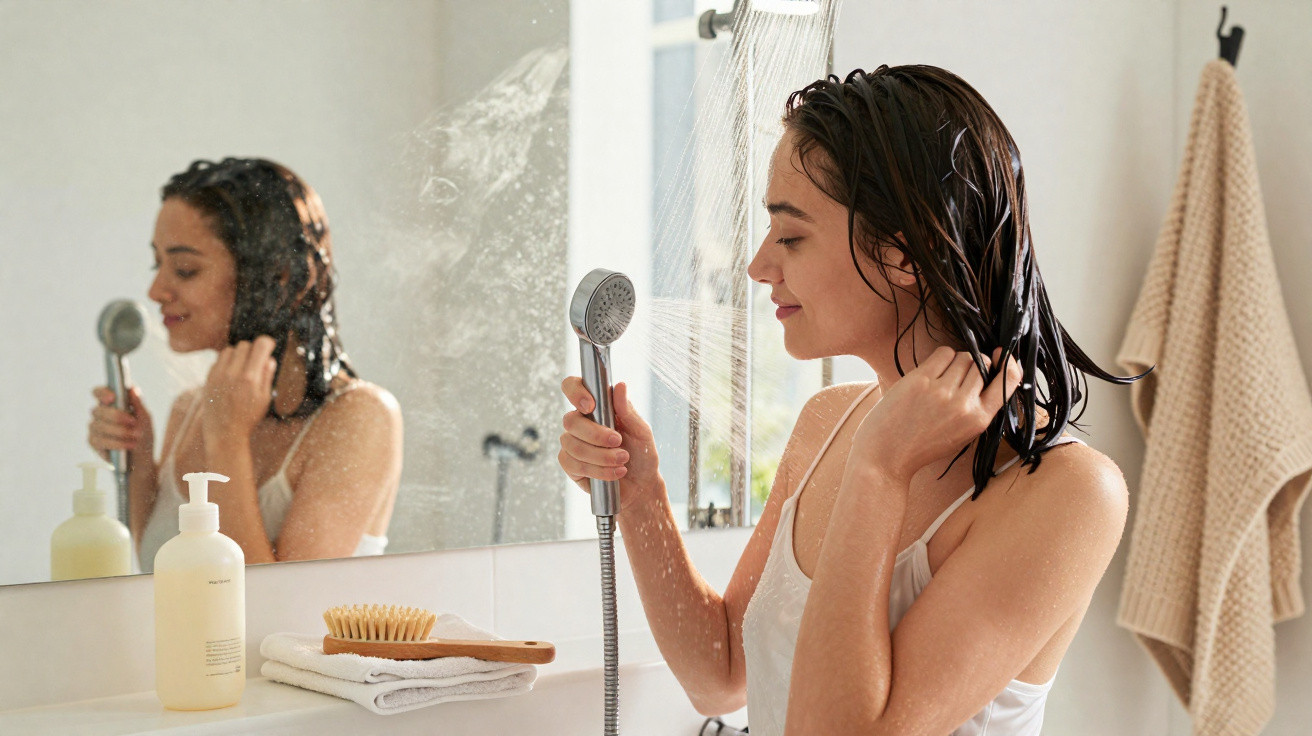
That faint crackle when you pull a jumper over your head and your hair springs upwards as though it is starring in a school science experiment?
That is winter quietly sabotaging your hopes of sleek hair. One second, your blow-dry looks perfectly respectable; the next, it appears you have been pulled backwards through a display of balloons. It is more than irritating – it can feel strangely embarrassing, particularly when you are trying to seem reasonably polished at work or on a first date.
We tend to blame the coat, scarf, biting wind and even the hat. We spray, smooth and mutter under our breath. But the true reason hair becomes a static cloud from November is more subtle, and the answer is neither a new serum nor a £35 brush. It is in the least exciting bottle in your shower, and it only takes one very minor adjustment.
The moment your hair starts rebelling
There is often a single day each year when it becomes clear: winter has arrived, and your hair is no longer cooperating. It may happen in the gym changing room, as you pull on a sports top and every strand suddenly stands upright, attaching itself to your lips and cheeks. You attempt to press it down with your hands, only for your palms to make the flyaways worse, as if they are adding more charge. You glimpse yourself in the mirror and think, “I did not sign up for live-action static electricity.”
Most of us have opened a lift or car door and watched our hair visibly stretch towards the glass. It seems oddly personal, as though your hair has taken against the season itself. You begin to avoid woolly hats, deciding that cold ears are an acceptable trade-off. But then you arrive at the office, remove your coat, and your hair repeats its balloon routine beneath the strip lights. There is seemingly nowhere to hide.
What makes it especially frustrating is that the usual remedies barely make a difference. You might reach for costly shampoo, luxurious oil or a smoothing spray making glossy promises. It still crackles beneath your brush. The more determinedly you tackle it, the more it appears to rise and stick, like your hair is staging its own small winter protest.
The unexciting science governing your hair
Static may sound dramatic, but its cause is remarkably straightforward: your hair has collected excess electrical charge. Whenever an individual strand rubs against something – a jumper, scarf or coat lining – it either gains or loses minute charged particles. If lots of strands acquire the same kind of charge, they push one another away. That is why they fan out and hover; each one is trying to move away from the rest.
Winter makes this effect much worse. Cold outdoor air retains less moisture, and central heating removes even more moisture from indoor air. Humidity falls, so the air can no longer help to “earth” the surplus charges. When hair and air are both dry, the static energy has nowhere to go and simply accumulates. Your hair starts behaving like a line of tiny magnets that will not settle together.
The dryness of the hair itself plays a greater part than we might want to acknowledge. A dehydrated hair fibre has a rougher, less supple surface, meaning it catches more aggressively on fabric and retains charge for longer. In effect, every time you force your head through a polo neck, you become a walking, talking Van de Graaff generator.
Why your regular conditioner stops coping in winter
Many of us apply conditioner half-heartedly: a quick squeeze, a rough application to the ends, then a rinse while our minds are already on dinner. Honestly, hardly anyone stands there carefully working it through as if they are in a hair advert, especially before work. During summer, that approach is usually enough because the air contains more moisture and hair tends to be naturally softer. Once temperatures fall, however, that casual method no longer does the job.
Conditioner is not only there to “make your hair soft”. It deposits a fine smoothing coating over every strand, helping the hair lie flatter and stay manageable. It also gives strands a little extra weight, which is essential when preventing them from lifting with static. In winter, though, that protective layer disappears more quickly: scarves, hats, dry air and increasingly hot showers all erode the protection you applied in those 30 seconds.
Your choice of conditioner matters as well. Light summer formulas marketed as being designed “not to weigh hair down” can leave static-prone hair nearly unprotected. They generally contain fewer silicones and conditioning agents that could make a real difference, leaving you with shine but little genuine control. Winter hair benefits from more substance, rather than another ultra-light mist that smells pleasant but achieves very little.
The small shower change that makes all the difference
Change your routine, not your entire shelf of products
Here is what is rarely explained: solving winter static is usually less about purchasing new products than altering how you use the product already in your bathroom. The adjustment is uncomplicated: instead of treating conditioner as a rushed final step, make it the focus. Use a little more than you assume is necessary, apply it with greater care and – most importantly – avoid washing away every final trace.
After shampooing, begin by carefully squeezing excess water from your hair. Soaking-wet hair cannot properly retain conditioner, because the product simply slips straight off. Work conditioner from ear level downwards, then add a small amount to the upper lengths, steering clear of the scalp if your hair becomes greasy easily. Distribute it with your fingers or a wide-tooth comb until the hair feels slippery and evenly covered.
Then comes the alteration that genuinely improves static: allow it to sit for a few minutes, rinse using lukewarm rather than hot water, and do not chase that squeaky-clean sensation. The faintest residue left on the hair shaft becomes an invisible anti-static barrier when your hair dries. It should not feel heavy or sticky; you are looking for a soft, subtly silky slip that lets your brush glide rather than drag.
The “half rinse” method for persistent static hair
For very fine hair, or hair that is forever floating away, there is a further option. Rinse out your conditioner normally in the shower, then smooth the smallest pea-sized amount back through the mid-lengths and ends before getting out. Leave this final application in. Gently towel-dry, then style in your usual way.
That microscopic coating works like an in-built leave-in cream, without adding another separate product to clutter your bathroom shelf. It provides just enough moisture and slip to prevent strands from building charge and sticking to your face whenever you remove a scarf. For many people, it shifts static from “constant” to “barely there”. Better still, there is nothing new to buy.
Why water, rather than oil, is winter’s essential ingredient
There is an understandable appeal to using hair oil or serum when your hair appears unruly and frizzy. It seems richer, glossier and more thoroughly “coated”. But static is not solely caused by surface dryness; it also reflects insufficient moisture within the hair fibre. Oils remain on the outside of the hair, which may help somewhat with frizz, but they cannot resolve the internal dehydration that makes hair charge at the slightest rubbing.
Effective conditioners have a water base, allowing them to restore moisture and then retain some of it with film-forming ingredients. The aim is for hair to be flexible and gently weighted, rather than encased in a shiny silicone coating that looks smooth but still crackles against a wool scarf. Static-prone hair often feels unusually light and airy, and the solution is properly hydrated strands with some real weight to them.
If you enjoy using hair oil, there is no need to stop – simply apply it in the right order. Allow conditioner to perform the primary hydrating work in the shower, then smooth one tiny drop of oil over the ends once your hair is mostly dry. Consider oil the topcoat on painted nails: attractive and protective, but ineffective without the layers beneath it.
The towel, brush and jumper: minor static culprits
Although the conditioner adjustment does most of the work, a handful of small changes can make the outcome feel nearly miraculous. The vigorous towel rubbing you have done since childhood is a static-producing habit. Instead, press or squeeze water from your hair with a soft towel or an old cotton T-shirt. Your hair will seem less dishevelled before you have even reached for a brush.
Plastic brushes and inexpensive combs are also excellent at generating static. A wooden brush or a brush with mixed bristles is gentler, and you will genuinely notice less of that quiet fizzing sound as it moves through your hair. When brushing in an exceptionally dry space – such as an office bathroom with a blasting hand dryer – run your hands beneath the tap first, leaving them slightly damp as you touch your hair. That trace of moisture helps absorb surplus charge.
Clothing has an effect too. Synthetic jumpers, polyester coat linings and fluffy scarves all intensify static. There is no need to discard your whole wardrobe, but it is helpful to recognise the pattern: if you are wearing a high-neck acrylic jumper, give your hair an extra smoothing application of conditioner in the shower that morning, or keep a mini leave-in spray as a reserve. Understanding the triggers prevents you from blaming your hair for what is actually your outfit’s doing.
The emotional impact of uncooperative hair
On paper, static hair may seem like a trivial irritation, but anyone who has stood in a brightly lit shop trying to tame escaping strands knows how much it can bother you. Hair is surprisingly connected to how composed we feel. When it starts acting independently – rising, drifting and attaching itself to lip gloss – it can leave you feeling untidy, childish and less in control.
There is also a discreet sense of embarrassment around fussing with it. You may find yourself repeatedly patting your head in a train window or café, attempting to persuade that halo of flyaways back into place. It can feel a little vain, although it is really about wanting your outward appearance to reflect how you feel inside that day. You want to present the calm person you have worked to become, rather than a flustered cartoon character with lightning-bolt hair.
This is why such a modest conditioner change matters more than it might appear. When your hair remains where you placed it, you no longer think about it every five minutes. You can take off a scarf in a busy bar without that small sinking feeling. Mornings also become slightly calmer, because winter is no longer a three-month battle between your hair and your clothes.
When the adjustment is not enough – and what it indicates
If you follow the “more mindful conditioner, lighter rinse” approach and your hair continues to resemble a static-charged hedgehog, it may be signalling something more significant. Severely damaged or over-processed hair struggles to retain moisture, regardless of how much conditioner you apply. Bleaching, strong dyes and years of heat styling can make its surface so rough that, even with the right routine, it catches on every jumper fibre that comes near it.
In this situation, view the conditioner adjustment as damage limitation rather than a miracle cure. It will remain useful, but you may also need a weekly intensive conditioning mask or protein treatment, or a break from straighteners. The objective is to slowly restore the surface of the hair, enabling it to hold moisture from the inside out instead of merely sitting beneath a cosmetic layer of shine. Sometimes static is the first small sign that your hair is more delicate than you had realised.
There is another straightforward reality: certain hair types will always be more “floaty” during winter. Very fine, straight hair has less natural weight and frequently produces less natural oil, so it is more likely to spring about. That does not mean your routine has failed; it is simply the nature of your hair. The aim is not to force it into submission, but to make it manageable enough for you to go about your day without inspecting every shop window.
Winter hair static, with less electricity
Once you know why winter transforms your hair into a static firework – dry air, dehydrated strands and friction from clothing – the season feels less like a personal assault. That ordinary bottle of conditioner you have been racing through begins to look like a useful everyday tool. Squeeze out additional water, spend 30 more seconds on the process, rinse a little less thoroughly and perhaps leave the faintest veil on the ends. It may not seem heroic, but your hair will quietly appreciate it whenever you remove a wool hat.
There will still be the occasional balloon incident, or a crackle when you pull off a jumper in the dark. That is simply winter doing what winter does. But those incidents no longer have to dictate your entire appearance or morning. One day, you will slide your coat from your shoulders, shake out your hair and notice – with a quietly smug smile – that nothing hovers or clings; it simply falls. Whether there is static or not, that is a very good feeling.














Comments
No comments yet. Be the first to comment!
Leave a Comment