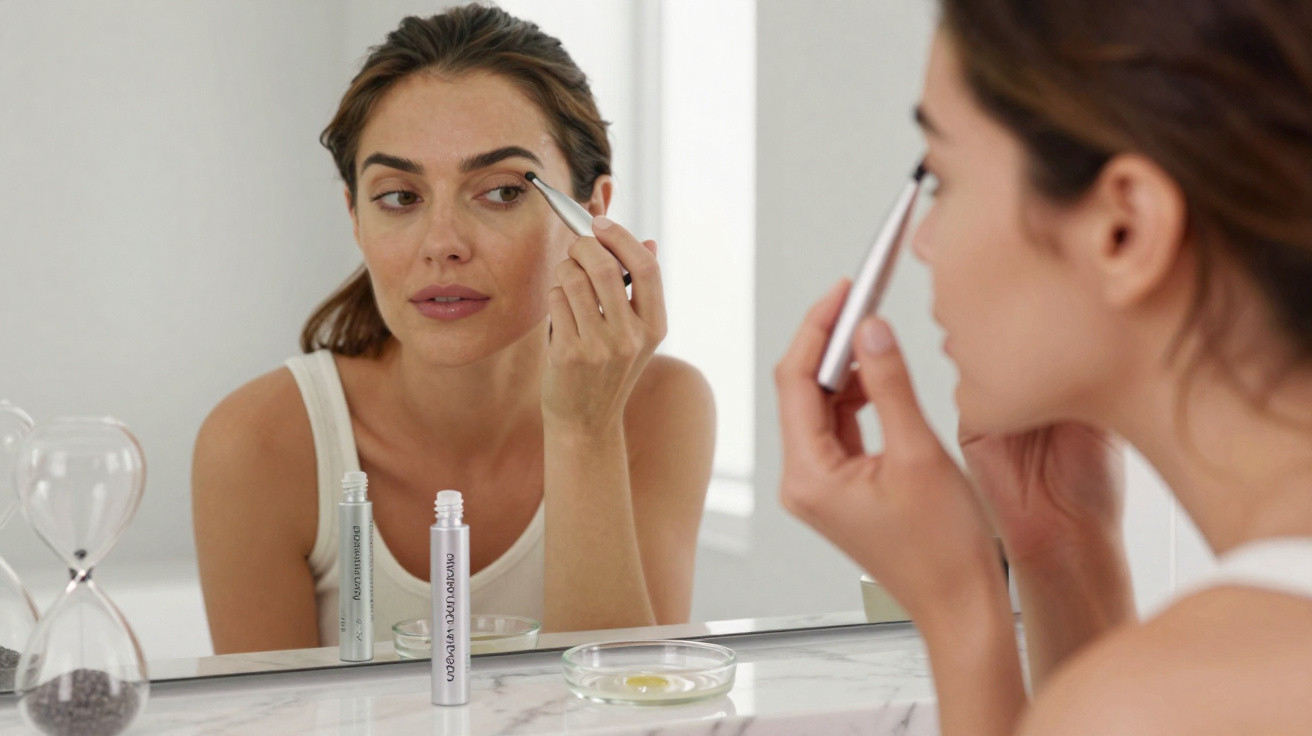
A new anti-ageing product now promises visibly smoother-looking skin in just one minute.
For years, the cosmetics industry has pursued the goal of reducing wrinkles as quickly as an injection can – but without needles, clinic appointments or leaving home. A combination pharmacy skincare product containing collagen and hyaluronic acid is now attracting attention. It claims to visibly soften expression lines after the very first application, offering a gentler alternative to botulinum treatments.
What is behind the new collagen- and hyaluronic acid-based wrinkle filler?
The concept is straightforward: rather than relying on individual active ingredients in isolation, the formula combines several forms of hyaluronic acid with marine pro-collagen, plus smoothing plant and marine extracts. The result is intended to be a type of “2-in-1 wrinkle filler” that brings together immediate cosmetic results and longer-term skincare.
The manufacturer describes the texture as “silicone-like”: creamy, exceptionally fine and designed to leave an instantly soft-focus finish. This does not mean that it creates a genuine silicone coating; instead, it refers to a smooth skin feel that makes the surface appear more even, much like a professional make-up primer.
The formula is intended not merely as background care within a skincare routine, but to provide visible smoothing immediately after application – particularly on the forehead, crow’s feet and nasolabial folds.
Four types of hyaluronic acid: why the blend matters
Hyaluronic acid has been an anti-ageing skincare staple for years. It becomes particularly interesting when molecular sizes are combined, as each size works in a different layer of the skin. This is precisely the approach taken by the new wrinkle filler:
- High-molecular-weight hyaluronic acid: largely remains on the skin’s surface, attracts water and forms an instantly smoothing, subtly plumping film.
- Medium-molecular-weight hyaluronic acid: penetrates slightly further, improves elasticity and helps maintain suppleness.
- Low-molecular-weight hyaluronic acid: can reach deeper skin layers, where it acts as a hydrating filler that retains moisture for longer.
- Hyaluronic microspheres: these expand when they come into contact with moisture in the skin, visually filling fine lines from within.
Together, these components are designed to create a multi-layered result: instantly noticeable smoothing at the surface alongside more intensive hydration in deeper layers, which may improve the skin’s texture over time.
Marine pro-collagen, lucerne and ferments: supporting the skin matrix
Hyaluronic acid is only one part of the picture. To remain firm, skin also needs a stable collagen framework. This is where marine pro-collagen comes in. It consists of collagen fragments derived from marine sources, which are intended to stimulate the skin’s own collagen production and support the elastic structure of connective tissue.
The product also contains an extract of lucerne. This plant is rich in secondary plant compounds and is often used in natural cosmetics to make mature skin feel more supple and reduce mild feelings of tightness. Another element is a marine ferment active, intended to strengthen the skin barrier and make the overall complexion appear smoother.
The combination of hyaluronic acid, pro-collagen and plant-based marine actives is designed both to conceal fine lines in the short term and to work on the skin’s structure over the longer term.
How the “1-minute effect” is intended to work
According to the manufacturer, a visible effect can be seen within around 60 seconds. This is said to result from a blend of optical smoothing and expanding active ingredients. Immediately after it is applied, the texture forms an ultra-fine film over the relevant area, visually evening out small irregularities.
At the same time, the hyaluronic acid combination starts to draw in moisture. The microspheres increase in size as soon as they meet moisture in the skin. This creates a subtle “filling effect”, making fine lines look less pronounced.
Precision applicator: applying it “wrinkle by wrinkle”
One notable feature is the packaging. Instead of a jar or standard tube, the product uses a special brush-tipped tube. Its tip makes it possible to place the product directly into the small indentation of each wrinkle, rather like using a fine pen.
The recommended method of use is as follows:
- Cleanse the face as usual, then apply toner and moisturiser.
- Gently squeeze the tube and apply a tiny amount directly into the relevant line, such as a forehead line, crow’s feet or the lip contour.
- Lightly tap it in with a fingertip, or spread it with small smoothing movements until the film blends in.
- After a brief wait, make-up can be applied over it.
When using it beneath foundation in particular, it is worth carrying out a quick test to see how well the product works with your own make-up, so that it does not later pill or settle.
What users reported in an initial study
The manufacturer states that the product was tested in a small self-assessment study involving 21 participants. Participants used the wrinkle filler in everyday life and subjectively assessed its effects. The reported results are striking:
| Observation | Percentage of participants |
|---|---|
| Wrinkles appear less visible | around 90% |
| Filling effect noticeable within 1 minute | 95% |
| Face appears younger after 28 days of use | 80% |
Although these figures sound impressive, they are based on subjective assessments from a small test group. Clinical studies involving larger groups have not yet been carried out. Even so, the information shows the product’s intended direction: a multi-step routine for anyone wishing to address wrinkles more gently.
An alternative to Botox? The limitations
The comparison with botulinum injections is an obvious one, as these smooth expression lines through temporary muscle relaxation. A topical wrinkle filler cannot fully replace this effect because it works only at the skin’s surface and does not affect muscles.
For many people, however, an everyday visual softening is sufficient, especially when they want to retain natural facial expression. There is another distinction too: the results from a skincare product depend greatly on consistent use, skin condition and realistic expectations. Anyone expecting deep furrows to disappear within seconds may be disappointed. Fine lines and early wrinkles, on the other hand, can often be made to look considerably more even.
Risks, tolerability and who the product may suit
Anti-ageing products containing hyaluronic acid and collagen are generally considered well tolerated, as they predominantly contain substances that already occur in the body. However, people with sensitive skin or a tendency towards allergies should always check the complete ingredient list.
Common ingredients that sensitive skin may react to include:
- Fragrances and essential oils
- Preservatives
- Certain emulsifiers or surfactants
If you are unsure, test the product on a small area first, such as along the jawline. If redness, burning or a feeling of tightness occurs, stop using it.
How to incorporate the wrinkle filler effectively into a skincare routine
The new collagen-hyaluronic acid filler is not a replacement for a complete routine; it is an addition to one. Ideally, it should sit within a clear sequence:
- Morning: gentle cleansing, toner, an antioxidant serum such as vitamin C, day cream, targeted wrinkle filler and sun protection.
- Evening: thorough cleansing, an active serum such as retinol or peptides depending on skin type, night cream and wrinkle filler on particularly affected areas.
A collagen-focused approach can be markedly more effective when combined with sun protection, as UVA rays are regarded as one of the biggest destroyers of collagen. Without consistent protection, any anti-ageing routine is working against ongoing damage.
Why collagen and hyaluronic acid are so often used together
Many anti-ageing products now rely on a combined collagen and hyaluronic acid strategy. Collagen provides stability, while hyaluronic acid delivers volume and moisture. As collagen levels decline over the years, skin loses firmness and wrinkles become more deeply etched. When moisture is lost at the same time, lines look sharper and more noticeable.
By targeting both of these elements at once, the overall appearance can look more balanced: the skin not only seems smoother in the short term, but may also remain plumper for longer with good skincare and a healthy lifestyle. Factors such as sufficient sleep, limited nicotine use, a balanced diet and moderate UV exposure can noticeably strengthen the effect.
Anyone choosing to invest in a highly concentrated wrinkle filler should therefore be aware that the tube alone will not solve every problem. However, it can be a valuable tool in a well-designed routine – especially when quick results are wanted for work, events or simply the mirror.










Comments
No comments yet. Be the first to comment!
Leave a Comment