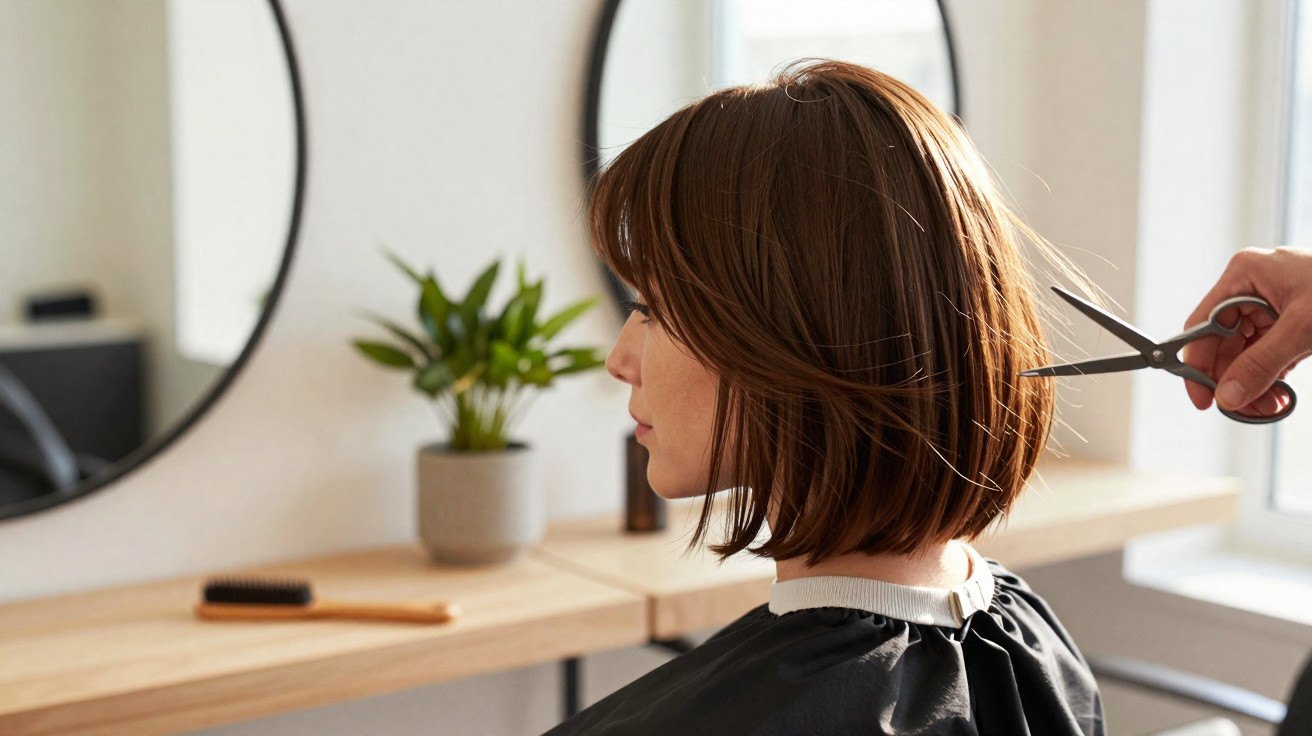
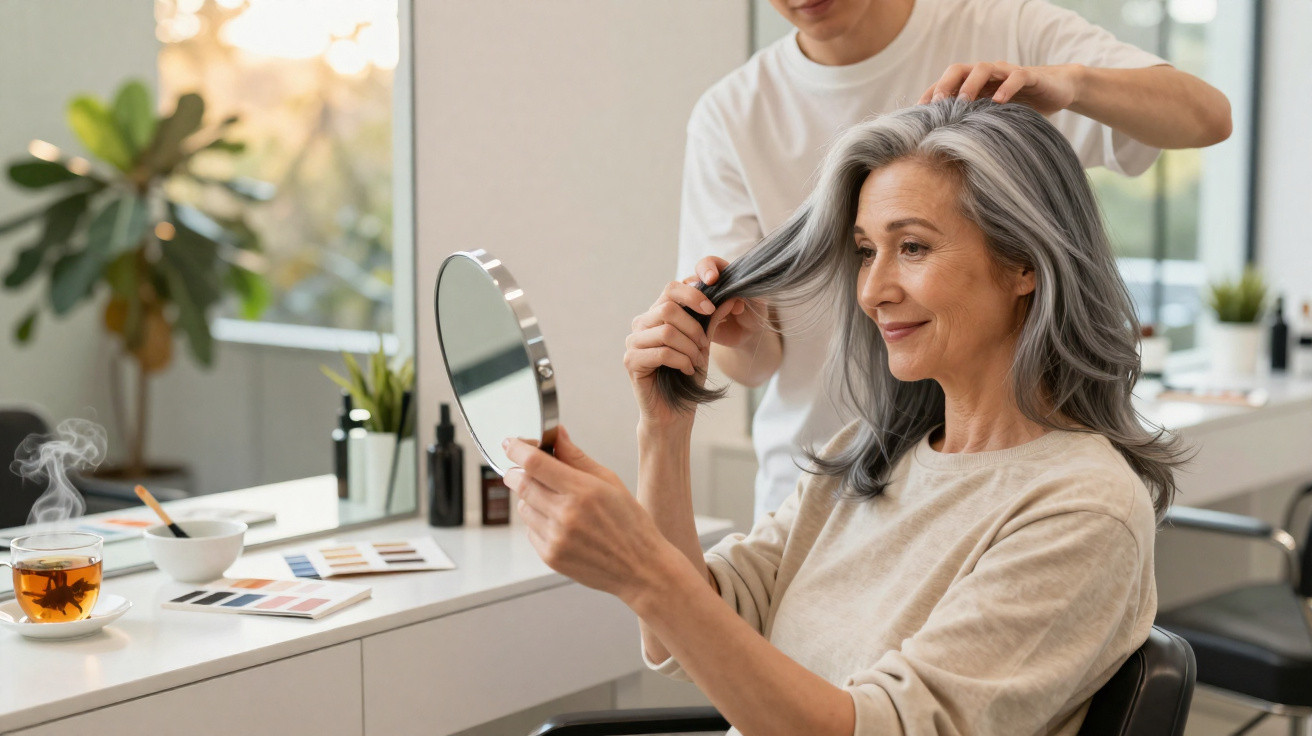
The woman in the mirror hesitates. Her bob falls to her shoulders in a straight, crisp line – cut with absolute precision, almost as though a ruler had been used. Stylish and defined. Yet something about it feels rigid, like a perfectly starched blouse kept in the wardrobe solely for job interviews. Behind her, the hairdresser holds a comb and quietly says: “Let me feather out the ends a little; it will make everything look softer and more modern.” A few millimetres, several seemingly random snips. Suddenly, the cut frames her face differently: with more life, almost as if the hairstyle can breathe. It is the same length and the same overall style, but the effect has completely shifted. You notice it immediately. All because of the ends.
Why textured ends suddenly look more modern than blunt edges
We have all experienced it: a haircut looks flawless in a photograph but somehow feels overly done in real life. Sleek, ruler-straight lines communicate control, accuracy and perfection. Everyday life rarely feels that way, though. Textured ends introduce a little disorder and chance into an otherwise fixed look. Their subtle irregularities soften the face and bring movement to the fore. The wind catches them, individual sections come loose, and the hair suddenly looks lived-in rather than lifted from a hairstyle catalogue. You see the person, not merely the cut.
A Berlin stylist told me a few months ago about a shoot with a well-known entrepreneur. In the first images, the woman wore a perfectly sleek long bob, cut precisely with every hair sitting in place. The photographs looked polished, but also cool and almost distant. During a break, the stylist picked up thinning scissors, opened up only the ends, pulled out a few individual strands and allowed the edges to “break”. In the second round, the same outfits immediately looked more interesting, her smile appeared warmer and she seemed more approachable overall. Afterwards, followers wrote in the comments that she “finally looked like herself”. Technically, almost nothing had changed – apart from the ends.
A smooth, blunt cut creates a distinct outline. Psychologically, our brains associate that with strictness, structure and sometimes even being hard on ourselves. Textured ends, by contrast, interrupt the line slightly and give the eye more to explore. The edges become a little less defined, while the transition between hair and face looks more natural. There is an interesting side effect: facial contours appear less severe, fine lines recede visually and the entire silhouette seems lighter. Rather than standing in front of the personality like a frame, the hairstyle opens it up. At a time when “Too perfect” can quickly seem inauthentic on social media, these imperfect ends feel especially current.
How to achieve textured ends that look modern rather than untidy
A modern textured look is not created by cutting away wildly; it comes from carefully softening the edges. A good principle is to retain the basic shape and enliven only the final one to two centimetres. Many hairdressers use point cutting for this: making small vertical cuts into the ends instead of cutting one solid line. You can state this clearly at your appointment: “I want to keep my base length, but I’d like the ends to be more textured rather than blunt.” Images are hugely useful, particularly close-ups of the ends. That way, your hairstyle remains clearly recognisable – whether it is a bob, shag or long hair – while looking instantly more current and less obviously styled.
The biggest pitfall with textured ends is that they can quickly be mistaken for damaged hair. Many people still remember the 2000s, when everything was excessively thinned out and the lengths eventually resembled three sad strands. We all know that moment when we realise too much has been taken from the ends. Let’s be honest: no one stands in front of the mirror every day with a round brush, heat-protection spray and 15 minutes for styling. That is why a modern textured cut needs substance, not just air. Keep the hair fuller at the roots and through the lengths, with texture limited to the final centimetres – then the result looks intentional rather than as though it is growing out.
“Textured ends are like a soft-focus filter for the whole hairstyle – they do not make anything perfect, but they make everything a little more pleasant to look at,” said a hairstylist I met in a small salon in Cologne.
This type of cut works particularly well when a few basic rules are followed:
- Never thin out the entire length; only open up the ends.
- Respect the hair’s natural texture rather than fighting it.
- Use no more than two styling products so the look does not seem “too done”.
- Have it trimmed every 8–10 weeks to keep the texture looking fresh.
- Be especially sparing with thinning scissors on fine hair.
What textured ends reveal about the current mood
Looking at street style from recent years, one thing stands out: the perfect Instagram waves, with every strand arranged identically, appear far less often in reality than feeds suggest. Instead, you see softer bobs, shags and long hair with moving ends. Hairstyles that look as though they have a story. Textured ends fit surprisingly well with this outlook. They signal: “I make an effort, but I no longer follow the rulebook every day.” You are allowed to have a few rough edges, even on your head – simply in a version that flatters the face.
It is striking how strongly this can affect the way someone feels in their own body. Many people say blunt, straight lines make them feel too severe more quickly, especially when paired with business outfits or formal make-up. Once the ends are lightly textured, the same blazers and shirts suddenly appear more relaxed, less like armour. The hairstyle takes a little pressure out of the situation. And yes, on bad days it can feel comforting when your hair is not shouting “I am perfect!” while, inwardly, you feel much more like wearing jogging bottoms.
Perhaps that explains why such a seemingly small change can have such a major effect. Textured ends visually say: a person lives here, not an avatar. They make room for imperfection and give the face space, rather than enclosing it like a picture frame. For many of us, that is a quiet but important move away from rigid beauty rules towards something that feels closer to real life. And perhaps that is the real luxury: a hairstyle that looks modern without becoming a daily project.
| Key point | Detail | Benefit for the reader |
|---|---|---|
| Textured ends instead of harsh edges | Small, controlled irregularities in the final centimetres of the hair | Looks more modern and softer, making the face seem more approachable |
| Technique and communication at the salon | Point cutting, clear visual references and a focus on the base shape | Lower risk of lengths that look “damaged”, with a result closer to your own vision |
| An everyday-friendly, current look | A less perfect but more lively silhouette requiring little styling effort | Greater confidence because the hairstyle looks like real life rather than a glossy filter |
FAQ:
Question 1 Which hair lengths are textured ends best suited to?
Textured ends work with almost every length, from a short bob to very long hair. The longer the hair, the more subtle the texturing should be so the lengths do not appear too thin.Question 2 Do textured ends also look good on straight hair?
Yes, and straight hair in particular benefits because its edges can otherwise look very harsh. Fine, vertical cuts into the ends create movement without ruining the shape.Question 3 Do textured ends damage the hair?
No, provided they are cut professionally. In fact, texturing removes the oldest, driest millimetres anyway. Good hydration and heat protection are important.Question 4 How often should textured ends be trimmed?
Every 8–10 weeks is a good rhythm to keep the texture fresh and prevent the lengths from looking “frayed”. For very fine or stressed hair, every 6–8 weeks is better.Question 5 Can you cut textured ends yourself at home?
With proper hairdressing scissors and plenty of care, a minimal refresh is possible, but major shape changes belong in the salon. One wrong angle is enough to make the ends uneven or frayed rather than modern.






Comments
No comments yet. Be the first to comment!
Leave a Comment