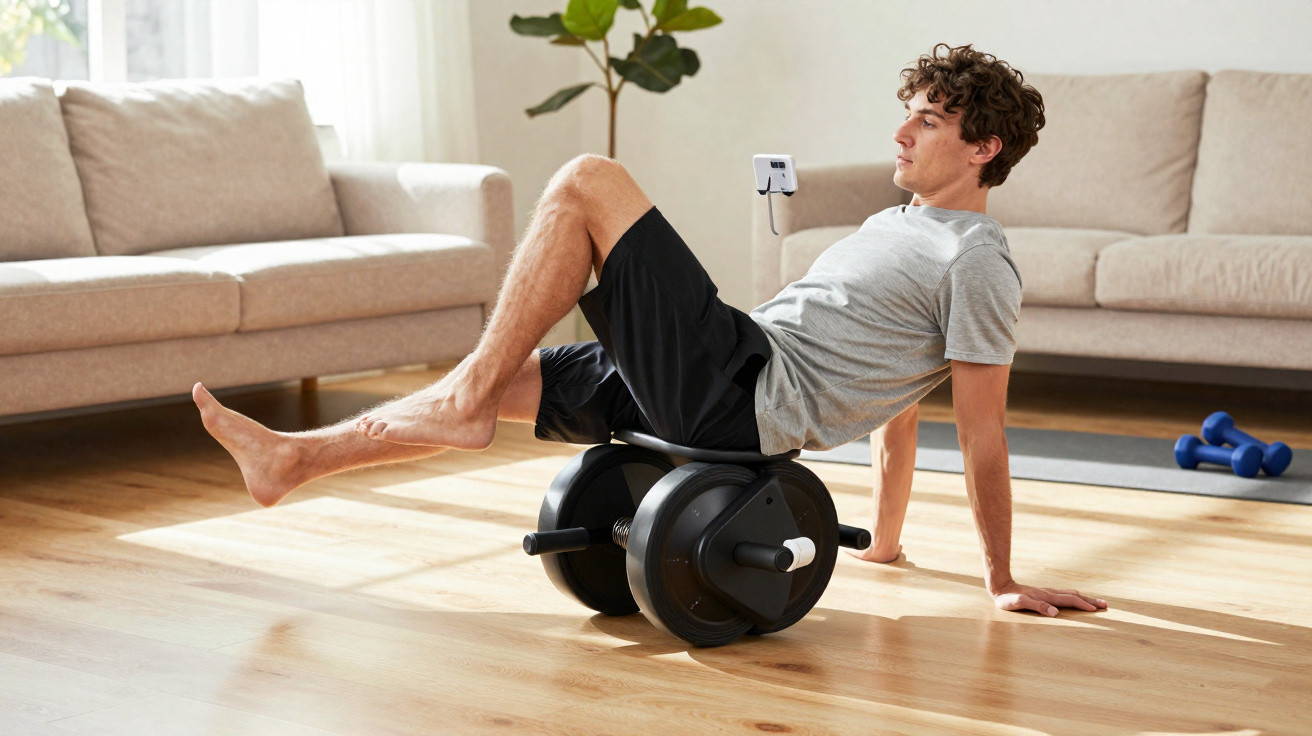
After work, anyone wanting to do something quickly for their core often turns to familiar classics: sit-ups, planks and crunches on the living-room carpet. Yet after only a few days, the neck, shoulders or lower back can start to complain – and motivation disappears. A Decathlon training device costing around £60 promises a solution: more effective abdominal exercises, less discomfort and more enjoyment. That sounds like a marketing claim, so it is worth taking a closer look.
What is behind the new Decathlon abdominal trainer?
At first glance, the device resembles a conventional ab roller, but its design has been taken considerably further. Rather than a single wheel, it uses a compact four-wheeled frame that supports the user on their forearms. While unstable single-wheel rollers can easily slip and slide, this model puts stability first.
“The core idea: to challenge the abdominal muscles to the maximum without placing unnecessary strain on the wrists, neck or lumbar spine.”
Padded elbow rests are also included. This shifts pressure away from the wrists, which are a common weak point with many traditional ab rollers. People who spend long periods at a desk or using their phone often already have sensitive wrists, making this design a clear advantage for that group.
Four wide wheels instead of an unstable ride
The four wheels are approximately nine centimetres wide and feature rubber strips. This delivers several benefits:
- improved grip on smooth surfaces such as laminate or parquet flooring;
- a lower risk of slipping;
- gentler contact with the floor surface;
- a steadier, more controlled forward and backward movement.
Their width spreads body weight more evenly. Anyone who has ever tipped forwards unexpectedly with a narrow ab roller will know how unpleasant that can be, particularly for the shoulder joints and lower back. The Decathlon device makes this familiar home-fitness challenge rather less intimidating.
Spring mechanism: support through the hardest part of the exercise
The internal construction is where things become particularly interesting: an integrated spring mechanism assists the movement. When rolling forwards, the muscles work against gravity as normal. During the return phase, however, the spring offers light assistance to help the user come back up.
The way back is widely considered the critical stage of this exercise. People who overestimate their ability or roll too far forwards often pull themselves back using the lower back rather than their core. Over time, this can result in tension or even injury. The spring is intended to prevent precisely that, without making the exercise entirely easy.
“The spring takes away part of the load, but leaves enough resistance for the abdominal muscles and core to continue working hard.”
How much support is felt also depends on the range of motion. Beginners can keep the device closer to their body, while more advanced users can roll much further forwards until their abdominal muscles are truly working.
Designed for beginners and fitness professionals alike
Decathlon is clearly aiming this device at a broad audience. Those just beginning to exercise can start carefully thanks to the stable base and spring support. The movement remains guided, significantly reducing the risk of collapsing into an excessive lower-back arch without control.
At the same time, experienced athletes have sufficient scope to push themselves. They can increase the range of movement, hold the end position for longer or simply raise the number of repetitions. The movement pattern stays the same, while intensity is controlled through distance and tempo.
More than simply “abdominal exercises”
One aspect many people underestimate is that these rolling movements do not train only the visible “six-pack”. They also involve:
- the deep abdominal muscles;
- the oblique abdominal muscles;
- muscles surrounding the lumbar spine;
- the shoulder girdle and chest muscles.
Sports medicine specialists refer to this area as the “trunk” or “core”. A strong core supports the spine, relieves pressure on the back and improves posture. For anyone who sits extensively or struggles with back pain, these exercises therefore offer benefits beyond appearance alone.
On-board electronics: counter, battery and smartphone holder
To make sessions more structured, Decathlon has fitted the device with a small LCD counter. Among other things, it displays:
- number of repetitions;
- elapsed training time;
- estimated calories.
It is not a technological breakthrough, but it can make it easier to keep track in everyday use. People who can see their progress in black and white are more likely to stick with it. The built-in battery is charged using the supplied USB-C cable. This suits people who already charge everything with the same connection – phone, headphones and tablet.
The smartphone holder also appears practical. It positions a phone so users can watch training videos, follow online programmes or simply play a playlist without leaving the device loose on the floor. It is a useful detail, particularly for people who prefer guided workouts.
Comfort features: knee protection and suitability for the living room
The set includes a soft knee pad, which can make a real difference on hard flooring. Anyone who regularly trains on tiles or thin carpet will know the issue: after ten minutes, the knees can burn more than the abs. By including an additional mat, the device neatly removes this objection to training.
The rubber on the wheels also makes using it in the living room noticeably quieter and gentler. After a long day, nobody wants to disturb the neighbours with loud rolling noises or leave scratches in parquet flooring.
Is this Decathlon device enough to lose belly fat?
However appealing it may sound, one training device will not make belly fat disappear. Professional institutions repeatedly point out that visible fat reduction around the midsection depends mainly on three factors:
- regular exercise combining strength and endurance work;
- a calorie-conscious diet based largely on fresh food;
- sufficient sleep and as little persistent stress as possible.
The body itself determines the order in which it reduces fat stores. Losing weight “only from the stomach” is not biologically possible. What the Decathlon device can do is make it easier to begin core strength training, make progress measurable and protect sensitive areas such as the neck and wrists.
“Anyone who uses the device regularly builds muscle, improves their posture and increases energy expenditure – all of which supports every form of weight loss.”
Who should buy it – and who should not?
The device is particularly relevant for people who:
- want to train at home without complications;
- experience neck or back pain with traditional crunches;
- struggle with pressure on their wrists;
- like to see their progress in numerical form.
It is less suitable for people with acute back problems, slipped discs or shoulder injuries. In such cases, any new training stimulus should first be discussed with a doctor or physiotherapist.
How to incorporate the Decathlon abdominal trainer effectively
A realistic example for beginners could look like this:
- 2–3 sessions per week;
- 3 sets of 8–10 guided repetitions each;
- rests of 60–90 seconds between sets;
- gradually increasing repetitions or range of movement over the following weeks.
Combined with straightforward exercises such as squats, lunges and press-ups, this creates a small full-body home programme that does not require extensive gym equipment.
People who have been training for some time can, for example, place the Decathlon device at the end of a workout and use it as a “finisher” to challenge the core once more. In that case, longer holds in the far-forward rolled position are suitable – and they work deeply.
Ultimately, the £60 device does not replace personal commitment or healthy habits, but it may provide a missing component that makes home training more practical in daily life. Above all, people who have previously been held back by pain or uncertainty about the movement gain a tool that reduces many common obstacles – and that can determine whether a good intention fades after three days or finally becomes a routine.









Comments
No comments yet. Be the first to comment!
Leave a Comment