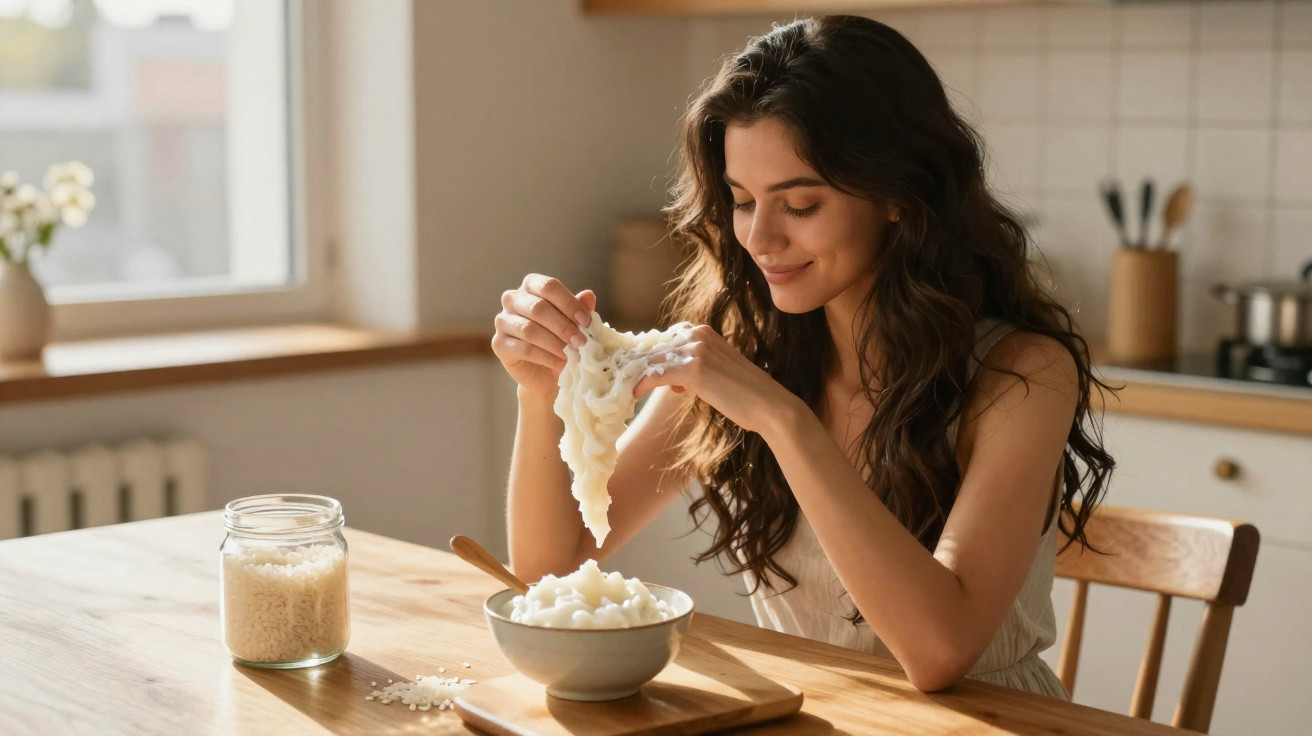
A kitchen staple can restore their shine at a surprisingly low cost.
When hair looks dull, many people immediately reach for expensive treatments from the perfumery. They promise high shine, come in luxurious packaging and carry a hefty price tag. Yet the answer is often already in the kitchen cupboard: rice. Prepared properly, this humble grain can make a remarkably effective hair treatment, delivering a visible result after just one use without putting a strain on the monthly budget.
Why hair looks so tired in late winter
Months of dry central-heating air, cold winds and thick woollen scarves leave their mark. The hair’s outer cuticle becomes roughened, moisture escapes, lengths look straw-like and ends begin to fray. Even hair that is usually well cared for can seem flat and lifeless at this time.
Turning to products with a high silicone content often merely disguises the issue for a short while. The silicone coating sits on the hair like a film and initially makes it feel smooth, but may place greater strain on its structure over time. A more useful approach is to reinforce the fibre rather than simply cover it up - and that is where rice comes in.
“Rice does not just give hair a visually smoothing effect; it also supplies the fibre with substances that remain active after rinsing.”
Rice as a beauty staple: rediscovering traditional knowledge
Rice water has been used for hair care for centuries in parts of Asia. During cooking or soaking, starch and valuable accompanying substances pass into the water. This blend coats the hair, smooths the cuticle and helps light reflect more evenly - creating that much-desired mirror-like shine.
One particular component of rice is especially interesting: inositol. This substance belongs to the B-vitamin group and has a particular affinity with the hair’s keratin structure.
- It penetrates the hair fibre rather than working only on the surface.
- Some of it remains after rinsing and forms a type of protective shield.
- It improves elasticity, thereby reducing the risk of breakage.
- It helps reduce split ends, as the tips are less likely to split open quickly.
Rather than relying on high-tech laboratories, this method uses a simple grain that has been eaten and used in care routines for millennia. That is precisely its appeal: little chemistry, little marketing and a clearly noticeable result.
How to make a rice hair treatment in your kitchen
The basic version requires only a small number of ingredients that are already found in most homes. No specialist equipment or exotic oils are required.
Basic ingredients for the rice treatment
- 100 g white, cooked rice (cooled and preferably slightly sticky)
- 2 tablespoons almond oil or olive oil
- about half a glass of rice cooking water or lukewarm water, if needed
The rice needs to be cooked until very soft so that it can be blended into a fine cream. Brown rice can work in principle too, although it often produces a slightly coarser texture.
Step-by-step: creating a creamy mask mixture
- Put the cooked rice into a blender or a tall jug.
- Add the oil - almond oil is particularly gentle, while olive oil provides intensive nourishment.
- Blend or purée for a long time until a smooth, white cream forms.
- If necessary, stir in cooking water or lukewarm water one spoonful at a time until the mixture is soft and easy to spread.
Aim for the most even consistency possible, without any grains of rice remaining. The finer the cream, the easier it will be to rinse out later and the more evenly the rice coating will cover the hair.
“In appearance and feel, the perfect rice mask resembles a shop-bought hair treatment - but it is far less expensive and has clear, manageable ingredients.”
Applying the rice hair treatment for maximum shine
The result depends greatly on how carefully the treatment is applied. Spending a few extra minutes on the process is well worthwhile.
Preparing your hair
- Dampen the hair, ideally with lukewarm water.
- Gently squeeze it out so that it is not dripping wet.
- Use a wide-toothed comb to remove any knots.
On slightly damp hair, the cuticles open a little. This allows the active substances to attach more effectively and penetrate the fibre.
Applying the rice cream
Divide your hair into sections and work through it methodically:
- Work a generous amount of cream through from the mid-lengths to the ends.
- If hair is extremely dry, lightly coat the roots too; otherwise, it is better to avoid them.
- Smooth each section between your fingers so the coating is distributed evenly.
Then tie the hair up and cover it with a shower cap or cling film. Wrap a towel over the top - the warmth created works like a mini sauna effect.
Ideally, leave the treatment on for between 20 and 30 minutes. Leaving it on longer usually brings no added benefit and can make fine hair feel slightly weighed down.
Rinse it out properly, or the shine will turn sticky
Once the processing time is over, rinse thoroughly with lukewarm water until no creamy residue can be felt. Gently massage the scalp as you rinse to release any remaining rice particles.
Next, use a mild shampoo, preferably one without harsh surfactants. Shampooing once is normally enough, because rice does not leave behind a greasy layer in the way that heavy oil blends can.
“Many people report noticeably smoother lengths, less frizz and shine that becomes especially apparent when blow-drying after the very first application.”
How often to use rice on your hair
For most hair types, one treatment every two to three weeks is sufficient. Very dry, heavily stressed lengths - for example, from frequent colouring or intensive styling - can also tolerate the rice treatment weekly.
Those with fine hair or hair that becomes greasy quickly should begin with longer intervals and slowly test how their hair feels. The treatment is intended to nourish and smooth, not weigh hair down.
More than a mask: what strengthens hair from within
No care product can permanently save a mane if the body is running on empty. Shiny hair needs building blocks - and these come from what is on the plate.
| Nutrient | Role for hair | Good sources |
|---|---|---|
| Protein | Building block for keratin | Eggs, fish, pulses, yoghurt |
| Iron | Supplies the hair root with oxygen | Red meat, lentils, millet |
| Zinc | Involved in hair growth | Nuts, seeds, porridge oats |
| B vitamins | Regulate the metabolism of the hair root | Wholegrains, eggs, green vegetables |
Drinking enough is just as important. Anyone who consistently consumes too little fluid will eventually notice it not only through dry skin, but also through brittle hair that breaks more easily.
Sleep, stress and styling: often overlooked hair enemies
Chronic stress raises levels of the hormone cortisol. This can disrupt the hair cycle, lead to increased shedding and visibly reduce shine. Regular relaxation, short breaks during the day and consciously winding down in the evening therefore support not only the nervous system, but indirectly the appearance of the hair too.
Too little sleep has a similarly negative effect. During the night, the body regenerates, blood flow to the scalp improves and repair processes run at full speed. Anyone who regularly sleeps too little deprives their hair of an important opportunity for renewal.
It is also worth reviewing your styling routine: continuously using the hottest blow-dryer setting, straightening every day and applying styling products high in alcohol all draw moisture from the fibre. Alongside a rice treatment, simply lowering the temperature slightly and introducing an occasional “heat free” day can often be enough.
Variations and little extras for different hair types
The basic mask is easy to adapt. For very dry curls, add a teaspoon of honey or a splash of coconut oil. Greasy roots? Treat only the lengths and reduce the amount of oil slightly.
Sensitive scalps often respond well to a blend of rice and oat milk instead of a strong oil. Anyone prone to allergies should test the new treatment on a small area of the forearm first.
Rice remains the constant: it smooths the hair surface and provides inositol. Combined with mindful nutrition, less stress and moderate heat styling, it gradually creates exactly what many people want: hair that looks healthy, thick and full of life without an expensive salon treatment.









Comments
No comments yet. Be the first to comment!
Leave a Comment