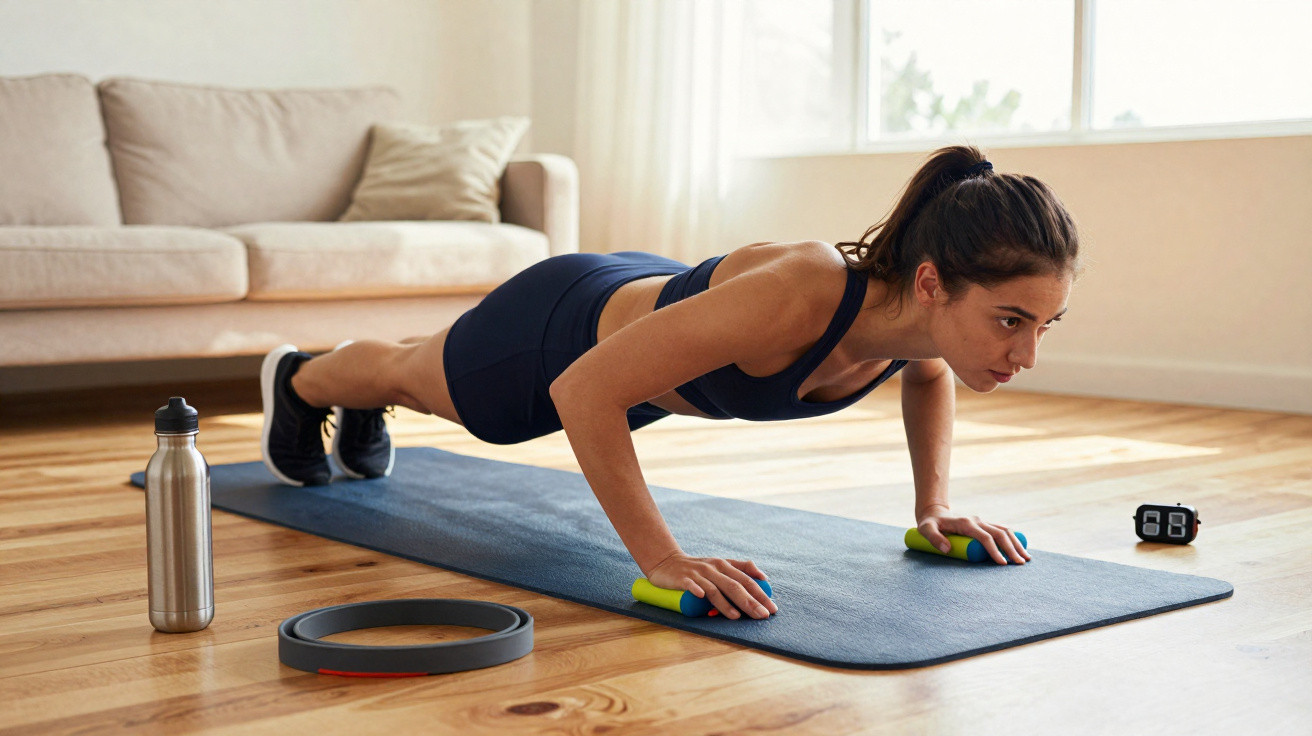
Many people want to tone their stomach but have neither the time nor the desire for a gym membership. This is precisely where an unobtrusive yet cleverly designed piece of Decathlon training equipment comes in. It promises an intensive workout for the abs and upper body without leaving home, making it ideal for anyone looking to tackle belly fat at home.
What the multifunctional push-up board offers
The focus is on the HMS DBP03 multifunctional push-up board, available from Decathlon. It is designed for anyone who wants to work specifically on their core at home. The equipment combines three features in one:
- a stable platform for planks and abdominal exercises
- sliding, colour-coded push-up handles
- a built-in counter with an optical sensor
The key feature is its counting system: an optical proximity sensor detects every downward movement and automatically adds up the repetitions. There is no longer any need to count mentally. This makes it easier to focus on correct form and to track progress clearly.
“The DBP03 turns traditional floor exercises into a structured, measurable workout – ideal for consistently targeting the abdominal area.”
At around €54, the board is positioned as a comparatively affordable alternative to a monthly gym fee, particularly when it is used regularly over several months.
How this board targets belly fat and the upper body at the same time
From an anatomical perspective, no piece of equipment can burn fat solely from the stomach. What the board can do is challenge several large muscle groups at once – which is exactly what increases energy expenditure. Anyone who trains consistently while also adjusting their diet will reduce overall body fat, including fat around the abdomen.
More than simply an “ab machine”
The DBP03 is designed to engage the whole upper body. The colour coding around the holes in the board indicates how the handles can be positioned:
- Chest: wide grip, with the hands rotated slightly outwards
- Shoulders: hands placed slightly further forward, with a narrower stance
- Triceps: handles positioned close together and near the body
- Back: staggered positions that involve the shoulder blades more strongly
At the same time, the core muscles are constantly at work. Every well-executed push-up requires the abs and lower back to act as stabilisers – precisely the areas where many people would like to become “flatter”.
“Performing push-ups on a fixed board prevents compensatory movements and forces the core to properly keep up – making the exercises significantly more effective for the midsection.”
Stability for better results
Its large, rigid base and foam pads provide a secure footing. The surface is non-slip, while the handles are foam-covered. This reduces pressure on the wrists and helps prevent hands from slipping when sweaty. This added security is particularly useful for beginners.
The solid base also makes controlled planks and dynamic variations easier. Anyone who has tried holding a plank on a slippery floor will know how much such details can matter.
How to use the Decathlon board in everyday life
Basic position for push-ups
Getting started is straightforward. A typical sequence looks like this:
- Insert the handles into the colour-marked holes according to the target muscle group.
- Grip the handles firmly, straighten the arms and position the shoulders above the hands.
- Keep the body in a straight line from head to heels, with the abs actively braced.
- Lower yourself under control until the chest approaches the board.
- Push back up without allowing the lower back to arch.
The optical counter records every downward movement and displays the number of repetitions on its screen. This provides immediate feedback and can encourage you to add another two or three repetitions.
Planks and abdominal exercises on the board
The board can be used in several ways for abdominal training:
- High plank: place the hands on the board with arms straight, brace the abs and do not let the hips sag.
- Forearm plank: rest the forearms on the surface, keep the elbows beneath the shoulders and maintain a straight body line.
- Alternating plank: push up from the forearms into a high plank, then lower back down, alternating continuously.
- Mountain climbers: from a high plank, draw the knees towards the chest one at a time.
This is where the non-slip surface shows its advantages. Hands and forearms stay firmly in place, protecting the joints and enabling more focused work through the abdominal area.
Who is this equipment really suitable for?
According to the manufacturer, the DBP03 is suitable for both beginners and more advanced users. In practice, this depends heavily on the exercise selection. Push-ups can be demanding, but they can also be adapted.
| Training level | Recommended use |
|---|---|
| Beginner | Knee push-ups, short planks (10–20 seconds), gradual progression |
| Intermediate | Full push-ups, alternating planks, longer holds, interval training |
| Very fit | Explosive push-ups, one-arm variations, combinations with additional weights |
“Anyone who has mainly been sedentary so far should increase the intensity gradually – the board offers plenty of scope for progression.”
People with shoulder or wrist problems should seek brief advice from a doctor or physiotherapist beforehand. Although the padded handles ease pressure on the wrists, poor technique can aggravate existing discomfort.
How the board can help in the fight against belly fat
Belly fat does not disappear through a single exercise; it requires a combination of physical activity and diet. The board contributes two key elements:
- More muscle work: Activating more muscle mass increases calorie expenditure, not only during training but also over the longer term through maintaining muscle mass.
- Frequent training: Since the equipment is kept at home, the barrier to doing shorter but more regular workouts is lower.
Working with the board for 15–20 minutes three to four times per week creates a sound foundation. Combined with walks, gentle endurance training and an adjusted diet, body-fat percentage can gradually fall. Visceral fat around the abdomen in particular often responds noticeably to regular exertion and lower calorie intake.
A possible 20-minute home programme
A realistic evening workout might look like this:
- 3 minutes of warm-up: arm circles, light squats and shoulder rotations.
- 3 sets of wide push-ups of 10–15 repetitions each, or the knee variation.
- 3 sets of forearm planks of 20–30 seconds each.
- 3 sets of narrow triceps push-ups of 8–12 repetitions each.
- 3 sets of mountain climbers on the board, 30 seconds each.
- 2 minutes of gently shaking out and stretching the arms and core.
The built-in counter makes it easy to see how the repetition total changes from week to week. This can be motivating and provides clear proof that the body is getting stronger – often before the difference is obvious in the mirror.
Risks, common mistakes and how to avoid them
Starting too aggressively primarily raises the risk of overloading the shoulder girdle and lower back. Common mistakes include:
- allowing the hips to sag during a plank, which strains the lumbar spine
- placing the arms too wide when strength is lacking, which irritates the shoulder joints
- holding the breath, which raises blood pressure
- doing too many repetitions in the first sessions
It is sensible to begin with a technique phase: fewer repetitions are preferable if they are performed with perfect body tension. As a rule of thumb, the set ends as soon as the hips drop or the shoulders fall forwards – the counter on the display should never matter more than your posture.
How the board can be combined with other activities
For lasting results, a combination approach is advisable: the equipment works the core and upper body, while other activities challenge the legs and cardiovascular system. Useful additions include:
- brisk walking or easy jogging
- cycling in everyday life, such as commuting or travelling to the shops
- taking the stairs instead of the lift, especially on office or home-working days
Anyone who also manages 5,000 to 8,000 steps per day and makes their meals a little lighter gives the body a clear signal to reduce fat. Within this mix, the board acts like a catalyst for the midsection.
What “abdominal girdle” really means and why it is so important
The term “abdominal girdle” does not refer only to the rectus abdominis, the muscle responsible for the visible “six-pack”. It describes an entire muscular corset:
- rectus abdominis (front centre)
- oblique abdominal muscles (side waist)
- transverse abdominal muscle (deep stabilising layer)
- muscles in the lower back
The push-up board engages this entire system. By incorporating push-ups and planks regularly, users not only improve the appearance of their stomach but also their posture, back health and day-to-day stability – from lifting a shopping basket to sitting at a desk.
For many people, the real sense of achievement will therefore be less about a flat stomach in the mirror and more about feeling stronger, steadier and more alert in their own body. The DBP03 from Decathlon provides a relatively simple entry point for this – provided it does not merely become living-room decoration but forms a regular part of the week.






Comments
No comments yet. Be the first to comment!
Leave a Comment