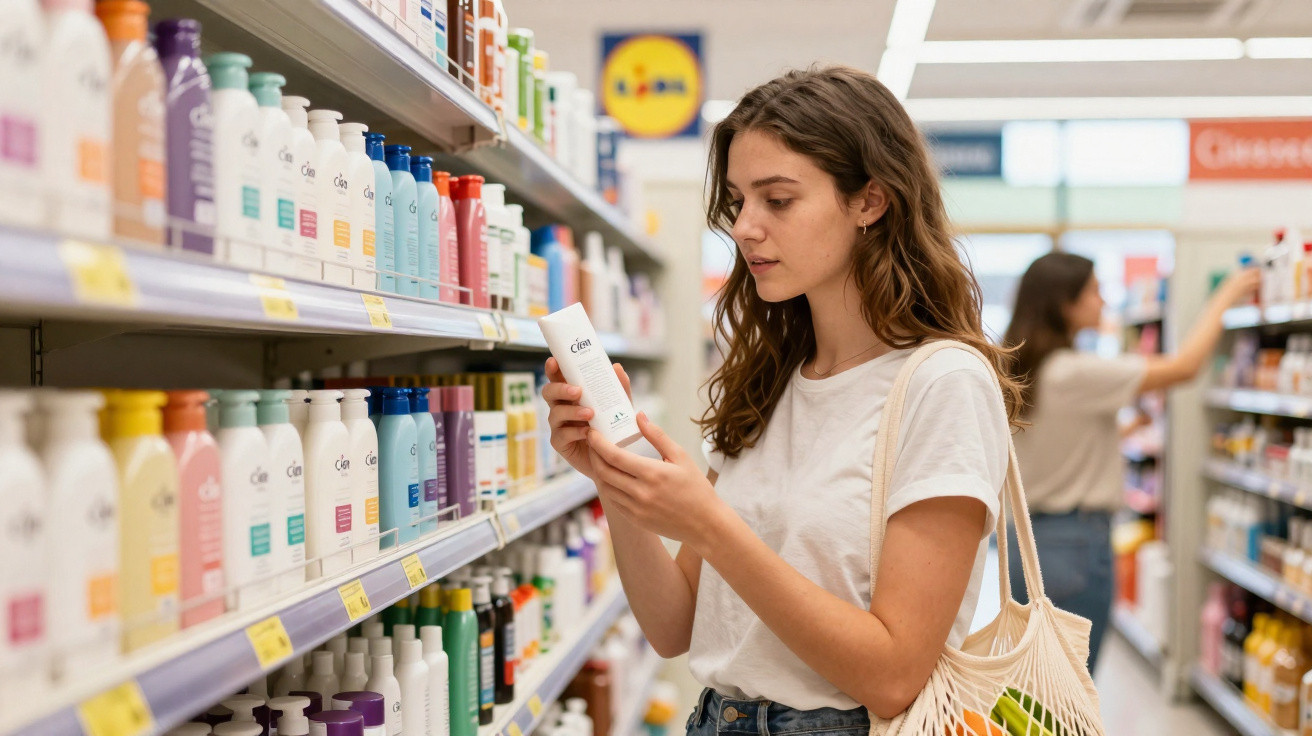
Behind these low-cost bottles lies a European manufacturer responsible for formulation, production and quality checks. This article identifies the players involved, the evidence of quality and the points to watch, helping you make purchases without losing sight of value for money.
Who is behind Cien?
Cien cosmetics do not appear from nowhere. Lidl relies on Dalli, a German family-owned company founded in 1845 in Stolberg. Dalli produces hygiene and personal-care products for major European retailers, including chains such as DM and Aldi. Its private-label expertise is built on large production volumes, well-established manufacturing lines and tightly defined specifications negotiated for every product.
This industrial set-up enables Lidl to offer an extensive Cien range comprising more than 70 products. The formulas use standardised ingredients, repeatable processes and quality controls at every stage. The aim is to keep costs consistent while delivering measurable performance, from deodorants to facial skincare.
“Cien skincare comes from a long-established manufacturer structured for mass retail, rather than an obscure workshop with no traceability.”
Quality and price: a carefully built balance
Dalli reduces costs by purchasing ingredients at scale, sharing packaging formats and streamlining production lines. Lidl then uses in-store exclusivity to protect the final price. This model is reflected in independent testing: several range deodorants, including Puro Frescor 48h and Nature Bio-Citrus, received favourable assessments in 2021, as reported by the German specialist press. These recognitions do not apply to the entire brand, but they do support particular formulas.
A low-price strategy does not mean technical standards are absent. Teams assess cream viscosity, sensory feel, stability in heat and cold, packaging compatibility and shelf life after opening. This network of tests is intended to deliver a consistent experience from one batch to another, despite strong price constraints.
What the regulations actually guarantee
The European cosmetics market is governed by strict rules. Every product falls under Regulation (EC) No 1223/2009. A “responsible person” must be named on the label. This person maintains the product information file (PIF), arranges the safety assessment with an expert, notifies the product through the CPNP portal and retains evidence supporting the claims displayed on the packaging.
Controls include microbiological testing, stability studies and safety assessments. Labels provide ingredients in INCI format, a period-after-opening (PAO) indication and, where relevant, additional logos for organic status, vegan products or recyclability. The European Union bans animal testing for finished cosmetics and their ingredients. In Europe, claims such as “not tested on animals” therefore add nothing from a regulatory perspective.
“Every Cien product placed on shelves must have a complete quality file and an identified responsible person, just like any brand sold in Europe.”
Trust, but choose carefully: the consumer’s view
Comparison services and consumer organisations stress that not every product performs equally. UFC-Que Choisir has highlighted Cien products worth watching, while others fare very well. The essential approach is to assess each individual product rather than the brand as a whole. A heavily fragranced formula or poorly rated UV filter may reduce a product’s appeal, whereas a minimalist treatment can suit reactive skin.
- Read the INCI list and identify recurring fragrance allergens, including limonene, linalool, citronellol, coumarin and geraniol.
- Compare product claims with actual use: texture, residue left on the skin, skin tolerance and all-day wear.
- Check the PAO and keep products away from heat and direct sunlight.
- Choose products that have been favourably tested by independent bodies, where this information is available.
Market impact and industrial operations
Cien reflects a major trend: the rise of retailer own brands in health and beauty. Lidl negotiates specifications with Dalli, secures shelf exclusivity and divides its offer into facial skincare, haircare, hygiene and sun care. This approach challenges national brands, which must innovate in natural credentials, packaging or sensory experience to justify higher prices. Consumers make trade-offs by pairing an affordable cream with a more technical serum, or choosing economical family sun protection alongside a targeted dermatological treatment.
Economic conditions reinforce the trend. Rising costs for raw materials and energy have led many households towards cheaper alternatives. Dalli and Lidl respond with established formulas, frequent updates and limited editions that refresh the shelves. Cien’s exclusivity at Lidl supports a volume-led policy that secures supply. It also limits the spread of product lines, allowing more concentrated quality monitoring.
“The combination of ‘expert manufacturer + retailer exclusivity’ makes it possible to maintain low prices while retaining technical safeguards.”
What to check by Cien product category
| Category | Points to check | Quality indicators |
|---|---|---|
| Deodorants | Alcohol content, fragrance allergens, aluminium salts depending on your preferences | Claimed 24–48 h effectiveness, findings from independent tests |
| Sun care | Listed UV filters, compliance with SPF, seasonal expiry date | Water resistance, frequent reapplication, texture compatible with the skin |
| Face creams | Fragrance for sensitive skin, humectant-to-emollient ratio | Glycerine, panthenol, squalane or ceramides depending on the need |
| Shampoos | Surfactants if the scalp is reactive, fragrance | Suitable pH, conditioning agents that do not feel heavy |
What Dalli manufacturing changes
An integrated manufacturer such as Dalli works with formula bases, ingredient modules and lines able to switch from shower gel to deodorant with rapid adjustments. This flexibility supports the swift launch of new variants, whether fragrance, format or texture. It also facilitates reformulation when regulations or sourcing conditions change. Lidl gains greater responsiveness in its stores, testing runs in pilot countries before wider rollout if sales follow.
Traceability nevertheless remains in place. Batch codes, responsible-person addresses, regulatory information and customer-service channels all make it possible to investigate a quality issue. Recalls are uncommon in this segment because internal protocols screen out many potential problems before products go on sale.
Practical advice for a smart beauty basket
Build a simple routine around three products: a gentle cleanser, facial moisturiser and daily sun protection. Compare price per litre or kilogram rather than looking only at the front label. If your skin reacts frequently, favour shorter formulas. Patch-test on a small area before wider use. Set aside textures that do not suit you and reuse them on the body to avoid waste.
Need a quick guide to the label? Look for the PAO symbol (6M, 12M), the ingredient order, as the first ingredients make up the greatest proportion of the formula, and fragrance allergens at the end of the list. Photograph the INCI list and compare it at home when you have time. If a product works well for you, record its batch number and purchase date to help find similar performance on your next shop.
“A retailer own brand can go hand in hand with regulated transparency, provided you read the INCI list, follow the PAO and select formulas suited to your skin.”
Useful additional information
Label terminology often causes confusion. “Hypoallergenic” does not guarantee that no reactions will occur; it means the formula is designed to reduce the risk. “Fragrance-free” is different from “odourless”: a fragrance-free product may retain the smell of its raw ingredients. “Dermatologically tested” means it has been tested on human skin, not necessarily that it performs better. When judging a product, rely on your own tolerance and on independent assessment findings where available.
Unsure whether to choose a national brand or Cien? Set one clear criterion: skin tolerance, a subtle fragrance or cost per millilitre. Try one Cien product in each key category, then expand only if the experience suits you. This method limits disappointing purchases while benefiting from the savings enabled by Dalli manufacturing and Lidl exclusivity.












Comments
No comments yet. Be the first to comment!
Leave a Comment