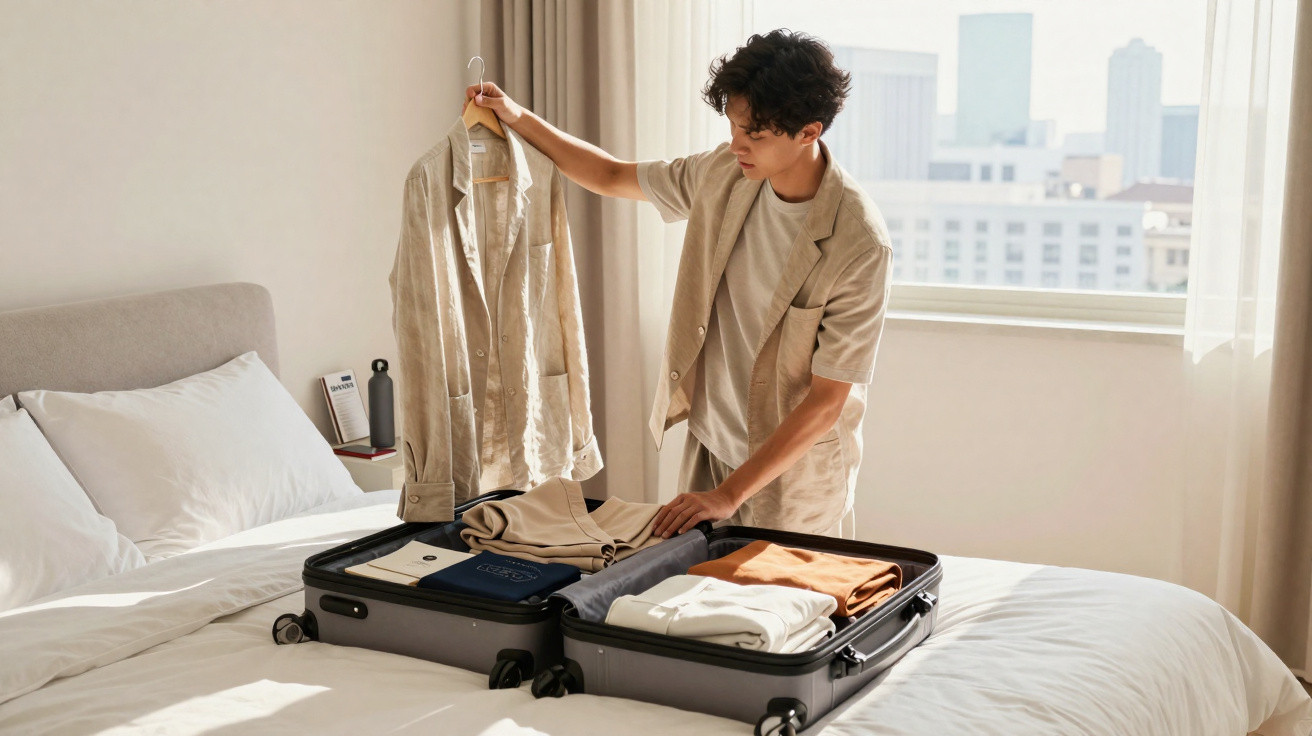
The evening before an early flight comes with a familiar soundtrack: shoes softly hitting the floor, a zip being pulled open and shut, and the resigned breath when the suitcase refuses to close. Faced with a wardrobe in chaos, you think, “I have nothing to wear”… while the bed is covered in clothes. There are shirts for “just in case”, a dress you may wear, and three jackets because the weather is impossible to predict. As the time disappears, stress builds, and the trip you had been looking forward to starts to feel like last-minute homework.
Then, at security, you spot that traveller with a small carry-on and an entirely relaxed expression. You start wondering what they have figured out that you have not.
The freedom of a smaller, smarter suitcase
Look inside the luggage of any regular traveller and a clear theme emerges: not less clothing, but better-chosen clothing. Think of a navy blazer that suits both jeans and tailored trousers; a black T-shirt that works as plane loungewear and a base layer for a client dinner; or neutral trousers that match every top in the case. It is not about achieving flawless style, but about having a low-key strategy.
When the contents of your suitcase work well together, both the literal weight and the burden of choice become lighter. There are fewer decisions to make, and mornings become easier.
Imagine two colleagues arriving for a work trip across three cities. One is hauling a checked suitcase, while the other walks away with a compact carry-on and a small backpack. At the hotel, the first spends twenty minutes weighing up clothing choices: Does this shirt match those trousers? Will these shoes hurt if we walk to dinner? The second opens their case, finds three tops, two bottoms and one blazer in a composed colour palette, and is ready before their coffee has cooled.
After ten days, the first traveller repeats items by accident because their packing was random. The second deliberately rewears outfits because each piece was selected for at least two uses. One feels slightly disorganised; the other feels unexpectedly free.
The principle is straightforward, yet it can have a surprisingly transformative effect. Once every item in your bag offers at least three outfit combinations, your wardrobe becomes less of a heap of fabric and more of a practical toolkit. You are not bringing “a shirt”; you are bringing a shirt that can be tucked into tailored trousers, worn over a swimsuit or layered beneath a jumper.
All at once, five or six pieces can create enough looks for a week. The effort put into planning at home turns into time saved on every morning of the trip. That is the understated benefit of versatility.
How to actually pick versatile pieces (without losing your mind)
Begin with one small rule: every item you take must suit at least three outfits. Test each piece while standing over your open suitcase. That white shirt could be worn with leggings on the plane, trousers for a meeting and jeans for dinner. A soft black dress works with trainers for sightseeing, under a jumper as though it were a skirt, or with earrings for an evening out. If three uses do not come to mind immediately, leave it at home.
Pick a core palette of two or three colours you genuinely enjoy wearing, then add one accent shade. You might choose black, navy, beige and white, or olive, cream, chocolate and rust. Allow the palette to do the hard work for you.
Many people fill their luggage with “fantasy” clothes: a dress for a party that may never happen, heels for a restaurant reservation that is never made, or tight jeans intended to provide motivation. These are the items that take over both your suitcase and your headspace. We have all had that moment of packing for the person we wish we were, rather than the person who will really be rushing through Terminal 2.
Pack for the trip you are actually taking: meetings, walking, weather and your genuine energy levels at 7 a.m. Ask yourself honestly, will I wear this twice? If the answer is “maybe”, then it is already a no.
“Once I forced myself to only pack clothes I’d happily wear on a random Tuesday at home, my suitcase got lighter and my trips got calmer,” says Ana, a consultant who flies twice a month. “I stopped chasing ‘perfect looks’ and focused on pieces that could survive coffee spills, long trains, and surprise dinners. That changed everything.”
- One neutral jacket or blazer suitable for both casual and smart outfits.
- Two bottoms in the same palette, such as black jeans and tailored black trousers.
- Three tops that each work with both bottoms.
- One pair of shoes comfortable enough for all-day walking, plus one slightly smarter pair.
- Lightweight accessories, including a scarf, earrings or belt, to alter the mood rather than add bulk.
Travel feels different when your clothes stop arguing with you
There is a particular sense of calm that comes from knowing every item in your suitcase will work. Whether you open your bag in a tiny Airbnb or a large hotel room, nothing feels like a random choice. Your outfits are effectively pre-approved; you simply select the one that suits the day. Morning stress fades, leaving your energy for catching the metro, locating the right conference room or seeking out the best bakery in the neighbourhood.
Versatile pieces do more than reduce the space you need. They preserve your attention, and attention is the one thing you cannot recover while travelling.
| Key point | Detail | Value for the reader |
|---|---|---|
| Build a tight colour palette | 2–3 base colours plus 1 accent so everything mixes | Quicker outfit choices, less visual chaos |
| Set a “rule of three” | Each item must work in at least three outfits | More looks with fewer pieces |
| Pack for real life, not fantasy | Choose clothes you would wear on a normal busy day | Less regret, more comfort and confidence |









Comments
No comments yet. Be the first to comment!
Leave a Comment