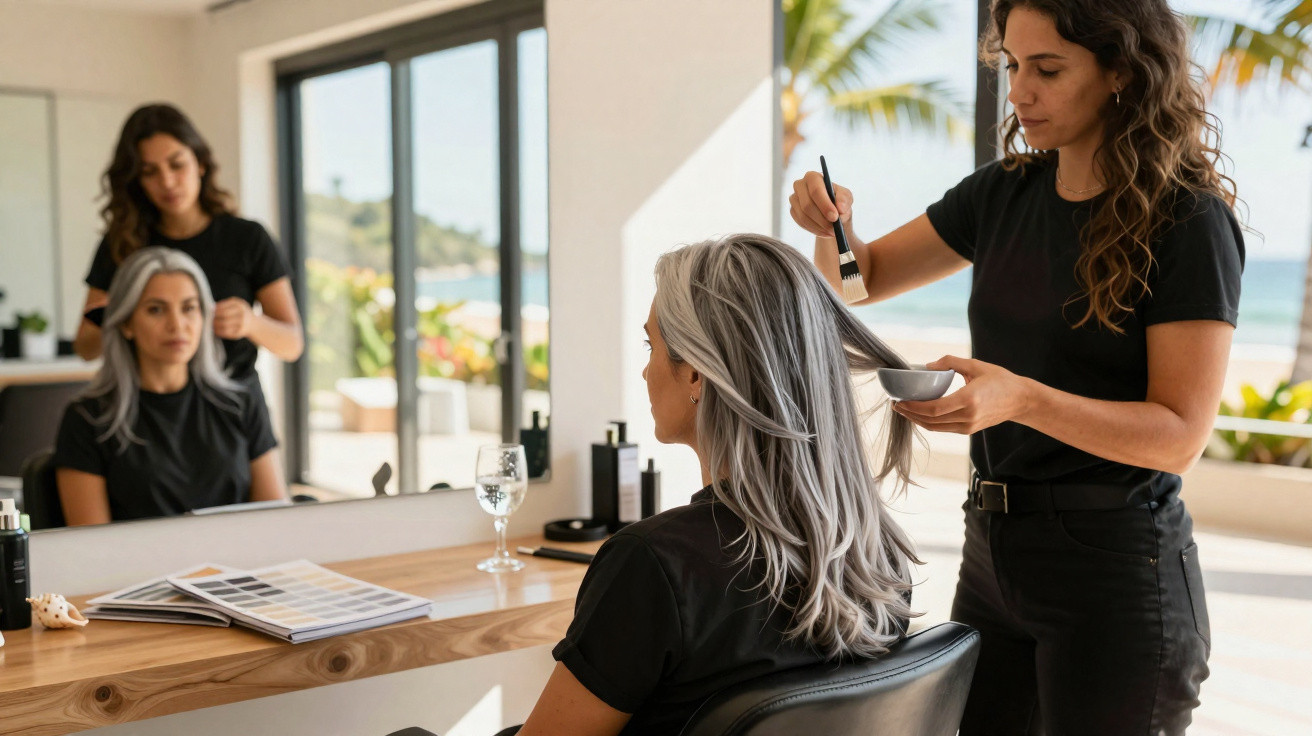
The woman facing the mirror is motionless, caught between two incarnations of herself.
A crisp silver line is emerging at her roots. Beneath it sits the solid, uniform brown of the box dye she has relied on for a decade. Her colourist stops with a small dish of clear gel in his hand rather than the familiar dense, ammonia-laden cream. “We’re not going full dye today,” he says. “We’re going to blur.”
She looks puzzled. Blur precisely what: her greys, her age, or the reality she has covered up every six weeks? In the next chair, a younger customer films her appointment, telling followers about “no-line grey coverage” and “stain technology” that, supposedly, is not even dye. The salon has less of a chemical scent and more of the fragrance of hair products from a skincare aisle.
Welcome to the latest battleground on your head.
Why classic dyes are losing ground in the fight against grey
Speak to any experienced colourist and the same understated admission emerges: grey coverage rules are being rewritten as they go. Conventional permanent dyes, which blanket each hair from root to end, now appear weighty and almost dated. Stylists discuss them much as we discuss old social-media filters: too intense, too noticeable, too 2013.
Grey hair was once treated as something to eliminate, rather than a texture to incorporate. Today, more clients arrive saying, “I don’t want to look dyed, I just don’t want this stripe.” The true issue has become that slim silver strip at the scalp, not grey hair itself. Hair specialists are therefore reaching for different approaches: transparent stains, low-alkaline gels and fine mists that feel closer to make-up than a chemistry lesson.
The aim is no longer to deny that you are going grey. It is to decide how prominently that reality should speak.
At a bustling London salon, stylist Mariah says that nearly half of her bookings once involved uncompromising, opaque root touch-ups. Many of those women are now replacing the full-dye timetable with gentler grey blending appointments. One regular client, aged 54, had coloured her hair jet black for decades. “She looked sharp,” says Mariah, “but the regrowth line was brutal. Two weeks and the silver halo was back.”
They then tested the divisive technique splitting the industry: a semi-transparent grey veil worked only through the regrowth, then feathered into the natural silver rather than completely concealing it. There was no strong developer and no saturation of the entire head. The outcome? Her hair still looked dark overall, while the greys gleamed through like intentional highlights. She wept in the chair, partly with relief and partly at the surprise of seeing her real hair incorporated rather than erased.
Those tears go a long way towards explaining why specialists remain divided about the change.
The reasoning behind this new movement is remarkably straightforward. Permanent colour was never created for subtle results. It opens the hair cuticle, drives pigment in and fixes it there. That works brilliantly for bold, durable colour, but less well for someone wanting simply to soften grey or reduce the visible difference between white roots and coloured lengths. Dense colour makes regrowth more severe, not more forgiving.
These grey veiling formulations behave more like a tinted finishing coat. Rather than overwhelming the silver, they stain the exterior of the hair shaft and sit around it, fading with greater softness. The dispute centres on the long-term implications. Some specialists caution that repeated layers of stain may still create unpredictable tones. Others believe this is finally a way to respect both the hair fibre and its wearer.
Behind the science is one uncomplicated question: are we hiding age, or editing it?
The controversial grey-cover method everyone’s whispering about
The approach that hair professionals debate behind closed doors goes by several names: grey veiling, grey blurring and shadow coverage. Its underlying idea is identical. Rather than coating every grey strand in opaque pigment, stylists apply a diluted, frequently acidic colour to tint the silver in part and reduce contrast against the natural base shade.
Picture tinting glass rather than painting a wall. Grey hair is not removed; it is filtered. A colourist generally blends a sheer formula slightly deeper than your natural tone, presses it into the regrowth and lightly combs it through the mid-lengths. It processes more quickly, has a gentler smell and is deliberately not flawless. Small flashes of brightness remain, functioning like built-in highlights.
It has that “undone” appearance that actually requires expertise to create.
Placement is the step that transforms the result. Specialists working this way do not pursue every individual white hair. They chart the head instead: the temples, parting and fine baby hairs around the hairline. Those areas receive greater focus because they catch the eye first. Other greys remain partly exposed, producing the soft, lived-in effect that people scroll past on Instagram and save almost without realising.
Let’s be honest: nobody truly does this every day at home. Stylists therefore create a routine for real life rather than fantasy. Many recommend a major reset appointment every 10–12 weeks, refreshing the veil and refining its placement. Between appointments, some clients choose tinted mousses or root powders in place of permanent colour. It is a slower and less frantic way to coexist with hair determined to change.
That slower pace is precisely what unsettles some traditional colourists, who regard any visible grey as work left incomplete.
Every scalp responds differently, which is where matters become complicated. The same mildness that makes these formulations appealing can also make their results less predictable. Grey hair may be coarse and resistant, absorbing excessive tone in one area while taking almost none in another. On fine hair, veiling can resemble a soft Instagram filter. On thick, coarse hair, it may look uneven after several washes.
There is also an emotional dimension. Practically speaking, veiling extends the gap between complete dye appointments. Personally, it means witnessing your age, history and genetics appearing in the mirror as it happens. On a day when you feel resilient, that may feel liberating. On a day when you are exhausted and running late for work, it may feel like betrayal. When your mother’s face suddenly seems visible in your own reflection, it can feel as though time itself is laughing.
This is why the issue is more than a professional technical argument. It is a quiet shift in identity, occurring one head at a time.
How to navigate the new grey-coverage trend without losing yourself
The most useful step with these newer approaches is unexpectedly low-tech: have a conversation before the colour bowl appears. Hair specialists who favour grey veiling often begin with one targeted question: “On a scale from 1 to 10, how okay are you with seeing any grey at all?” The question is not “how old do you feel” or “what’s your natural shade”, but how much visible silver you can accept on a difficult day.
From there, it makes sense to regard the first visit as a trial run. Rather than immediately veiling the whole head, many experts advise beginning only at the hairline and parting. You can then wear the result for several weeks, observe its fade and notice your own emotional reaction. Adding more depth at the next appointment is far easier than removing excessive stain after panicking at home beneath unforgiving bathroom lighting.
We have all experienced the moment when a bathroom mirror feels like an interrogation lamp.
There are familiar errors people make when using modern grey-management methods. First is the swing between extremes: moving from years of opaque box dye directly to an ultra-soft veil. The difference can be startling. Many specialists recommend a transition period using a few strategically positioned lowlights, giving your eye something recognisable to hold on to while you adapt.
The second pitfall is pursuing youth instead of balance. If your natural level is medium brown but you are holding on to almost-black dye, every new coverage technique will be challenged. The regrowth line will always be louder than the method itself. Lifting your overall colour by one or two levels straight away makes every grey strategy more accommodating.
Then comes the emotional mistake: regarding each stray silver hair as a failure. Hair experts repeatedly hear the same hushed admission, from people apologising for their roots as though they have broken a rule. This new approach to coverage works properly only if you loosen your hold on that quiet script of shame.
One Paris-based colourist expressed it bluntly:
“I’m not here to erase your age. I’m here to write it more beautifully.”
Her clients go home with printed care notes that read more like a gentle manifesto than standard aftercare guidance.
- Plan appointments around your actual life, rather than fear of the mirror.
- Pick a tone that complements your skin now, not the person you were at 25.
- Expect some grey to appear between visits: that is the design, not a mistake.
- Treat temporary tints as make-up for hair, rather than a permanent crutch.
- Revise the plan if your feelings shift; hair is chemistry, but it is also conversation.
On paper, those brief statements sound straightforward. Before an important meeting on a Tuesday morning, they may feel radical.
What this grey-coverage war really says about us
Remove the jargon and the contest between “outdated dyes” and “innovative veils” is almost painfully human. It concerns who decides how age shows on a face, and at what pace. Permanent colour in a bottle provides control, certainly, but it also brings a kind of inflexibility. These translucent stains give more flexibility, while requiring you to live with a little more truth.
For some, that is freeing: a simpler routine with fewer heavy chemicals, hair that does not announce “just dyed” every four weeks, and texture that still feels like real hair. For others, it seems incomplete, like paying for a haircut and leaving with one side longer. The divide among professionals reflects the divide between clients. Neither side is entirely wrong.
What is evident is that the former script-cover every grey as early and completely as possible-no longer dictates the rules. Younger clients deliberately try silver streaks. Older clients seek ways to grow out their natural white without enduring the painful zebra stage. Between these positions lies this contentious middle ground, where stains, veils and tints quietly soften the line separating coloured hair from natural hair.
Perhaps that is the point. The real conflict is not between traditional dye and new technology. It is between the fantasy of remaining 34 forever and the gentler risk of looking like yourself at every age. That is harder to sell than a “no-grey in 20 minutes” box. It is also more honest.
| Key point | Detail | Why it matters to the reader |
|---|---|---|
| The end of opaque dye at all costs | Specialists consider conventional permanent colours too inflexible for modern grey regrowth | Better understand why your previous colour habits may suddenly feel outdated |
| The rise of “grey veiling” techniques | New translucent formulas tint white hair rather than masking it completely | Discover a gentler option for managing the transition without a harsh demarcation line |
| The emotional issue behind the technique | Choosing to cover, veil or embrace grey affects identity, confidence and everyday pace | Helps you select a method that respects your mood as much as your hair fibre |











Comments
No comments yet. Be the first to comment!
Leave a Comment