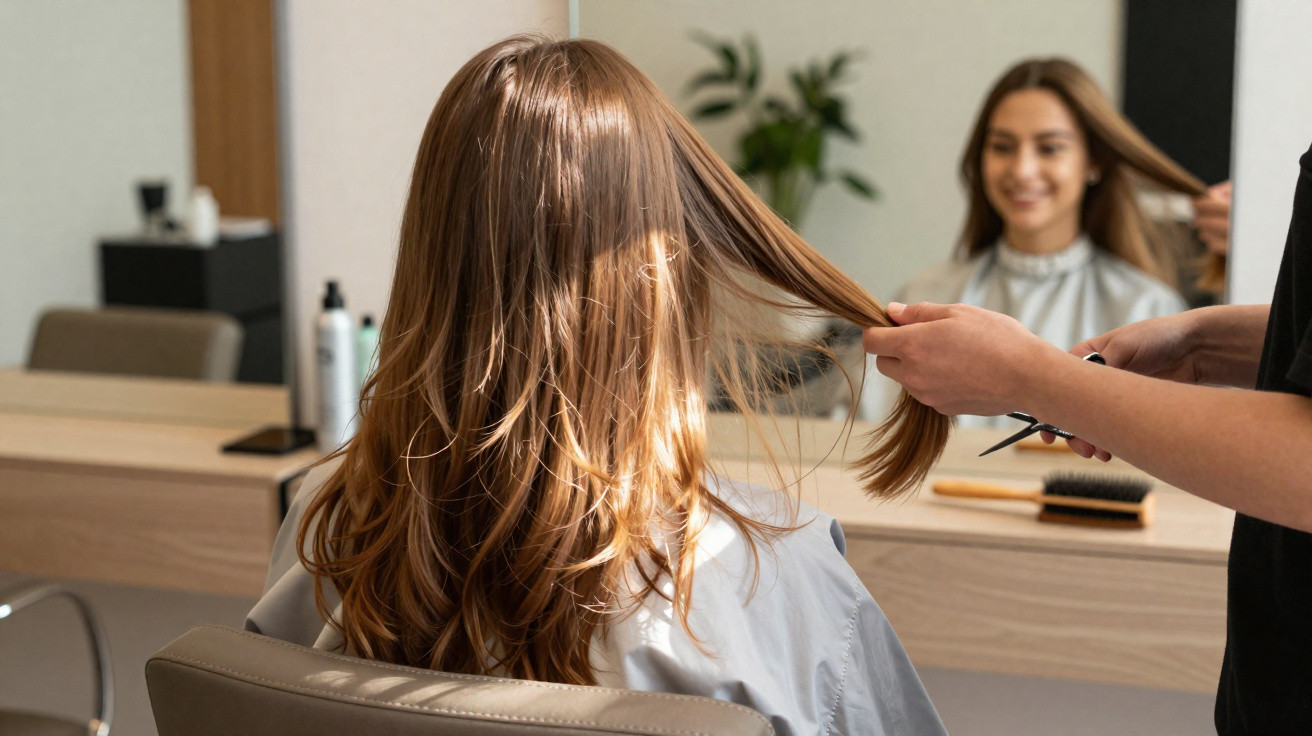
Her hair is long and glossy, yet it lies flat against her head. “If we cut layers, it’ll look fuller, right?” she asks, already preparing herself for the reply she has heard countless times: more layers means less length.
The stylist standing behind her smiles, clips up a section at the crown and begins discussing another option. Invisible layers. No blunt, choppy tiers and no obvious 1990s “Rachel” effect. Instead, there is a discreet inner structure beneath the surface, designed to give fine hair a little more lift without sacrificing those valued inches.
Ten minutes later, her hair appears thicker, lighter and almost springy, while the ends still fall to the middle of her back.
Nobody else in the salon can quite work out how the transformation happened.
Why invisible layers are the salon secret everyone is discussing
Invisible layers are an understated kind of haircut. They are barely visible in photographs, but their effect is immediate: hair gains lift and movement, rather than sticking to the scalp like a damp curtain.
Stylists often describe the approach as creating “air pockets” in the hair instead of cutting visible levels. The upper layer remains nearly one length, smooth and polished. Beneath it, concealed shorter sections support the longer lengths, providing fine strands with a little internal framework.
Out and about, it simply looks as though you were born with naturally thick hair.
A London stylist told me about a client who visited after a break-up, holding Pinterest images of thick, wavy hair that looked nothing like her own exceptionally fine, straight strands. She would not give up her length; it had become her comfort blanket.
They had tried blow-dries, curling irons and volumising foams. The effect lasted for one evening, but by morning gravity had won again. Then he proposed a small adjustment: invisible internal layers rather than a clearly layered cut.
They devoted most of the appointment to cutting within the shape rather than around its outer edge. By the end, her hair still fell beyond her shoulders, yet it had gained a soft lift away from her face. “It looks like my hair,” she said, staring at the mirror, “just… not depressed.”
In theory, this technique is straightforward. Instead of removing substantial sections from the outer silhouette, the stylist works on the inside of the hair, generally from the mid-lengths to just beneath the crown.
They separate small sections, lift them and take away weight internally using point cutting, slide cutting or thinning scissors - always with a very gentle touch. The perimeter, that prized outer line which makes hair appear long, is retained intact or almost intact.
The principle is simple: fine hair falls flat when it is overly heavy and uniform. Redistributing its weight without cutting into the outline creates movement and lift, while preserving the appearance of fullness through the ends.
How stylists cut invisible layers and what to request
Invisible layers are often created on dry or nearly dry hair. Many stylists prefer to observe how fine hair falls naturally before using their scissors. They section the hair according to how the client normally wears it, then work through vertical or diagonal panels.
Next, they raise the sections slightly and cut into the interior, without beginning too near the roots. The aim is gentle weight removal, not short pieces that stick out. With very fine hair, they may take away only one or two millimetres at a time.
If you are in the salon chair, one useful phrase is: “I want invisible, internal layers for volume, but I don’t want to see obvious steps in my hair.”
Most people with fine hair struggle to trust scissors and, frankly, that caution is justified. One overly enthusiastic “volumising” cut can leave you with stringy ends and an unavoidable ponytail until everything grows back.
Invisible layers are most effective when they are subtle and customised. With ultra-fine, low-density hair, a stylist will probably leave the perimeter almost blunt, adding only a few understated hidden layers around the crown and through the mid-lengths.
A frequent mistake? Requesting invisible layers while showing inspiration images with heavily layered hair. Another is excessive texturising with thinning shears, which can damage strands that are already delicate. Let’s be honest: nobody really creates that perfect, lengthy round-brush blow-dry every day. The cut needs to work even when you only do the minimum.
One Paris-based stylist put it this way with a shrug and a smile:
“Fine hair doesn’t need more product, it needs smarter architecture. Invisible layers are like putting support beams inside a house instead of hanging everything from the ceiling.”
This is why many professionals combine this haircut with very simple styling. Apply a lightweight mousse at the roots, roughly dry it with your head upside down and, perhaps, use a round brush only for the final touch. The cut itself does 70% of the work.
- Request internal or invisible layers rather than “lots of layers”
- Show images where hair looks full at the ends instead of wispy
- Maintain a strong perimeter if your hair is fine or thinning
- Take it slowly: small trims every 8–10 weeks are better than one dramatic cut
- Combine the cut with gentle volumising habits, not aggressive backcombing
Living with invisible layers: styling, confidence and the feeling of thicker hair
Invisible layers do not demand attention on the first day. Their real benefit quietly becomes clear around three days later, when you are hurrying out, your hair is only half dry, time is short, and you catch your reflection in a shop window.
Your hair is no longer stuck flat against your temples. It curves. It rises slightly at the crown. A quick run-through with your fingers restores its shape, rather than letting it collapse as it normally would. On a difficult day, that can feel more significant than it sounds.
Emotionally, this haircut touches on something deeply familiar. We have all experienced that moment of looking at ourselves in the lift, exhausted, only to find that flat hair makes us appear even more drained.
Invisible layers will not solve everything, but they can alter the message your hair sends. Long hair no longer has to mean heavy, limp and lifeless. It can stay long while looking light, as though it is holding a hidden pocket of air.
People start touching and styling their hair again instead of concealing it. They wear it down on an ordinary Tuesday, rather than saving it for perfect weather or days when they have extra time. There is also something unexpectedly liberating about having a “fancy” haircut that does not demand a 20-minute routine every morning.
That is the real appeal: a smart, nearly undetectable technique that quietly makes fine hair behave as if it belongs to an entirely different category.
| Key point | Detail | Benefit for the reader |
|---|---|---|
| Invisible layers = internal architecture | Weight is removed from inside the hair rather than from its outline | Gain volume and movement without losing precious length |
| The perimeter remains strong | Ends stay blunt or softly full rather than wispy | Hair continues to look long, healthy and “thick” at the bottom |
| The cut handles most of the styling | Delicate internal layers help hair lift and fall more effectively | Less dependence on daily heat styling and heavy products |














Comments
No comments yet. Be the first to comment!
Leave a Comment