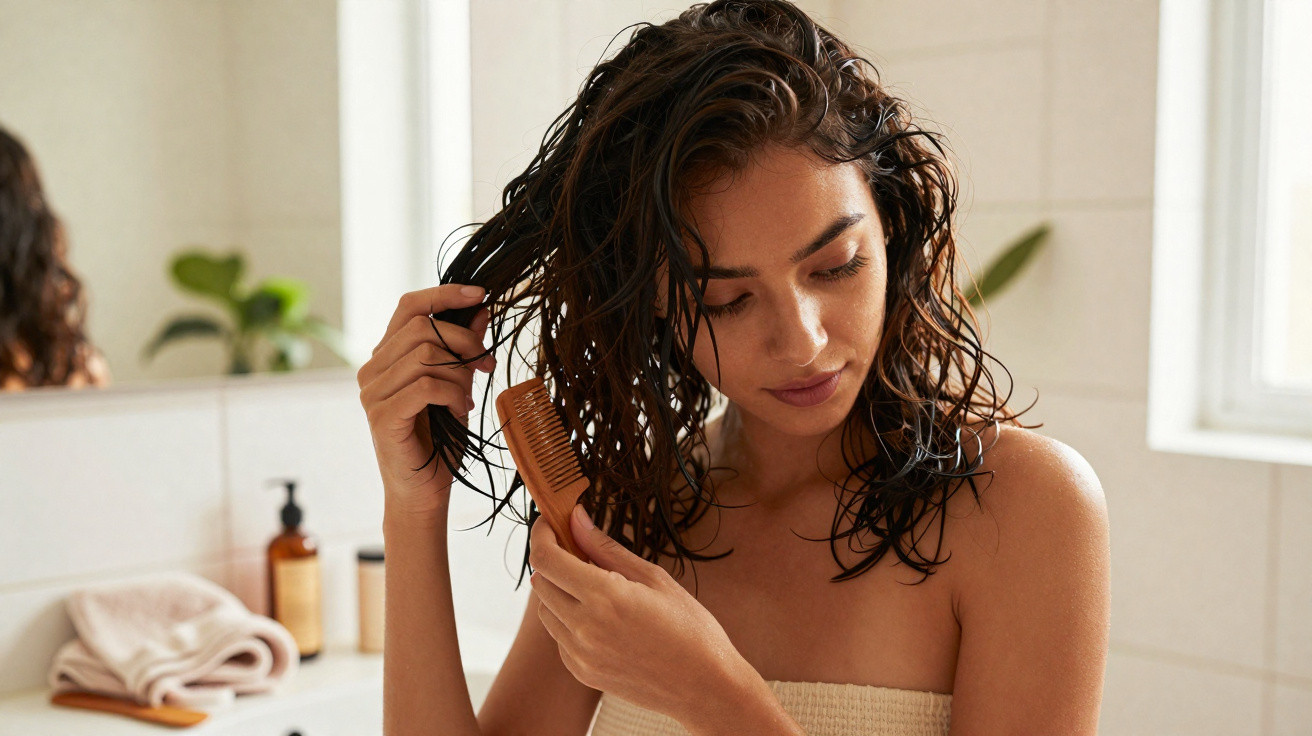
With a towel draped over her shoulders and her phone in one hand, she pulls a glossy plastic comb through her soaking hair with the other. Steam fills the bathroom and the mirror is partly misted over, yet one sound is unmistakable: the soft, rubbery snap of hair pulled too tightly.
She flinches, flicks several broken hairs from the comb’s teeth and carries on. “My hair’s everywhere lately,” she says, combing more forcefully so she can finish before work. Hormones, stress, the weather and even her pillowcase get the blame. Anything except this small everyday habit.
But what if the real culprit is not your shampoo, age or genes, but the unnoticed damage caused whenever a conventional plastic comb is pulled through wet hair?
What happens when you brush wet hair
Immediately after a shower, hair can feel soft, weighty and almost stretchy. It may appear stronger because it sits flat, smooth and coated in water and conditioner. In reality, it is more vulnerable. Water makes each strand swell, while the cuticle lifts slightly, like roof tiles in a storm. The hair shaft’s natural internal bonds are also temporarily weakened.
Now imagine pulling a stiff, inexpensive plastic comb with close-set sharp teeth through it. Every pass works like a miniature crowbar against a delicate structure. The hair stretches beyond normal levels before reaching the point at which it breaks. Some strands snap outright; others suffer microscopic weakening. You may not spot the consequences immediately, but the hairs in your brush and shower drain are already evidence of it.
Most of us know someone who suddenly insists their hair has “gotten thinner” in photographs over the past two years. Usually, they blame everything except their rushed daily routine of combing just after showering.
At a London salon, a stylist began gathering the hair shed by regular clients during appointments over the course of a year. A clear trend emerged: clients who arrived with wet hair that had been pulled through with a hard plastic comb had considerably more broken fragments than naturally shed full-length hairs. Some strands were short and ended bluntly, clear signs of mechanical breakage rather than normal shedding from the root.
One client in her late 30s, with long brown hair, believed she was “losing” it. Her ponytail seemed less substantial and her ends appeared translucent in pictures. The stylist asked her to alter a single practice: stop combing dripping-wet hair with her old plastic comb. Four months later, the salon bin showed a very different pattern. There were fewer broken lengths, less “hair dust” around the chair and a ponytail that felt properly full in her hand again.
The science is not glamorous, but it is straightforward. Hair consists of keratin held together by several types of bonds, and water temporarily weakens some of them. When saturated, strands may stretch by up to 30% of their length. Apply too much force with a rigid tool and the damage becomes irreversible.
These small “snaps” do not create bald patches overnight. Instead, they contribute to slow, long-term thinning. You may see reduced density through the mid-lengths, increasingly ragged ends and short broken hairs that never achieve your intended length. A standard plastic comb with tight, unyielding teeth cannot flex or soften when it meets resistance. It pushes straight through, effectively becoming a tiny guillotine for fragile wet hair.
After months or years, your hair is sending a simple message: it is not falling out; it is breaking off.
How to handle wet hair if you want to keep it
The best time to deal with tangles is not while your hair is dripping wet. Wait until it is damp rather than saturated, with conditioner or leave-in product providing some slip. First, carefully squeeze away excess water using a soft towel or an old cotton T-shirt, pressing the fabric against the hair rather than rubbing it. This one change significantly reduces friction.
Rather than reaching for an old rigid plastic comb, choose a tool with wider, smoother and more accommodating teeth. This could be a wide-tooth comb with rounded ends, a flexible detangling brush or even a wooden comb that glides instead of scratching. Work in small sections from the ends upwards, and stop whenever you encounter resistance rather than forcing the tool through.
Approach it less as “brushing your hair” and more as carefully loosening a fine knot in your favourite necklace.
When they are in a rush, many people pull a comb angrily from root to tip in one movement. This is where cumulative damage builds without being noticed. Naturally fine, bleached and curly hair is particularly susceptible because its structure is already more delicate. However, even those with thick, supposedly “strong” hair can eventually find their length stops progressing or that their ends always look thin and straggly.
Let’s be honest: nobody manages this as a flawless daily ritual. Life gets in the way. You might sleep with wet hair, tug at a knot or share a comb at the gym. Perfection is not the aim. The aim is to stop repeating the most damaging habits so frequently that your hair has no opportunity to recover.
If you change just one habit, make it this: stop automatically tearing through wet tangles with a stiff, narrow plastic comb.
Hair specialists have quietly shared this advice for years, often as casual remarks beside the salon basin. One trichologist I spoke to put it bluntly:
“People come in convinced they’re going bald. Half the time, what I see under the microscope is not shedding from the root, but hundreds of snapped, mid-length hairs from rough handling on wet hair.”
A straightforward, almost unexciting checklist can transform the way your hair behaves over the coming decade:
- Comb hair only when it is damp, rather than soaking wet.
- Choose a wide-tooth or flexible detangling tool instead of a rigid, narrow plastic comb.
- Begin at the ends, then move upwards through sections.
- Create slip with conditioner, leave-in product or a light detangling spray.
- Stop at knots and loosen them with your fingers rather than using brute force.
It may not seem glamorous, but it discreetly safeguards your future ponytail, your volume and the satisfaction of seeing genuinely thick-looking hair in back-camera photographs.
Rethinking normal hair habits before it is too late
Many people experience a strange realisation in their 30s or 40s. Looking at older pictures, they notice their hair once looked… different. It is not merely the hairstyle, but the density. The ends were fuller, the outline around the temples was softer and the overall shape seemed more generous. Ageing, hormones and genetics clearly all have an effect, but so do the small daily sources of friction that are often considered harmless.
Using a rigid plastic comb on soaking-wet hair is one of those small, easily forgotten actions that quietly accumulates. You do not count every strand that breaks. You simply see the bin fill more quickly, the drain block more often and the hair tie require an additional turn. Long-term thinning is not always caused by sudden shedding; it can result from persistent breakage that receives little attention until it becomes plainly visible.
Perhaps it is time to view that old plastic comb as you would the worn T-shirt you sleep in but would never wear outside. It is familiar and, in its own way, comforting. Yet it would not be your choice if you knew it was gradually taking away the length and fullness you are trying so hard to preserve.
| Key point | Detail | Why it matters to the reader |
|---|---|---|
| Wet hair is structurally weaker | Water causes the hair shaft to swell and loosens internal bonds, leaving strands more likely to stretch and break. | This explains why post-shower routines, rather than genetics alone, can influence thinning and breakage. |
| Rigid plastic combs increase breakage | Narrow, inflexible teeth push through tangles and cause strands to snap at the mid-lengths and ends. | It identifies a specific cause that readers can easily replace or stop using. |
| Gentle detangling protects long-term density | Using wide-tooth or flexible tools on damp hair and starting at the ends limits mechanical damage. | It provides a clear, manageable routine adjustment that helps retain thickness and length over time. |














Comments
No comments yet. Be the first to comment!
Leave a Comment