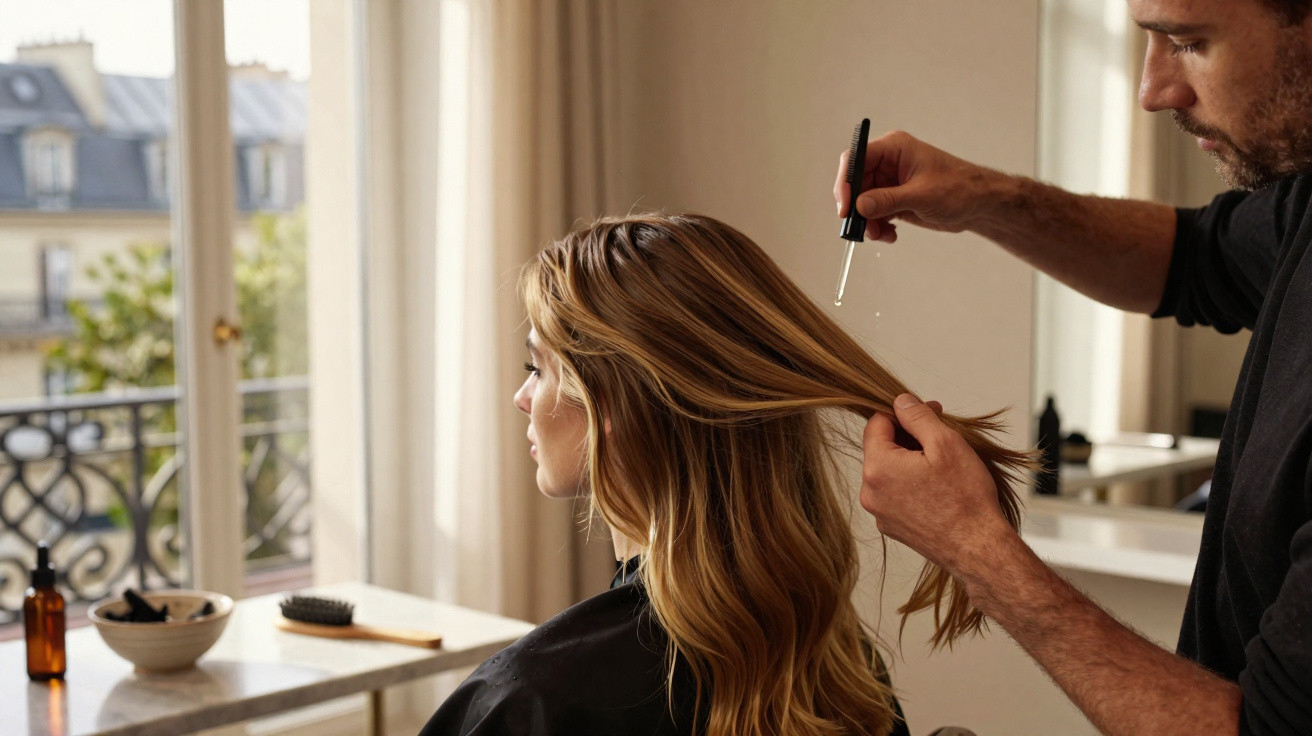
On a grey Thursday in Paris, in the pause between two downpours, the door of a salon on rue de Courcelles swings open. A young woman enters, gripping her umbrella as though it were a lifeline. Her roots are darker than she recalls, and her last highlights were “just before summer”. It is February. She looks from the mirror to the booking diary on reception, her expression carrying the question so many clients arrive with: “Do I really have to come back this often?”
Stéphane Macquaire, standing behind the chair, smiles. He has witnessed it countless times: the guilt, the cost, the lack of time, and the quiet wish that appointments could be further apart without hair becoming yellow or visibly striped.
It can be done.
The Paris colourist who dislikes “striped hair”
Viewed from the street, Stéphane’s salon does not advertise luxury. There is no neon sign or gold armchair, only wide windows, soft light, and the steady background sound of hairdryers and Parisian conversation. Yet one principle shapes everything inside: colour that wears well over time. It should not merely look attractive as you leave, but still work at week six, week eight and week twelve.
He has particular sympathy for professional women arriving between meetings, with a laptop still open in their bag. Once seated, they admit: “I can’t keep coming every six weeks, I just can’t.” Rather than reacting with irritation, he adjusts the chair, examines the hairline and asks about their habits. He then rethinks the approach. The reality is that making highlight appointments less frequent begins well before the following visit. It begins when you explain what everyday life actually looks like.
Consider Léa, a 36-year-old communications manager from the 9th arrondissement. At her first appointment, her hair told three separate stories: white roots, orange mid-lengths and platinum ends. She had visited three salons in a year, each with a different method, promise and no continuity at all. She believed that her “hair grows too fast”. Stéphane disagreed.
Instead of full-head highlights, he gave her a gentle balayage concentrated around the face and across the top layer. He used fewer foils, created more tonal variation and kept the colour slightly deeper at the roots. After two hours, she said: “I don’t even see where my natural color starts.” She did not feel the need to return for four months. She came back because she wanted to, not because she felt embarrassed. Those four panic-free months were not magic; they were the result of careful construction.
The reasoning becomes clear beneath the salon lights. Highlights requiring attention every six weeks are often overly light, uniform or contrasting. The eye catches the “line” where natural hair begins, and after a month that line can feel impossible to ignore. If the colour is blended into shade, the roots are softly melted and the chosen tone is only one or two levels lighter than the base, the line fades away. Rather than a harsh border, there is a gradient.
Leaving longer between appointments does not mean putting up with unattractive roots for longer; it means creating colour that remains beautiful for longer. This is where Stéphane acts as a strategist as well as a colourist. Less can achieve more, and softness can be more powerful. The true luxury is not the exact blonde shade, but an appointment rhythm that fits your life.
Highlights and appointments: small adjustments and everyday rituals
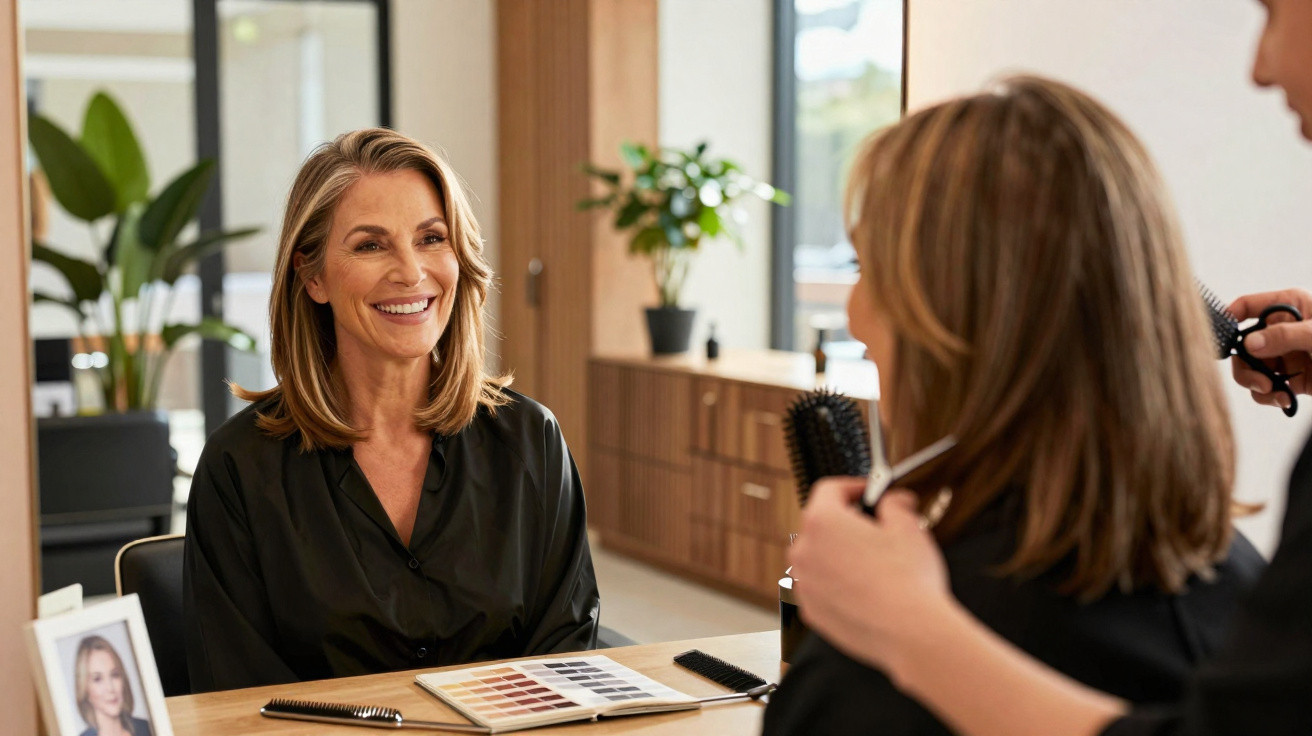
His process starts at the initial consultation. Stéphane asks every client the same direct question: “Honestly, how often can you realistically come back?” For some, the answer is every eight weeks; for others, it is every six months. The technique follows from that answer. He may add a root shadow for clients hoping to wait longer, position fewer foils slightly away from the scalp, or select warmer, more forgiving shades for anyone unable to pay for monthly toners.
He also assesses the way each person’s hair behaves. With fine, delicate hair, he uses lighter and more diffused highlights so regrowth attracts less attention. For thick hair, he works with depth and allows natural colour to remain visible between the foils. It resembles landscaping: untouched natural areas help the overall effect mature gracefully. Ten minutes of this planning can readily provide an extra four to six peaceful weeks between appointments.
Then there is the subject people would rather avoid: at-home care. Parisian hard water, overheated flats and daily blow-drying all gradually undermine colour. Yellow tones develop sooner and shine fades. Without care, the very same highlights can appear “old” after four weeks. With a minimal routine, they can remain “fresh” for twice as long.
In truth, almost nobody follows an ideal routine every day. A mask left on for ten minutes and a cool rinse belong to Pinterest life. Everyday life is washing your hair at midnight because you have a meeting at nine. Stéphane therefore keeps it simple: one quality sulphate-free shampoo, one nourishing mask each week and one purple or blue shampoo every 10–15 days, no more. There is no lecture and no blame, only small habits that protect the time between salon visits.
When he explains this, he sounds less like he is issuing instructions and more like someone familiar with rushed mornings.
“Women are exhausted,” he says quietly. “I don’t want hair that demands a personal assistant. I want hair that forgives you when you skip a treatment. So I build that forgiveness into the color.”
He regularly writes a “survival kit” on an ordinary piece of paper before slipping it into the client’s bag:
- One gentle, colour-safe shampoo to slow fading
- One nourishing mask, for 5 minutes once a week, no more
- One mild purple shampoo every 10–15 days to cool brassiness
- Heat protection before using any hairdryer or straightener
- A salon toner every 8–10 weeks for anyone who prefers ultra-cool blondes
Nothing excessive, and nothing that demands an entirely new bathroom shelf. It is simply enough to make highlights last another month or two, without making your shower feel like a laboratory.
Living comfortably with gradually changing hair
What you take away from Stéphane’s chair is not only the colour, but an unfamiliar kind of permission: the acceptance that hair can pass through “in-between” stages without making you look untidy or careless. During the first week, it is exceptionally glossy. By week four, it is softer and more lived-in. At week eight, it can resemble naturally sun-kissed strands. It is generally only around week twelve that you begin to think: “Okay, it’s time.”
There is a subtle freedom in that. Regrowth no longer controls your diary. You stop arranging emergency appointments “because of a dinner” or an unexpected meeting. On days when it seems slightly flat, you learn to wear it in a low bun, experiment with partings and accept that, on certain mornings, the mirror will not reflect precisely the same person seen under salon lighting. That is perfectly fine.
For many of Stéphane’s regular clients, the key is not a miracle product or a colourist’s skill alone. It is bringing expectations into line with reality. Hair grows, colour evolves, and life does not stop for highlights. Once that is understood, extending the gap between appointments becomes a strategy rather than a sacrifice. You select a rhythm that respects your budget, energy and time, and choose a colourist who hears your limitations before recommending a technique. Everything else comes down to nuance and patience - two qualities which, in Paris, often age better than an overly bright blonde.
| Key point | Detail | Value for the reader |
|---|---|---|
| Match technique to your rhythm | Balayage, root shadow and softer contrast for clients who visit less often | Fewer “urgent” appointments and colour that grows out gracefully |
| Keep home care simple | Gentle shampoo, a weekly mask, occasional purple shampoo and heat protection | Highlights remain glossy and fresh for longer, with less brassiness and greater control |
| Embrace the in-between stage | Colour created to look attractive at 4, 8 and 12 weeks, rather than only on day one | Less anxiety about roots and more freedom with your diary and budget |














Comments
No comments yet. Be the first to comment!
Leave a Comment