
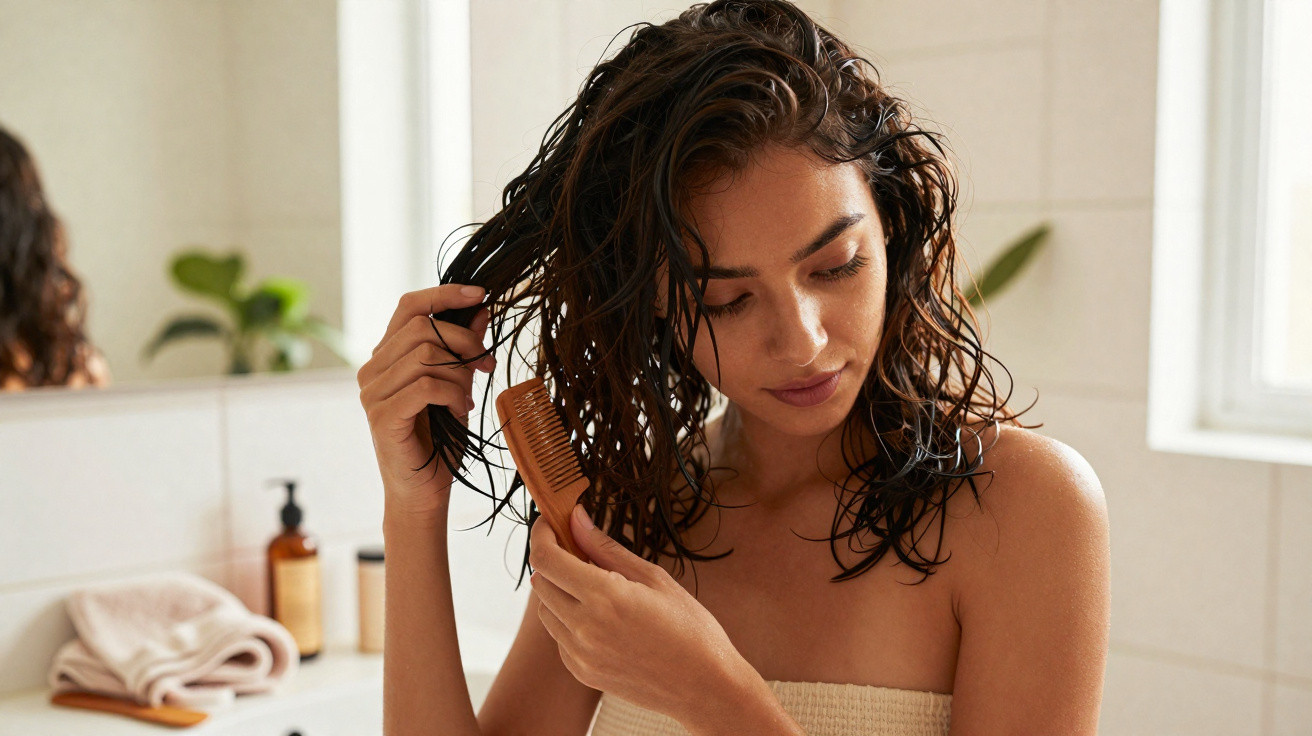
On a Tuesday evening that already has the drained feeling of Thursday, Léa sits on her sofa, scrolling with a towel around her damp hair.
Her feed has become a stream of gleaming scalps and slow-motion hair flicks, each one advertising “scalp spa at home” transformations that claim to take limp, exhausted hair to Disney-princess fullness in 30 days.
She sees a creator drip peppermint oil along her parting, run a gold-plated massager over her scalp and murmur about “activating follicles” with the same hushed conviction others reserve for manifesting wealth.
Without hesitation, Léa puts a €49 scalp brush in her basket.
For a moment, she pictures herself six months later: a new job, renewed confidence and thick hair falling across her shoulders.
Then the advert moves on. Another woman strokes her roots as though making a promise.
Something about it does not sit right.
It feels very wrong.
When “self-care” begins to resemble a monthly subscription trap
The scalp spa at home trend did not appear out of nowhere.
It quietly entered our bathrooms via TikTok, Instagram Reels and carefully curated “Sunday reset” vlogs.
Initially, it seems innocent enough: a calming brush, a fresh mint serum and a brief massage ritual.
It is presented as a way to take back a little time for yourself in a world where your manager still messages at 9:42 p.m.
But then the wording changes.
You are no longer simply looking after your scalp; you are supposedly “healing trauma stored in your roots” or “reversing years of damage”.
All at once, shampoo is not merely there to wash your hair.
It becomes a supporting character in the story of your self-worth.
The figures tell a similar story.
Market analysts put the worldwide hair-loss treatment market at billions of dollars, with women increasingly targeted through broad labels such as “density” and “volume health”.
On social media, a single viral scalp spa routine can attract hundreds of thousands of views.
Beneath every video sits a shopping list: exfoliating scrub, pre-wash oil, detox shampoo, micro-needling roller, peptide serum, silk towel and hair-growth gummies.
A 21-year-old student in Lyon told me that, over three months, she had spent almost half her monthly rent on these products while pursuing baby hairs that never appeared.
She laughed as she said it, before falling silent.
In that pause, you could hear both hope and shame.
At first, the reasoning behind the trend sounds almost scientific.
Scalp massage may improve blood circulation.
Exfoliating can clear away sebum and product build-up.
That is how the promise takes hold: through a partial truth.
If circulation is beneficial, more blood reaches the follicles; if follicles are content, hair should grow wildly.
Brands pull that idea as far as possible, packing it with pseudo-medical language and flawlessly filtered before-and-after images.
Dermatologists keep making the same point: a clean, balanced scalp can indeed help hair function as it should.
But genetics, hormones and ongoing stress cannot be solved with a fragranced scrub.
The industry understands this perfectly well.
Desperation, however, sells more products than realism.
The boundary between gentle care and obsessive scalp rituals
There is a genuinely caring form of scalp care.
Think of it as dental hygiene for your hair: straightforward, regular and reliably unexciting.
That can mean washing when your scalp is greasy, rather than when an influencer instructs you to.
It can mean choosing a shampoo that does not burn, itch or leave you wanting to scratch.
It may also involve spending two or three minutes in the shower massaging with your fingertips, rather than your nails.
If your scalp is prone to flakes, a mild exfoliating lotion used once a week may be useful.
It does not mean a harsh, grainy scrub that feels like sandpaper, or seven different “detox” products piled on top of one another.
Your scalp is skin, not a kitchen floor that needs scouring.
Most women I have spoken to about hair loss are not taken in by marketing buzzwords.
They are simply worn out.
Worn out by finding more hair in the plughole.
Worn out by noticing their parting widen in photographs.
So they layer products as if they were armour.
Oil over serum over tonic, followed by panic when their roots become greasy and their skin begins to itch.
Some scrub so forcefully with “stimulating brushes” that they irritate their scalp, which may actually make shedding seem worse.
Then guilt starts to take hold.
If their hair is not growing, perhaps they are not trying hard enough.
Not consistent enough, not disciplined enough, not “high-maintenance” in the way modern beauty culture praises.
The straightforward reality is this: most home scalp spa routines make vastly exaggerated claims about hair growth.
Massage feels pleasant.
It may relax muscles and briefly create a sense of control.
Yet the major factors in hair health remain decidedly unglamorous: a balanced diet, iron and vitamin levels assessed by a doctor, stress management, and treatment for real conditions such as androgenetic alopecia or thyroid problems.
No viral rosemary oil can overrule a hormonal imbalance.
One dermatologist I spoke to was blunt:
“The trend worries me because it shifts responsibility from medicine to cosmetics. Women blame themselves for not buying the right serum instead of asking for a proper diagnosis.”
A more useful approach is to reframe the question entirely.
Rather than asking, “What else can I buy?”, ask, “What can I simplify?”.
- Stick to a basic, gentle shampoo that does not cause irritation.
- Introduce one treatment at a time rather than five, then observe your scalp’s response for several weeks.
- Avoid frequent physical exfoliation or micro-needling unless a professional has recommended it.
- Record changes with photographs taken in the same lighting once a month, not daily.
- If shedding is sudden or severe, spend your money on a medical appointment before buying more products.
Reclaiming your head from the business of insecurity
Beneath the shimmering packaging, the scalp spa craze touches a sensitive truth.
Hair is bound up with identity.
For many women, it is linked to femininity, desirability and even professional credibility.
Losing it, or merely worrying that you might, can feel like failing at a part you never chose to play.
Algorithms understand that.
They notice how long you linger over a video on “thin hair hacks”, then show you twice as many overnight-growth miracles.
Each clip suggests that your body is a problem waiting to be fixed with a basket full of products.
We have all had that moment: staring at ourselves after a shower and counting the hairs caught in the brush as if they were a judgement.
That is precisely where marketing forces its way in.
Into the small, exhausted fracture in your confidence.
There is another route, though it is less photogenic and therefore rarely becomes a trend.
It looks like a woman arriving at a dermatologist’s surgery with a page of notes, rather than entering a beauty shop with a list of discount codes.
It means deciding that hair which is “good enough” is, in fact, enough.
It means accepting that some thinning after childbirth, during intense stress or with age is normal, rather than a scandal that must be erased.
It can mean arranging one scalp check, then using the rest of your budget for things that bring genuine pleasure instead of constant self-monitoring.
Let us be honest: despite what aesthetic “daily routine” videos suggest, nobody really does this every single day.
Most people choose what works in real life, between work, children, washing, and the need to lie on the sofa and do nothing for a while.
Step back slightly and the picture becomes clearer.
It is a multi-billion-dollar industry offering answers to a problem it quietly intensifies with every anxious video.
The answer is not to stop caring, nor to give up every bathroom ritual altogether.
It is to renegotiate the arrangement.
Whenever a miracle bottle appears on your screen, ask: “Is this about my scalp, or about my fear?”
Some readers will continue their Sunday-night scalp massages because they enjoy the calm.
Others will discard three-quarters of their products and immediately feel lighter.
Both decisions are valid when they reflect your own priorities rather than someone else’s sales target.
Like every beauty craze, this trend will fade.
Your relationship with your body and your bank account will last longer.
| Key point | Detail | Value for the reader |
|---|---|---|
| Scalp spas do not override biology | At-home rituals cannot reverse genetic or hormonal hair loss; they can only support overall scalp comfort | Limits false hope and encourages medical advice where appropriate |
| Simpler routines are more effective | Gentle cleansing, light massage and one or two focused products will often suffice | Avoids irritation, saves money and makes care sustainable over time |
| Marketing feeds on insecurity | Social platforms direct growth promises at women concerned about thinning, encouraging overconsumption | Helps readers recognise manipulation and safeguard their emotional and financial wellbeing |
FAQ:
- Question 1 Does a scalp spa at home genuinely make hair grow more quickly?
- Question 2 How frequently can I massage or exfoliate my scalp safely?
- Question 3 Are scalp brushes and micro-needling tools unsafe?
- Question 4 When should I visit a doctor rather than purchase more products?
- Question 5 What is a simple, realistic scalp routine that genuinely helps?






Comments
No comments yet. Be the first to comment!
Leave a Comment