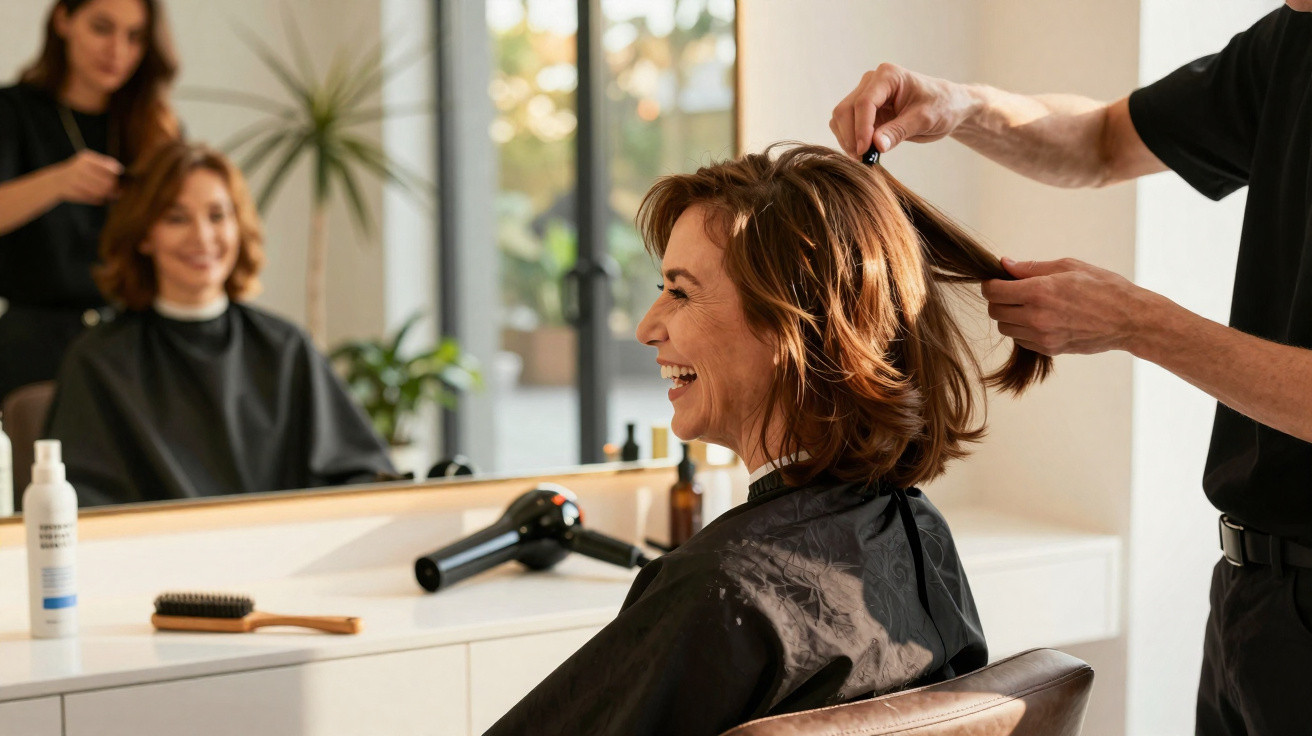
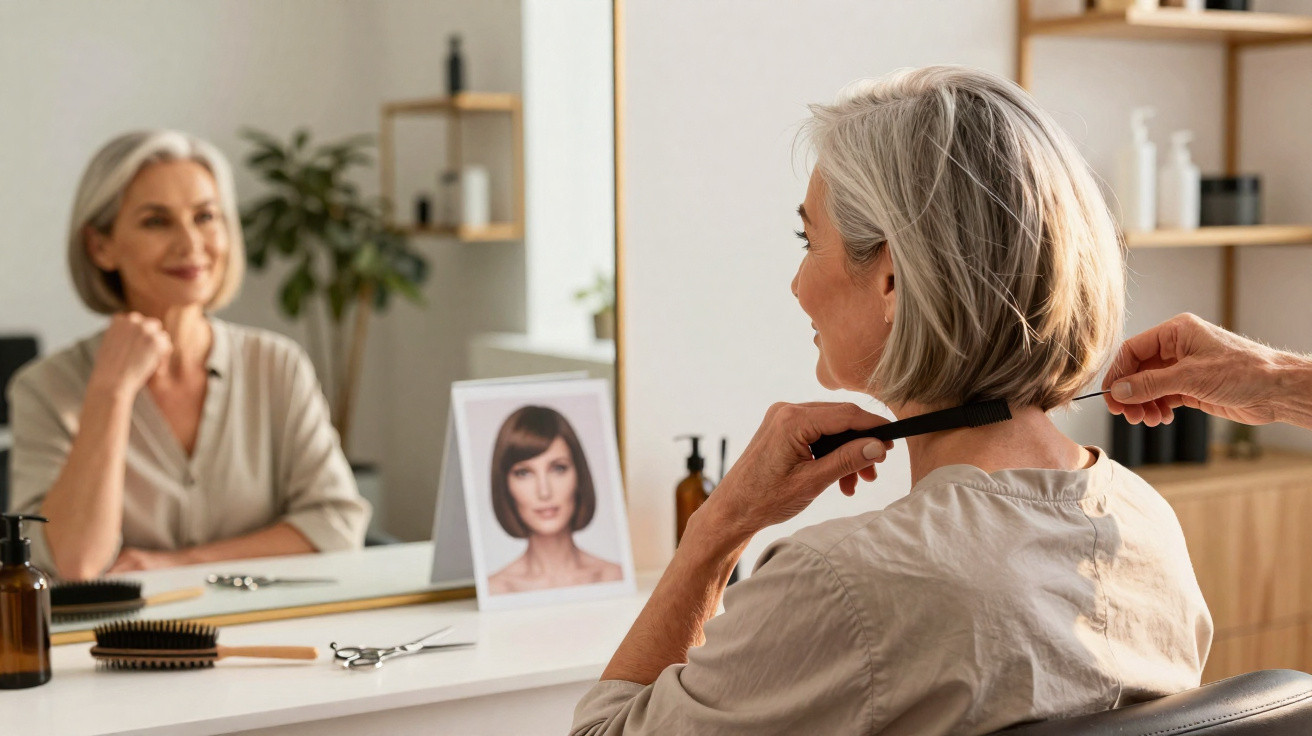
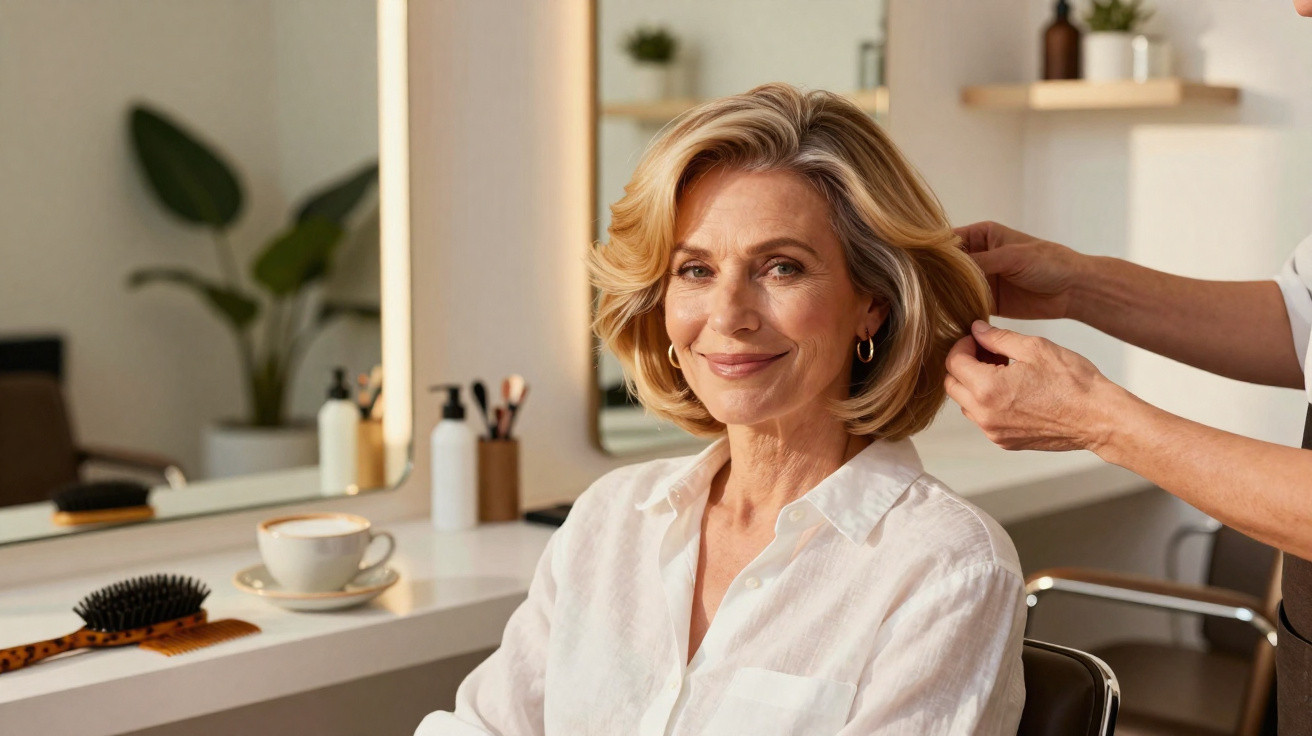
At 9:15 on a Tuesday morning, the salon is already buzzing as Marie arrives, lightly pulling at her ponytail. At 57, she is elegant and successful, yet plainly irritated by hair that appears to fall flat as soon as she takes a seat. In the mirror, the light reveals the scalp at her crown - something she insists “wasn’t showing last year.” She laughs that she needs a hat permanently attached to her head, but there is no humour in her expression.
Her stylist, Lena, fastens a cape around Marie’s shoulders before doing what she always does first: picking up a comb, lifting a section of hair and simply paying attention.
Between the sighs and casual conversation, the same pattern becomes clear.
Fine hair after 50 seems to operate by an entirely different set of rules.
“My hair used to behave. Now it just collapses.”
Lena says she can recognise the over-50 fine hair haircut from the other side of the salon. It has a familiar shape: hair sitting around shoulder level, wispy-looking rather than substantial ends, and roots pressed flat despite mousse puffing up the rest. The client generally begins with the same complaint: “My hair has changed, and nothing works anymore.”
Hormones, stress, years of colouring and a little lifetime fatigue in the follicles can all become visible in the hair first. It is not only finer; it is frequently drier and more vulnerable, meaning that techniques which worked at 35 can suddenly make it heavier. Frustration then seems to grow more quickly than the hair itself.
One of Lena’s regular clients, a 62-year-old solicitor, used to arrive with Instagram screenshots of full blow-dries, springy layers and endless volume. Every appointment ended with one question: “Why doesn’t mine look like that?” After several visits, Lena began taking her own before-and-after photographs.
On paper, the solicitor’s routine followed every classic volume rule: volumising shampoo, thickening mousse, a round brush and heated rollers at home. In practice, her hair had dropped by lunchtime. They simplified the routine with lighter products, a jaw-skimming shorter cut and a new blow-drying angle. In the following photograph, her hair appeared to have twice the density. The hair itself had not altered; the approach had.
After 50, hair biology changes direction. The growth stage in the hair cycle becomes shorter, some follicles shrink, new strands grow in finer and the scalp produces less natural oil. Together, these changes can leave hair flat at the roots while its ends feel dry - an aggravating contradiction that prompts many women to layer products for both “volume” and “moisture” at once.
The issue is that standard volume advice rarely accounts for these age-related changes. The dramatic blow-dry copied from a 20-year-old on YouTube will not perform the same way on finer, more delicate fibres. A stylist working with everyday clients learns that what works after 50 is not about battling the hair, but removing the things that weigh it down.
Fine hair after 50: cuts and styling techniques that create lift
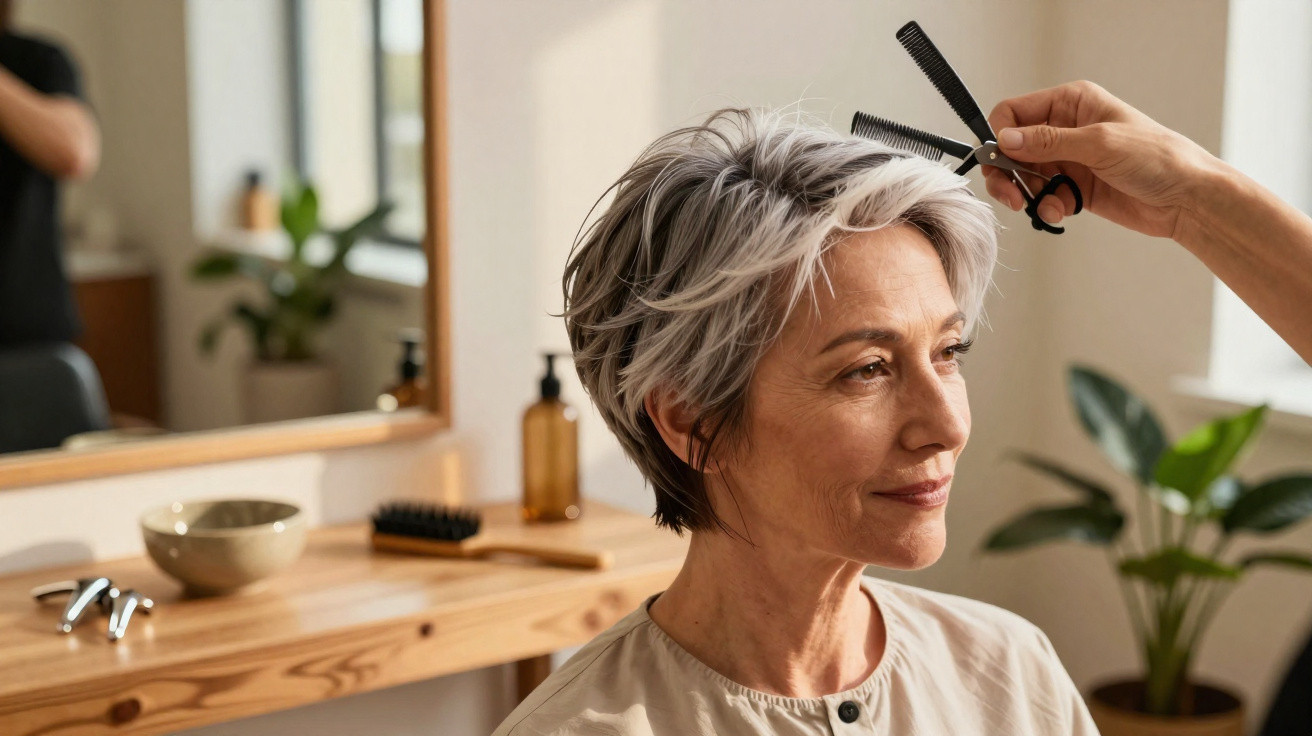
When Lena discusses volume after 50, products are not her starting point. She begins with the scissors. With fine hair, she steers clear of weighty, blunt cuts landing at the shoulders and turning out in awkward directions. Her preferred range is from the cheekbone to just above the collarbone, using gentle internal layers that retain fullness at the ends.
She also works with the “weight line” - the point at which the eye reads hair as fuller. For certain clients, a marginally shorter nape combined with longer sections around the face immediately suggests more density. This is not about making an extreme cut or following fashion. It means taking away the dead weight that physically pulls the roots down, then creating a shape that lets the remaining hair lift itself.
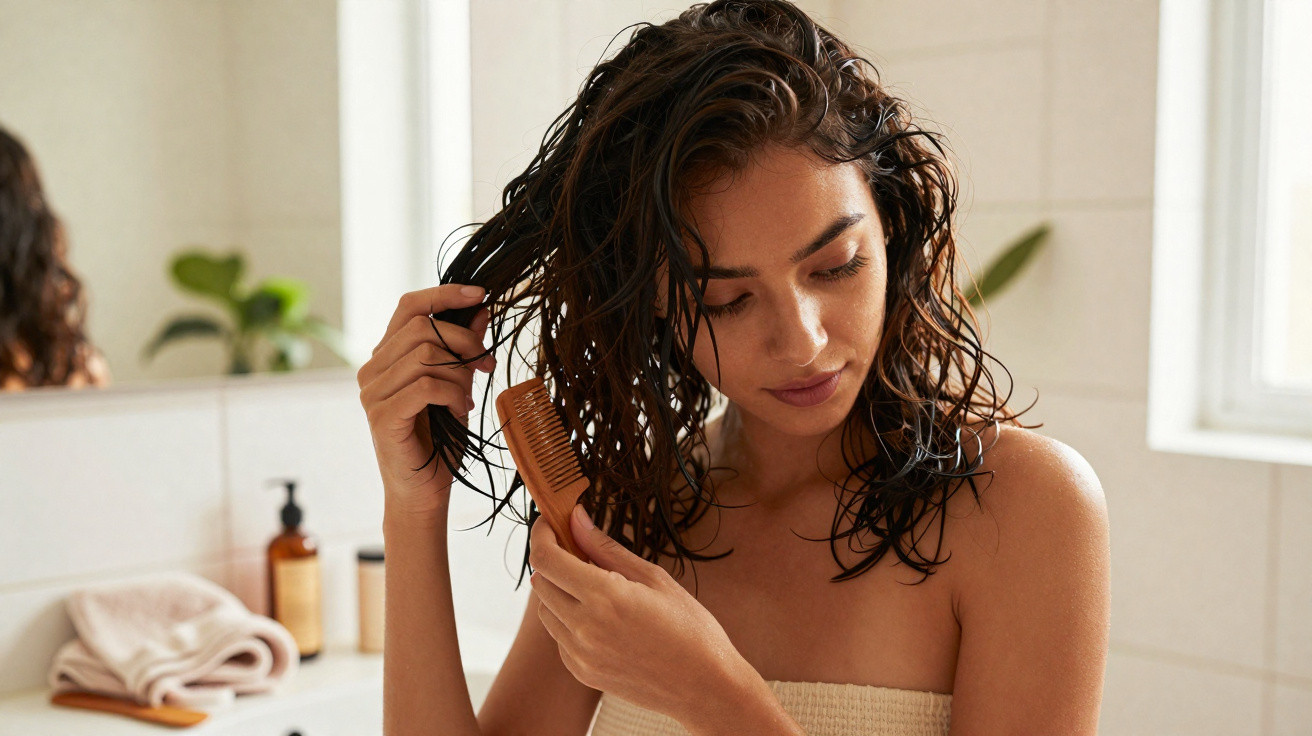
The bathroom is the other front line. Lena says that many of her clients with fine hair after 50 wash it “either too often or not nearly enough”, and either extreme can make it flat. When the scalp becomes oily, the first few centimetres cling to the head like clingfilm. When dry shampoo and product residue build up, it collapses for another reason.
She directs clients towards a mild, lightweight shampoo and conditioner applied only from the mid-lengths to the ends, never at the roots and never in large amounts. Her essential next step is a heat protector with a little hold, worked through from root to tip. This is followed by a blow-dry that raises the roots away from the scalp using fingers or a brush. It is a straightforward routine, but when practised consistently it outperforms any “miracle” spray. Hair responds more to routine than to wishful thinking.
She admits that the most difficult job is helping clients unlearn decades of habits. Some still rely on heavy oils and dense serums because they believe these products are “nourishing” their hair, when they are actually suffocating it. Others scorch their roots with straighteners in an attempt to “smooth out frizz”, then eliminate what little natural volume they had.
“After 50, my goal isn’t to give you a younger person’s hair,” Lena says. “My goal is to give your hair its best possible version right now - lighter, lifted, and touchable, not shellacked into place.”
- Light layers, not thinning – Request soft internal layers that leave the ends looking full, rather than razor-cut or over-texturised.
- Root-focused styling – Use mousses, sprays or root-lifters chiefly at the base rather than throughout the hair, so delicate lengths are not weighed down.
- Volume-friendly washing rhythm – Find a balance: hair should be clean enough to lift, but washing should be spaced out enough to avoid stripping already-fragile strands.
- Gentle heat, strong direction – Blow-dry with airflow aimed from root to tip, lifting the hair upwards and away from the scalp.
- Product minimalism – One effective volumising product plus one lightweight protector is better than a packed shelf of heavy, half-used formulas.
Letting your hair reflect who you are, not your age
Fine hair after 50 may feel like a betrayal. One morning, you may realise that your ponytail is half its former size. But the clients who become happiest are not those who resist the change most fiercely; they are those who approach their hair as a different material with new possibilities. They acknowledge that the rules have shifted, then explore those rules with curiosity instead of panic.
There is a quiet strength in making that change. When Marie came back to the salon a month after her “lighter, shorter, smarter” cut, she had no screenshots with her. Instead, she showed Lena selfies from a weekend away: her hair slightly tousled, her fringe falling perfectly. “I didn’t think about it once,” she said. For Lena, that is the real success.
| Key point | Detail | Value for the reader |
|---|---|---|
| Rework the cut | Shorter, lifted shapes with soft layers instead of heavy lengths that sit at the shoulders | Immediate visual fullness without extra styling time |
| Clean, light routine | Gentle shampoo, conditioner kept away from roots, and minimal but focused products | Volume that lasts longer and less scalp show-through during the day |
| Root-centered styling | Blow-dry with lift at the base, moderate heat and directional airflow | More natural height and movement, with less damage to fine strands |







Comments
No comments yet. Be the first to comment!
Leave a Comment