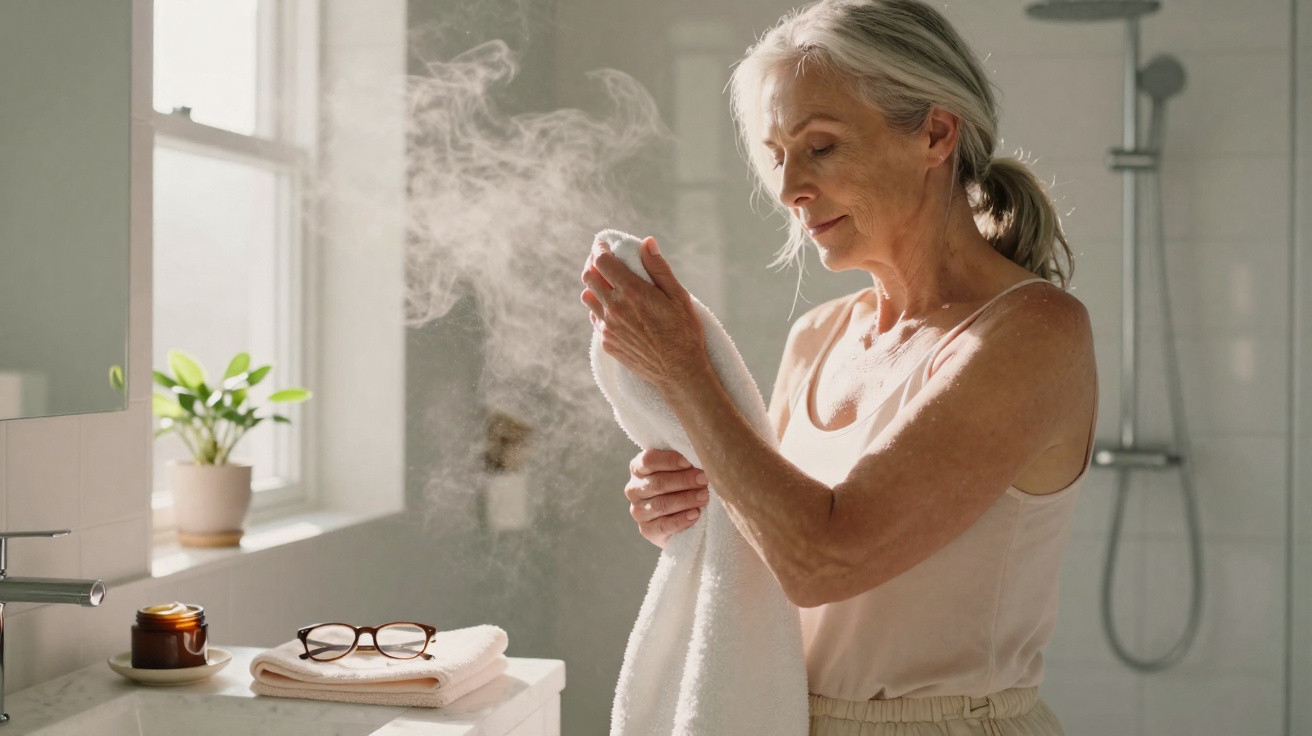
She scrubs her arms vigorously, much as she did at 25 when she was hurrying to work, then pulls the towel over her neck until her skin goes pink. Beside her, a younger woman gently dabs herself dry, unhurriedly checking her phone between movements. Neither says a word, but the contrast is almost uncomfortable to witness. One body is adjusting to ageing; the other is paying it no mind. A week later, red patches cover the older woman’s arms, which she puts down to “chlorine” and “age spots.” Yet the cause is much more ordinary. One minor everyday action, performed thousands of times, can suddenly make a difference.
Why your skin after 65 reacts to drying like sandpaper
Once you are over 65, skin is not merely “older”: it is finer, drier and more delicate than many people appreciate. The outer barrier, which once recovered easily from lengthy baths and rough towels, now finds it harder to mend itself. Just a few more seconds of rubbing may bring on stinging, itching or unexplained red plaques that appear to develop overnight. A previously harmless routine can become a gradual source of irritation. Your body is quietly telling you to alter the way you touch it. Many of us have not learnt to listen yet.
Most of us know the feeling: stepping from the shower, feeling cold and rubbing ourselves dry quickly because we simply want to get dressed. Consider Lucienne, 72, who lives on her own and showers each evening “to feel clean before bed.” For years, she rubbed her calves and forearms until they tingled, before telling her doctor she had “allergies” and “winter skin.” The actual offender was her bath towel. Once she was advised to pat her skin dry instead, leaving it a little damp before applying a light cream, her evening itchiness was reduced by half within three weeks. There was no new medicine involved. Only a new way of drying.
The explanation is remarkably straightforward. Ageing skin makes less sebum, contains less collagen and retains less water, leaving its protective barrier more permeable. Vigorous towel-drying does more than remove water: it creates friction and tiny injuries. Minute splits form in the skin’s top layer. Moisture then escapes more rapidly, while irritants in soap, washing detergent and even tap water can penetrate more easily. This is what can cause the tight, burning feeling after a shower, or the small flakes on your shins dismissed as “just dry skin.” It is more than dryness: it is damage repeated every day.
The right way to dry: small changes, major relief
The encouraging news is that skin responds rapidly to more considerate treatment, including at 70 or 80. The most protective approach is also the easiest: pat rather than rub. After a bath or shower, press your towel gently onto your skin instead of pulling it across your body. Begin with the most sensitive areas: the neck, chest, armpits, groin and backs of the knees. Keep a slight trace of moisture on the skin, particularly on your arms and legs. This fine layer of water helps any cream or oil you apply spread more smoothly and absorb more readily. It is a two-minute adjustment that can feel unexpectedly indulgent.
Many older people admit that they still dry themselves as though they are late for work, even when they have plenty of time. Established habits linger, as do certain worries: “If I don’t rub hard, I won’t be really clean.” It is a persistent belief, although washing takes place in the shower rather than during drying. Another pitfall is the valiant use of a “hot towel” straight from the radiator. While it may feel soothing, it can overheat skin that is already sensitive. Realistically, hardly anyone does this every day. Nevertheless, doing it even once or twice weekly can trigger a pattern of irritation, scratching and further irritation. A soft, cool towel is gentler than a scorching one.
“After 65, drying is no longer just a detail at the end of your shower. It’s a real step in skin care, on the same level as choosing your soap or your cream,” says Dr. Elise Martin, dermatologist in Lyon. “The way you handle your towel can either support your skin barrier or slowly break it down.”
To make this new practice easier, some people prefer to keep a small “face towel” for their most sensitive areas, along with a larger, softer towel for the rest of the body. Brief, straightforward routines can help.
- Pat rather than rub, particularly on the neck, chest and inner arms.
- Choose soft, non-abrasive towels washed without strongly fragranced products.
- Keep skin a little damp before putting on cream or oil.
- Thoroughly dry between the toes, in skin folds and beneath the breasts.
- Replace towels regularly to prevent bacteria and unseen irritants building up.
A small ritual that changes how you feel in your own skin
When you begin to notice how you dry yourself, an unexpected thing happens: the shower no longer finishes in a hurry. Instead, it becomes a brief act of care, especially when the mirror shows a body that has altered faster than you anticipated. Choosing a softer towel and spending ten additional seconds pressing rather than scrubbing can feel like a quiet way of making peace with that body. It’s a form of respect you can still offer yourself, even on days when energy is low and joints ache a little more than yesterday. When the itch settles, better sleep often comes too.
| Key point | Detail | Value for the reader |
|---|---|---|
| Gentle patting instead of rubbing | Press the towel against the skin and avoid dragging movements | Lessens microtrauma, itching and redness after washing |
| Use soft, well-rinsed towels | Steer clear of rough fibres and heavily perfumed laundry products | Reduces exposure to irritants and protects the skin barrier |
| Moisturise on slightly damp skin | Put on cream or oil within minutes of leaving the shower | Enhances hydration and lasting comfort with very little effort |














Comments
No comments yet. Be the first to comment!
Leave a Comment