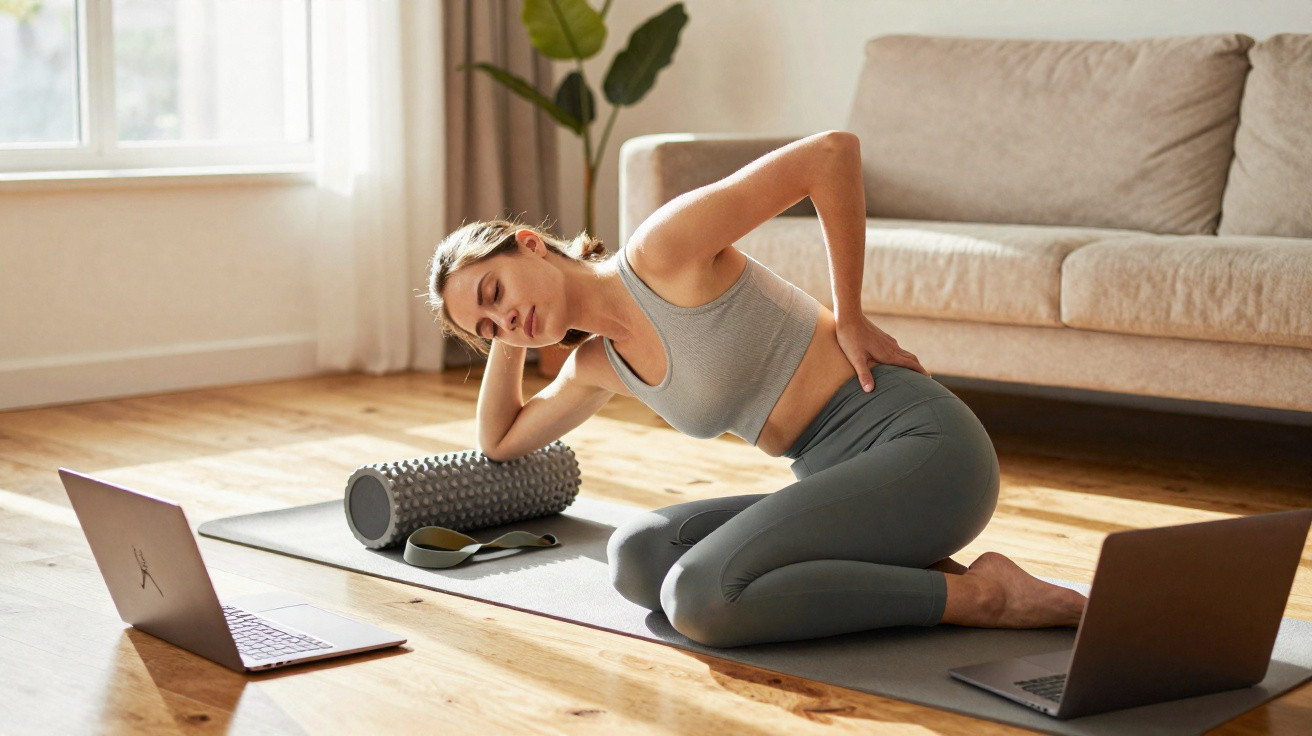
Exercises to relieve back pain can help by easing stiffness in the spine, engaging the deep abdominal muscles and restoring hip mobility. After the age of 40, remaining inactive for several days often increases the feeling of being locked up, whereas gentle, repeated movements teach the lower back to cope better with everyday activities.
Which movements are best to start with?
Three exercises are often well suited to doing at home, as they need no equipment and accommodate different levels of pain: cat-cow, glute bridge and knee-to-chest. Together, they provide mobility work, muscle activation and gentle stretching, without impact or maximum effort.
Exercises to relieve back pain should be performed through a comfortable range of movement. Sharp pain, intense tingling, loss of strength in the leg or a rapid worsening of symptoms require professional assessment before continuing.
How does each exercise work the muscles around the spine?
Cat-cow takes the spine through flexion and extension, which can help ease stiffness on waking or after spending many hours sitting down. The glute bridge engages the glutes, abdominal muscles and lower-back stabilisers, reducing some of the load placed on the back.
- Cat-cow: loosens the thoracic and lumbar spine through slow movement on the floor.
- Glute bridge: strengthens the hips and stabilising muscles that support the lower back.
- Knee-to-chest: eases tension in the lumbar area and stretches the glutes in a controlled way.
Why is gentle movement usually better than prolonged rest?
A short period of rest may be helpful when back pain is highly irritated, but going several days without moving can reduce circulation, strength and confidence in movement. The spine needs light loading so that the discs, joints and muscles continue to receive stimulation.
Exercises to relieve back pain provide a gradual return to movement. Rather than “forcing your posture”, they teach the body to bend, extend, contract and relax without triggering muscular guarding with every movement.
How can you perform the three exercises at home?
Complete the sequence on an exercise mat, a padded mat or a folded towel. Begin with cat-cow, move on to the glute bridge and finish with knee-to-chest, as this order warms up the spine before asking it to stabilise, then ends with a gentle stretch.
- Cat-cow: place your hands and knees on the floor, slowly round your back, then open your chest without throwing your neck backwards. Perform 8 to 10 repetitions.
- Glute bridge: lie on your back, bend your knees, plant your feet and lift your hips until your shoulders, hips and knees form a line. Perform 8 to 12 repetitions.
- Knee-to-chest: while lying down, bring one knee towards your torso, hold for 15 to 25 seconds, then change sides. Do this twice on each leg.
What frequency can help you feel relief in the first few weeks?
To get started, practise 4 to 5 times a week, for 8 to 12 minutes per session. During the first two weeks, the aim is to finish with less stiffness rather than to end up tired. If your body responds well, add one set of glute bridges or include 2 more cat-cow repetitions.
Exercises to relieve back pain become more effective when they are part of your routine before discomfort reaches its peak: when you get up, after long periods of sitting or at the end of the day. Improvement often shows as greater ease when putting on shoes, rising from a chair and walking without the lower back “holding back” the movement.














Comments
No comments yet. Be the first to comment!
Leave a Comment