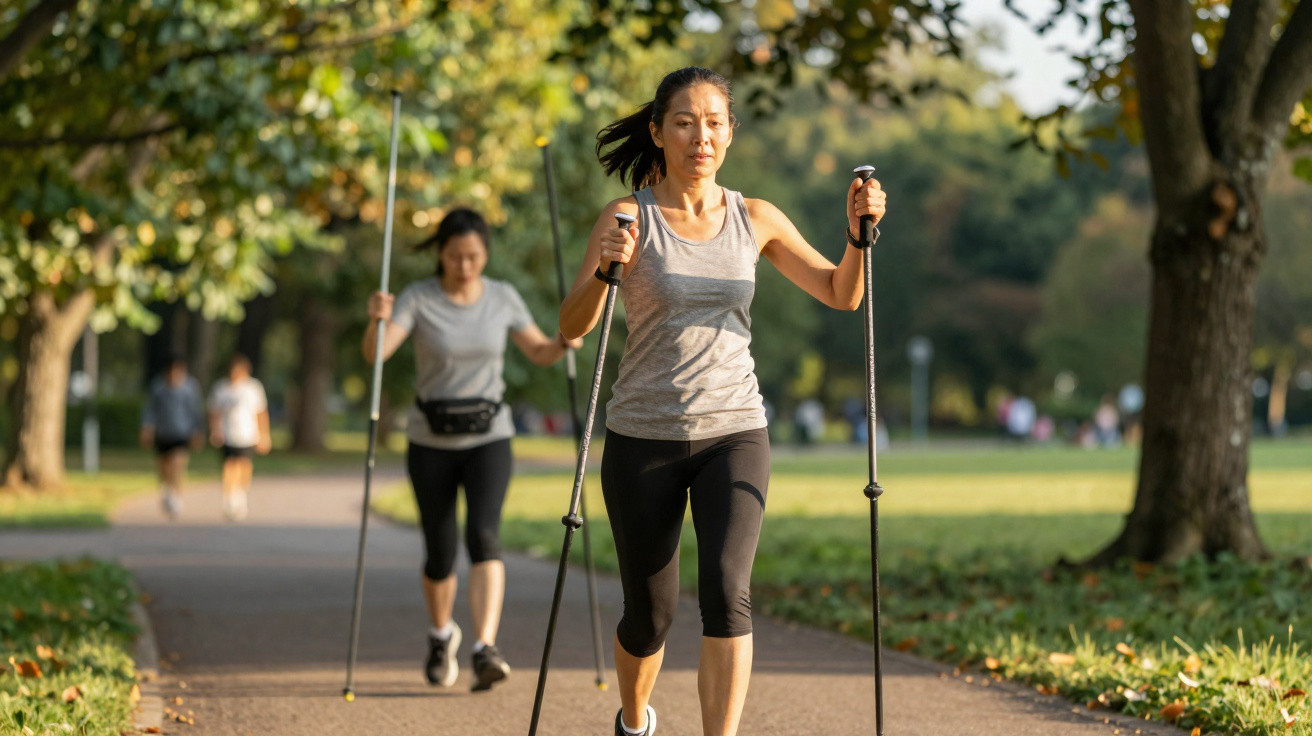
In parks, along riverbanks and on woodland paths, people carrying poles are everywhere. Nordic Walking looks straightforward, almost like ordinary walking with a little extra equipment. That impression is precisely why many beginners - and even long-time walkers - use poor technique and miss out on a substantial share of the health benefits.
Why Nordic Walking is far more than ordinary walking
Nordic Walking was originally developed as summer training for cross-country skiers. Its movement pattern mirrors the use of poles on a ski trail, simply without skis. The result is a type of full-body walk that delivers considerably more than a standard stroll.
“Anyone who masters the technique can engage up to 80 per cent of their muscles while Nordic Walking.”
Unlike a conventional walk, it works more than just the legs and glutes. It also involves:
- the shoulders and upper back
- the arms and forearms
- the chest and abdominal muscles
- deep core muscles that provide stability
The stepping rhythm combined with pole use gets the circulation moving. Many walkers reach an intensity that effectively combines fat burning with endurance training, without having to push themselves to exhaustion.
The activity has several practical benefits, particularly for people over 50 or those with joint problems:
- the poles reduce strain on the knees and hips
- the movement supports spinal stability
- the cardiovascular system is challenged moderately but consistently
- regular sessions can help with weight management
- the risk of diabetes and cardiovascular disease is reduced
Common mistakes that make Nordic Walking ineffective
Because the sport appears so harmless, most people begin without instruction or a course. As a result, they develop movement habits that may seem to work but waste almost all of the intended training effect.
Merely carrying the poles while walking
This is the classic mistake: the poles lightly tap the ground in front of the feet and are dragged along rather than used actively. Many people plant them vertically beside their body, treating them mainly as an aid to balance.
That means a key benefit is lost. The poles should propel the body forwards, much like in cross-country skiing. Only then do the arms, shoulders and core genuinely contribute, while the legs are relieved at the same time.
“In Nordic Walking, the poles are not an accessory; they are the engine of the movement.”
What matters is:
- plant the poles diagonally backwards rather than vertically downwards
- the pole tip should touch down roughly level with the rear foot
- open the hand at the end of the movement - the strap holds the pole
- create a noticeable forward push with every step
A rounded back and downward gaze
Many walkers look at their feet or at the ground immediately ahead. Their shoulders roll forwards, the back rounds and the chest collapses. Not only does this look unenthusiastic, it also restricts breathing.
The activity works better with a stable but relaxed upper body:
- look around 10–15 metres ahead rather than at your toes
- keep the shoulders relaxed instead of lifting them
- raise the breastbone slightly and gently engage the abdominal muscles
- lean the torso very slightly forwards, without dropping into an exaggerated hollow back
This allows the ribcage to move freely, gives the lungs more room and encourages deeper breathing. Many people notice within just a few minutes that the effort feels more comfortable.
Arms and legs moving out of rhythm
Nordic Walking depends on a diagonal movement pattern: right arm with left leg, and left arm with right leg. Without paying attention to this, it is easy to develop an uncoordinated-looking stride - or to use both poles almost at the same time.
This disrupts the body’s rhythm and diminishes the training effect. It also increases the risk of catching a pole or stumbling.
A simple practice method is to start walking without poles, deliberately focusing on the diagonal arm swing. Then add the poles while retaining the same natural swing. With a little patience, the movement becomes smooth and almost automatic.
How to make the ideal start with Nordic Walking
Getting started properly avoids months of trial and error and poor posture. Adult education centres, sports clubs, rehabilitation centres and health providers often run beginner courses. Investing in one to three sessions is nearly always worthwhile.
“A short technique course delivers more than the most expensive high-tech equipment.”
Choosing the right equipment
When selecting equipment, the correct fit matters more than the brand:
| Equipment | What to look for |
|---|---|
| Poles | Length of around 0.68 x height, ergonomic grip, secure straps, shock-absorbing tip |
| Shoes | Flexible sole, good heel support, tread for woodland paths, not too heavy |
| Clothing | Breathable layers, with a windproof layer in cool weather |
| Accessories | Rubber pads for tarmac, lightweight gloves in cold conditions, a hat or cap |
Anyone who regularly walks on tarmac should fit rubber pads over the pole tips. They reduce noise, protect the tips and ease pressure on the wrists.
Build up training volume realistically
Beginners in particular tend to try to do too much too soon. A rough guide for starting out is:
- 2–3 sessions per week
- 20–40 minutes per session during the first four weeks
- plan a rest day between sessions
If you can still hold a conversation while walking, you are usually working at a sensible intensity. Burning lungs, a stitch or dizziness are signs that you should slow down.
How Nordic Walking eases body and mind
Alongside the measurable health effects, there is also a mental benefit. The steady movement, rhythmic clacking of the poles and time spent outdoors act like a reset button after a stressful day for many people.
For people who struggle with jogging or quickly develop joint pain, Nordic Walking is often the missing middle ground: more demanding than walking, yet substantially gentler than running.
The social side is also worth noting. Established walking groups have formed in many communities. People who arrange to meet are more likely to keep going, gaining twice over through physical activity and regular contact with others.
What older people and those with existing conditions should consider
Anyone with heart problems, diabetes, high blood pressure or severe osteoarthritis should speak to their GP before starting. The advice is often not “avoid it”, but rather: “Yes, but with a plan.”
- increase the intensity gradually
- build in breaks; shorter walks more often are preferable
- choose softer surfaces such as woodland paths
- watch for warning signs including chest pressure, severe breathlessness or dizziness
People with knee or hip problems especially benefit from the load-relieving effect of the poles. Learning the technique properly shifts some of the strain to the arms and upper body, which can significantly reduce pain.
Related forms of exercise for variety
Anyone who enjoys Nordic Walking can include similar activities to work different muscle groups:
- hiking with poles on hilly terrain
- cross-country skiing in winter as a more intensive option
- light bodyweight strength training as a supplement
- walking without poles to develop a natural arm swing
Many trainers recommend deliberately varying pole use from time to time: sometimes focusing more on speed, sometimes on technique and sometimes on breathing. This keeps the activity engaging and provides the body with fresh stimuli.
Whether it is a return to exercise, a gentle alternative to jogging or a regular appointment with a walking group, Nordic Walking can be much more than a walk with poles. The key is to avoid the most common technical mistakes - then every step becomes a small full-body workout.










Comments
No comments yet. Be the first to comment!
Leave a Comment