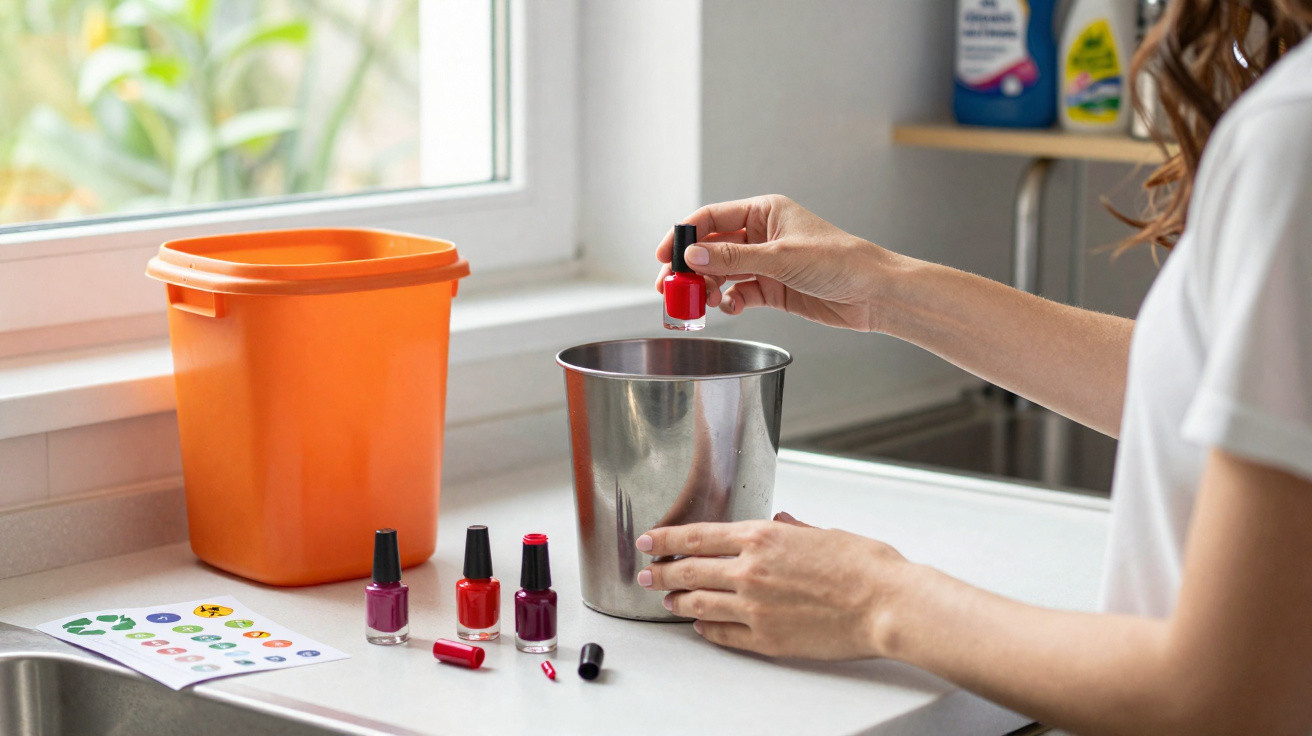
Many people thoughtlessly throw dried-up or unwanted nail polish into the bathroom bin or a glass recycling bank. It may seem harmless and feel like the “right” kind of recycling, but it is wrong in two ways. Nail polish is classed as hazardous waste: it can damage processing facilities, put workers at risk and, in the worst case, even result in a fine.
Why nail polish does not belong in the glass recycling bank
Not all glass is the same
The instinct is understandable: the bottle is made of glass, so it should go into the glass recycling bank. That is precisely where the issue starts. Cosmetic glass differs considerably from conventional drinks bottles and jam jars.
- it is often specially toughened or coated
- it may be coloured or frosted
- it contains different chemical additives from food-grade glass
Old nail polish bottles can therefore disrupt industrial recycling processes. They melt differently, affect the quality of the molten glass and may render entire batches unusable.
Too small, too complex and too contaminated
Their size is another problem. Tiny bottles can slip through sorting machinery or may not be properly detected by sensors. Their mixed construction makes matters worse:
- glass bottle
- lid, usually made of plastic or metal
- plastic brush
- residual polish and solvents inside
“Even small amounts of polish and solvents can make an entire batch of glass intended for new bottles unusable.”
This combination of materials contaminates the glass-recycling stream. Chemicals that do not belong there can suddenly enter a process designed to produce clean raw materials for new bottles.
What nail polish really contains
A miniature chemical cocktail
Behind romantic shade names such as “Romantic Red” or “Nude Rose” are chemically complex formulations. They commonly include:
- solvents such as toluene or ethyl acetate
- formaldehyde releasers or related substances
- plasticisers, including certain phthalates
- film-formers, resins, colour pigments and glitter particles
Although many newer polishes advertise themselves as “free from X, Y or Z”, that does not make them entirely harmless. If these substances enter ordinary household-waste incinerators or even landfill sites, they can produce toxic gases or allow pollutants to reach groundwater.
Fire risk in refuse vehicles
Nail polish and conventional nail polish remover are flammable. This is usually indicated by the warning symbol on the bottle. In practical terms, this means:
- bags are compacted in refuse vehicles, which can break bottles
- polish residues can mix with other chemicals
- flammable vapours may encounter pressure and friction
“An inconspicuous little bottle can become a genuine fire risk for workers in a refuse vehicle or sorting facility.”
This is exactly why waste operators classify nail polish as hazardous waste rather than material for ordinary residual waste.
Empty or half-full: it makes a major difference
The theoretical exception: genuinely completely empty
In theory, a container that is absolutely empty and free of residue is treated as normal packaging waste. With nail polish, however, this is largely a theoretical scenario.
Anyone who has tried to empty one of these bottles completely will know the difficulties:
- the product clings to the inside walls
- the bottle neck is very narrow
- residue remains in the thread and on the brush
The container could only be thoroughly rinsed with a generous amount of nail polish remover, but this would introduce fresh solvents into wastewater. It merely shifts the problem elsewhere.
The usual case: polish left in the bottle means hazardous waste
In almost every household, nail polishes are discarded because they have thickened, dried out or simply become unusable. At that point, polish is still left in the bottle, meaning it is legally not just a simple glass container but a chemical container.
“As soon as polish remains in the bottle, it is classified as hazardous waste and must be disposed of accordingly.”
This category also includes items such as paint tins, aerosols, solvents and certain adhesives. Legislation requires a separate disposal route for these materials.
What penalties can incorrect disposal bring?
Fines for sorting waste incorrectly
Many towns, cities and districts are now taking a much stricter approach to incorrectly discarded items. The reason is simple: every hazardous product disposed of wrongly increases waste-treatment costs for all fee payers.
Anyone caught putting solvent-based products or other hazardous materials into an ordinary residual-waste bin can face a fine in the double-digit range. The precise amount varies between local authorities, but typical figures are often around €30 to €40 per incident.
When it becomes much more expensive
If payment is not made on time, the penalty can increase rapidly. Higher fines may also apply if someone illegally leaves chemicals or nail polish in a park, woodland or beside glass recycling banks.
“Anyone who simply leaves hazardous waste somewhere risks a three-figure sum very quickly – and causes visible harm to the environment.”
The supposed disposal “shortcut” may ultimately cost considerably more than buying a new polish on the next visit to the chemist.
How to dispose of nail polish properly
The correct waste category: hazardous household waste or special waste
In Germany, nail polish generally falls within the category known as hazardous household waste or special waste from private homes. This refers to small quantities of dangerous materials that are commonplace in households but do not belong in residual waste.
This includes, for example:
- nail polish and nail polish remover
- leftover paint and paint tins
- plant-protection products and pest-control products
- strong solvents and certain cleaning products
Where should the bottles go? Practical options
Most local authorities offer several disposal options:
- permanent recycling centres: a dedicated area for chemicals, often in a lockable container or room
- hazardous-waste collection vehicles: lorries that visit neighbourhoods at set intervals to collect hazardous household waste
- retail collection points: some DIY shops or chemists accept certain products, in some cases through take-back schemes
“If you are unsure, make a quick call to the local authority or check the local waste guide. It will usually state exactly where nail polish should be taken.”
How to reduce nail polish waste
Buy sensibly and use products up deliberately
The easiest form of disposal is the kind that never becomes necessary. A few practical approaches are:
- buy smaller bottles that can realistically be used up
- choose shades you genuinely wear often instead of trend purchases
- check older opened bottles before buying a new one
Storing polishes in a cool, dry place away from light extends their shelf life. That alone can prevent many trips to the recycling centre.
Rescue old polish or reuse it creatively
If a favourite polish has become slightly thick, a specialist nail polish thinner from the chemist will often help. Add a few drops, then roll the bottle between your hands rather than shaking it; this usually restores a usable consistency.
Shades you no longer want to wear can be passed on to friends, family or swap groups, provided the polish is still in good condition. Many people also repurpose nail polish as a durable miniature paint:
- markings on keys
- coloured dots on tools or garden equipment
- small decorative details on stones, vases or tins
“Every extension of a product’s useful life means one fewer bottle that has to be disposed of as hazardous waste.”
What many people do not know: legal and chemical reasons
Why small quantities are particularly difficult
At home, nail polish comes in seemingly harmless miniature portions. From a chemical perspective, these scattered small quantities are particularly troublesome because they are difficult to capture. If they enter incineration plants or landfill sites unfiltered through residual waste, they escape targeted treatment.
When local authorities collect these materials in concentrated quantities instead, they can be treated in specialist facilities at high temperatures using sophisticated filtration systems. Hazardous components can then be destroyed or captured far more effectively.
Reading warning symbols correctly
A look at the bottle can help with assessment. If pictograms such as a flame, exclamation mark or skull and crossbones appear, the product is clearly hazardous. Without lengthy explanations, these symbols indicate that it does not belong in ordinary household waste.
Anyone who treats nail polish as a small chemical product in future and takes it to a recycling centre is therefore doing the right thing: it is better for the environment, safer for people working in waste management and considerably cheaper than risking a fine.















Comments
No comments yet. Be the first to comment!
Leave a Comment