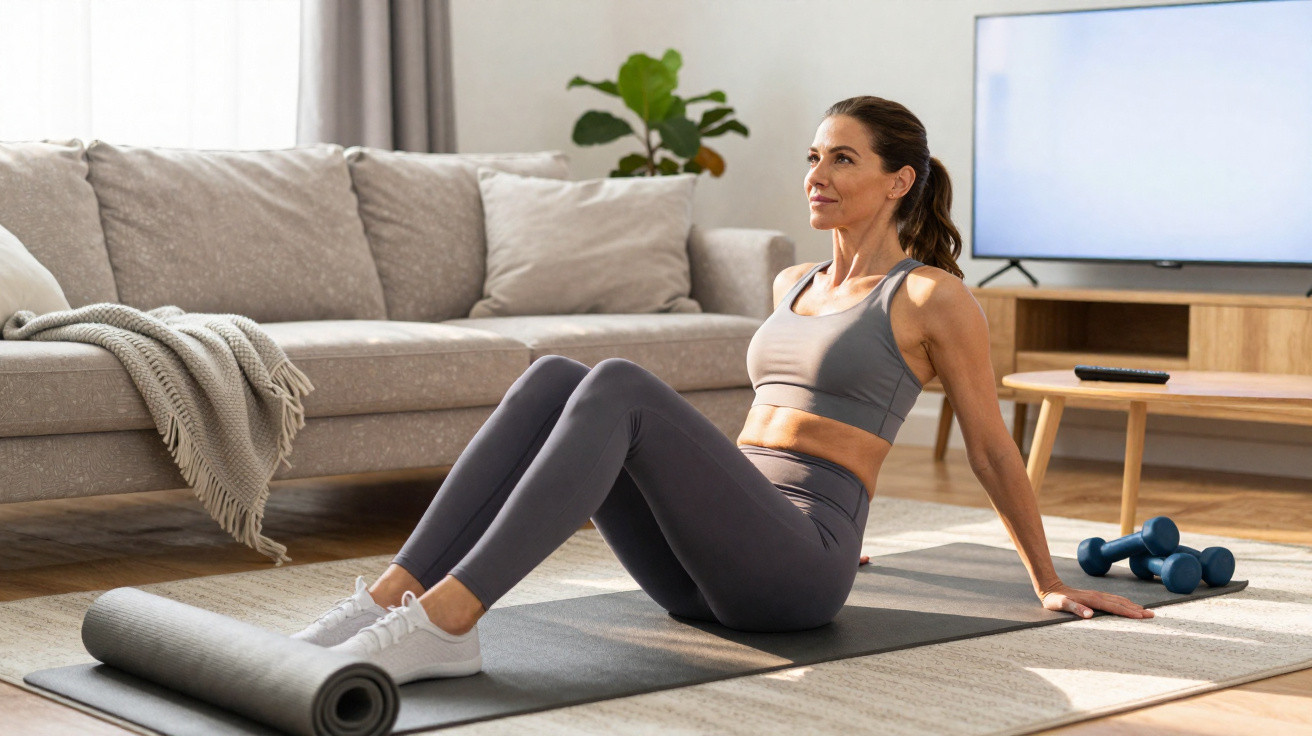
With a few discreet movements in front of the television, you can work on exactly that area.
Anyone who only wants to watch a series after a long day knows the dilemma: the mind needs rest, but the stomach makes itself known. Rather than feeling guilty and doing no exercise at all, turn your love of television into a small body-shaping boost. These four straightforward exercises can be done sitting or lying down, strengthening the stomach and core without having to put down the remote control.
Why the stomach becomes more stubborn from 40 onwards
The body changes over the years, and many people first notice this around their middle. There are several reasons for this:
- Basal metabolic rate decreases, so the body burns fewer calories.
- Muscle mass gradually declines unless it is actively trained.
- Long periods of sitting at work encourage fat deposits around the stomach.
- The pelvic floor loses tension, making the stomach more likely to “fall” forwards.
Beyond a certain age, simply “eating a little less” is rarely enough. The muscles around the waist, back and pelvic floor need targeted stimulation. This is where calm, controlled movements excel: they may not look spectacular, but they work very deeply.
“Rather than hundreds of frantic sit-ups, slow, precise movements achieve far more – especially for the deep abdominal muscles.”
This layer of muscle supports the spine, helps the stomach look flatter and relieves the lower back. Activating it delivers several benefits at once: posture improves, the stomach protrudes less and discomfort in the lumbar area often eases.
Turn the sofa area into a small workout space
You need very little for the following four exercises: a patch of carpet or a thin runner in front of the television, or alternatively a blanket – and ideally bare feet or grip socks. A sports bra may provide extra comfort, but workout clothing is not essential. The only important thing is that your clothes do not restrict movement.
To start with, choose a series or news programme that still allows you to focus on the movements. Put your phone away, pick a short episode and follow a clear exercise sequence – that turns 20 minutes of entertainment into a small core routine.
Exercise 1: side plank for a firm waist
The side plank works the oblique abdominal muscles, waist and entire core.
- Lie on your side and support yourself on your forearm, positioned beneath your shoulder.
- Straighten your legs and place your feet either on top of each other or one behind the other.
- Lift your pelvis until your body forms a straight line from head to feet.
- Engage your stomach, buttocks and thighs, without allowing your lower back to arch.
- Hold the position for 10–20 seconds, then lower yourself slowly.
Too difficult? Place your knees on the floor, bend your lower legs and perform the side plank with a shorter lever. The key is to maintain a stable line from shoulder to knee.
“If you shake in the side plank, you are not doing anything wrong – your body is working and the oblique abdominal muscles are waking up.”
Exercise 2: seated abdominal activation on the sofa
This movement is ideal for evenings spent watching a series. It looks gentle, yet it places a clear demand on the deep abdominal muscles.
- Sit upright on the edge of the sofa, with both feet hip-width apart on the floor.
- Draw your shoulders back, lift your chest slightly and rest your hands by your sides.
- As you exhale, consciously draw your stomach inwards, as though pulling your navel towards your spine.
- At the same time, lift one knee without tipping your upper body forwards.
- Place your foot back down and switch sides.
If you have a resistance band, place it beneath your feet and hold the ends in your hands. This increases the tension and gives you a clearer sense of the movement. Important: the knee should move, not the upper body. Once you start to “curl” forwards, pressure is taken off the stomach and shifted towards the neck.
Exercise 3: scissor movement for the lower stomach
The classic scissor exercise targets the lower abdominal area – precisely where a stubborn “spare tyre” often develops.
- Lie on your back with your arms by your sides.
- Keep both legs straight and lift them slightly.
- Raise one leg to roughly 45 degrees while keeping the other just above the floor.
- Switch legs at a controlled pace, opening and closing them like scissors.
If your lower back arches quickly or you experience back pain, place your hands flat beneath your pelvis or bend your knees slightly. The movement may be challenging, but it should not hurt.
Exercise 4: small leg movements for greater stability
Like the scissor exercise, small up-and-down movements of the legs work the lower stomach intensively.
- Lie on your back again and lift your straight legs slightly.
- Keep both legs almost parallel, with only a few centimetres between them.
- Make short, quick up-and-down movements from the hips.
- Keep your core still and your stomach actively drawn inwards.
“The skill lies not in large leg swings, but in control and consistency – a few centimetres are completely enough.”
How often and for how long: the right television routine
Rather than overdoing it, it is worth starting moderately. Here is one possible plan for a series episode lasting around 30 minutes:
- Warm-up: 2 minutes of conscious inhaling and exhaling while seated, with the stomach lightly engaged.
- Side plank on the right: 2 sets of 15 seconds.
- Side plank on the left: 2 sets of 15 seconds.
- Seated abdominal activation: 3 sets of 10 knee lifts per side.
- Scissor movement: 2 sets of 15–20 repetitions.
- Small leg movements: 2 sets of 20 seconds.
Rest periods of 20–40 seconds between sets are enough, ideally during advert breaks or scenes that do not require your full attention. As you become fitter, gradually increase the holding times or number of repetitions – always while maintaining good technique.
Safety: when your body tells you to stop
Abdominal exercises are often considered harmless, but poor form can strain the neck, back or pelvic floor. Take the following warning signs seriously:
- Sharp pain in the lower back.
- Pulling in the neck or headaches after exercising.
- Downward pressure in the pelvic floor, such as the sensation of “pushing down”.
- Dizziness or shortness of breath.
If any of these signs occur, stop the exercise, adjust your position and reduce the intensity. Anyone with existing disc problems, recent abdominal surgery or severe pelvic floor discomfort should speak to a doctor or physiotherapist beforehand.
Why the pelvic floor matters during abdominal exercises
When people think about their stomach, they often focus only on visible muscles. Yet the pelvic floor belongs to the same system. It supports the bladder and bowel, and together with the deep abdominal and back muscles it forms a kind of muscular “hammock”.
When exercising in front of the television, it is worth consciously engaging this area too: as you exhale, gently draw the pelvic floor inwards and upwards, as if trying to stop the flow of urine. At the same time, the deeper abdominal area engages. In this way, every exercise trains not only appearance, but also continence and stability in everyday life.
What abdominal exercises really do for fat burning
Abdominal exercises shape and strengthen the muscles. However, reducing fat deposits depends heavily on two further pillars:
- Nutrition: a moderate calorie deficit, plenty of vegetables, high-quality protein and few heavily processed products.
- Everyday movement: taking the stairs rather than the lift, walking short journeys and going for regular walks.
The television routine does not replace a complete training programme; it complements one. Combining a healthy diet with daily steps and the four sofa exercises builds muscle, which in turn burns more energy over the long term – even at rest.
Practical tips for sticking with it
Many good intentions fail because they are too complicated. A few simple approaches can help establish the new habit:
- Make one particular programme your “workout series”.
- Keep the blanket or mat beside the sofa permanently.
- Write down small improvements, such as longer holding times.
- Arrange a shared television workout with your partner or housemate.
Those who start gently and link the exercises to an enjoyable ritual – a series evening, tea and comfortable clothes – will not experience the routine as a strict duty. Step by step, it becomes a new normal: watching television while doing something positive for your stomach and back.











Comments
No comments yet. Be the first to comment!
Leave a Comment