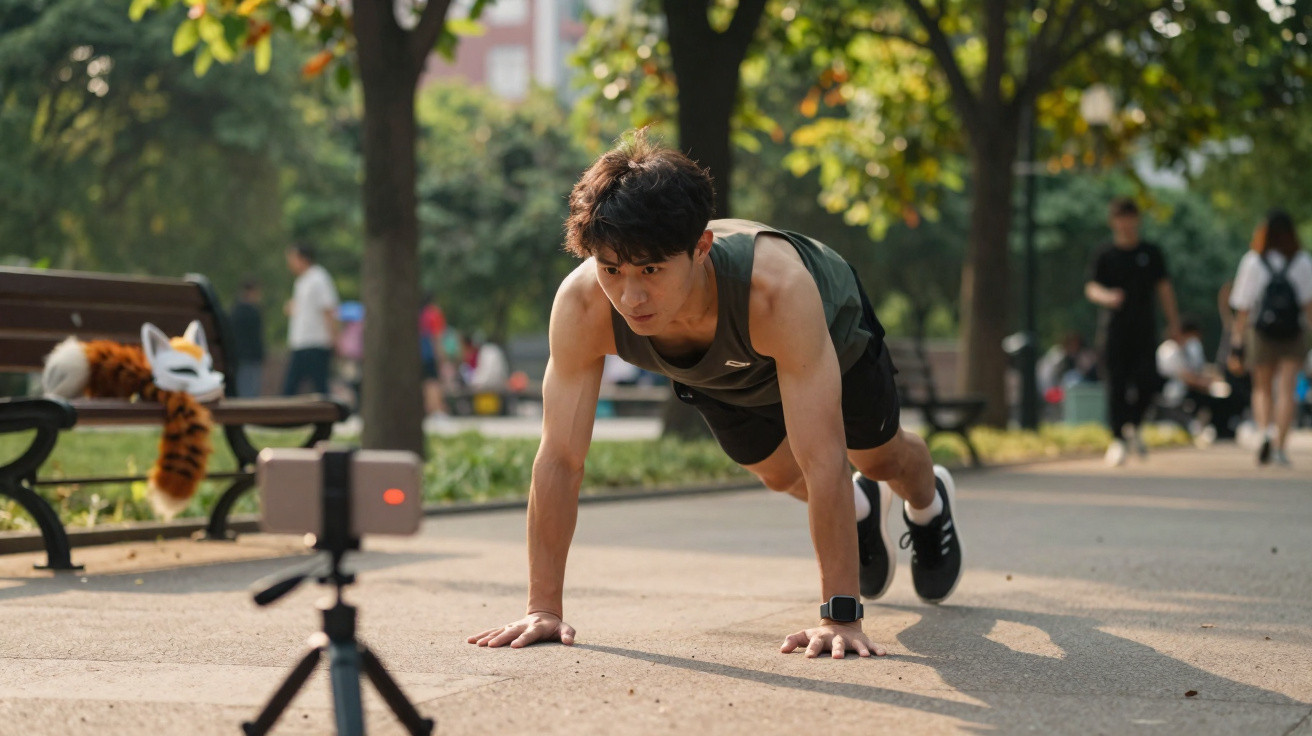
A new online trend has people scuttling, crawling and springing about on all fours while recording themselves – and the resulting videos are drawing considerable attention.
Known as quadrobics, the activity makes for quite a spectacle.
Advocates of quadrobics say these movements can improve fitness, strength and mobility, and may even offer a spiritual benefit by helping people reconnect with nature and their "primal" selves.
The term quadrobics combines quattuor (the Latin word for four) with aerobics, meaning rhythmic, repetitive exercise that engages the body’s large muscle groups, as running does.
Yet is this style of exercise genuinely beneficial? Is it simply another fad propelled by the attention economy? Or could it be both?
From world records to the therian subculture
Quadrobics first attracted widespread attention in 2008, when Japanese sprinter Kenichi Ito set a Guinness World Record for completing 100 metres on all fours.
Since then, the record has fallen several times. American Collin McClure recorded 15.66 seconds in 2022, before Japanese runner Ryusei Yonee broke it again this year with a rapid 14.55 seconds.
Yonee has said that he studied how animals moved from an early age, watching dogs, cats and monkeys before developing his own technique on an athletics track.
More recently, an increasing number of social-media users, especially younger people, have begun sharing their own quadrobics videos.
In certain countries, including Russia, distinct subcultures of “quadrobers” have developed. Combining quadrobics with costume play, they may be seen crawling outdoors in animal masks.
A large proportion of quadrobics material online originates within the therian community. Therians are people, frequently children, who identify as a non-human animal.
Some of the earliest adult practitioners of quadrobics were therians. Although not every therian practises quadrobics, those who do often describe four-limbed movement as a physical expression of their identity.
Therians can readily be mistaken for members of the “furry” fandom, though the two are not the same. Whereas therians identify as animals, furries are interested in anthropomorphic animal characters – animals with human attributes.
Furries develop individual avatars known as “fursonas” and attend gatherings and conventions in “fursuits”.
Across Russia and other former Soviet states, the sight of young people running about in fox masks and tails has triggered a moral panic among certain politicians and religious figures.
In Uzbekistan last year, the Interior Ministry warned parents that children’s involvement in quadrobics would be regarded as parental neglect. Russian politician Vyacheslav Volodin also blamed the West for the growing trend of dressing as animals, describing it as a “dehumanisation project”.
Quadrobics: fitness or performance?
Quadrobics is chiefly about movement, rather than identity, costume or role play.
It forms part of a wider surge in “ancestral” or “primal” wellbeing trends, such as paleo diets, ice baths and the Liver King’s raw-meat diet. Such practices claim to restore a connection with nature, while also functioning as performance.
Even established health and wellbeing outlets have started acknowledging quadrobics, with articles outlining its claimed advantages for working the major muscle groups and enhancing coordination.
Followers demonstrate techniques including bear crawls, leopard walks, leaps and balances. Many of these movements and exercises, however, have long been used as warm-ups or mobility drills.
Some people who practise quadrobics report concrete outcomes, including improved fitness and weight loss.
There is limited research indicating that quadrupedal movement may enhance balance, flexibility and core stability. Its rhythmic quality can also raise the heart rate, potentially benefiting aerobic fitness and health.
That said, quadrobics has limitations.
Risks and limitations of quadrobics
As quadrobics uses resistance from body weight alone, the stress applied to the muscles cannot exceed your own weight. It is therefore unlikely to be as effective as weight training for increasing strength and bone density, since lifting weights enables progressively heavier loads.
Although quadrobics can provide an aerobic stimulus, it demands a fair amount of skill. This makes it difficult to sustain for extended periods or perform at greater intensity. Activities such as running would deliver stronger cardiovascular benefits.
Like all forms of exercise, quadrobics also carries a possible risk of injury, though that risk is likely to be low.
Anyone wishing to try quadrobics should allow their muscles and joints time to adjust to these new demands. This matters particularly for the hands, wrists, elbows and shoulders, which may not be accustomed to working in this way. Begin very gradually and pay attention to how you feel following every session.
Overall, there is little evidence that quadrobics is superior to conventional types of exercise. Crawling and leaping may improve stability and flexibility, but research has not yet examined its long-term benefits or risks. At most, it should complement established training.
Quadrobics’ present success on social media is driven less by exercise science than by its visual spectacle. Its entertainment appeal is obvious and it predictably generates likes, shares and comments – making it as much about theatre and identity as it is about fitness.
Samuel Cornell, PhD Candidate in Public Health & Community Medicine, School of Population Health, UNSW Sydney and Hunter Bennett, Lecturer in Exercise Science, University of South Australia
This article is republished from The Conversation under a Creative Commons licence. Read the original article.














Comments
No comments yet. Be the first to comment!
Leave a Comment