
The pain nearly always begins quietly: a slight tug at the bottom of your neck as you pick up your phone, a muted ache in your lower back while you wash up, or a gradual tightness across your shoulders after spending 20 minutes on the same email. You put it down to a tiring day, stress or getting older. You do a quick stretch, circle your neck, crack your knuckles, and then return to sitting exactly as you were.
As the hours go by, that discomfort fades into the background of the day: easy to overlook, but never truly gone.
Then, one day, you reposition yourself slightly in your chair or bend your knees another way as you get out of the car, and the pain improves. Not completely, but noticeably.
It makes you question whether your body is really “broken” - or whether the issue is how you move throughout the day.
How tiny movements can quietly create major pain
Look at people standing at a bus stop and their discomfort can often be spotted immediately. One hip drops to the side, one shoulder sits higher than the other, and their necks lean forwards as though they are still looking at a phone. Nobody is crying out in pain, but many faces have that slightly strained expression that says, “My back hurts again.”
We tend to assume pain arrives suddenly: after a poor night’s sleep or one awkward movement at the gym. More often, its cause is slower and far less exciting. It is the result of tiny repeated movements accumulating over months and years, like water persistently falling on the same patch of stone.
Take Sara, a 34-year-old marketing worker. She does not lift heavy loads, run marathons or have an obvious “injury story”. She simply spends a great deal of time sitting. For eight to ten hours each day, her laptop is slightly to her left, her weight rests on the same hip, and one leg is tucked beneath her.
By 3 p.m. on most days, her neck has become stiff and her lower back is throbbing. She takes ibuprofen, does a brief stretch and promises herself that she should “work on her posture someday”. Months later, she sees a physio, who watches her rise from her chair, take three steps and sit down again.
“You’re not broken,” he tells her. “You’re just repeating the same tiny stress, in the same way, every day.”
Pain specialists frequently refer to “load” rather than “injury”. The body can tolerate plenty, but it is affected by how often you do something, for how long and in which position. Sitting with your spine slightly rotated to one side is a small load. Repeating it for 2,000 hours a year is another matter.
The important change in perspective is that everyday discomfort is usually less about one dramatic incident and more about your default setting: how you stand when bored, how you bend to tie your shoes, and how you hunch over when tired and scrolling. Once you recognise this, changing one small habit no longer seems pointless. It starts to feel like sensible damage control.
One small adjustment that can change your whole day
If you make just one change this week, try lowering your shoulders and gently drawing your chin back whenever you look at your phone or laptop. Nothing extreme is required: this is not military posture or forcing your chest forwards. Simply allow your shoulders to move away from your ears, then glide your head back so that your ears sit roughly above your shoulders.
Try it while sitting, standing, waiting for the kettle to boil or queuing at the supermarket. When you notice your neck poking forwards, do not tell yourself off. Just reset. This small adjustment can reduce the continual pull on the muscles at the base of your skull and across the top of your back.
Think about the last time you spent an entire evening on the sofa, partly lying down and partly sitting, with your head slightly turned towards the television. You probably got up feeling 90 years old. Now imagine making small corrections every 20 minutes: placing both feet on the floor, softening your shoulders and gently bringing your head back into alignment.
A 2021 survey from a European posture clinic found that changing head angle by 10–15 degrees could cut perceived neck strain by up to 30%. This is not a miracle cure; it is a subtle effect that builds over time. You may not see much change over a week, but after six months you may realise that your “constant neck pain” is no longer quite so constant.
The reasoning is frustratingly straightforward. Your head weighs around 4–5 kg. When it is positioned directly above your shoulders, your spine manages that weight well. Move it forwards by a few centimetres and the muscles in your neck must work much harder simply to hold you upright.
That extra work can become the afternoon headache, burning shoulders and “my back is killing me” messages you send friends. The small adjustment - bringing your head back and allowing the shoulders to settle - spreads the work through the spine rather than placing it all on a handful of tense muscles. It’s like moving a heavy bag from one tired hand to a backpack you can actually carry.
Moving a little better, more often
Another change that benefits almost everyone is to bend from your hips rather than your waist, while letting your knees help. When picking up a dropped sock or loading the dishwasher, move your hips backwards slightly and hinge there. Think of a “small squat” rather than folding through the middle.
You do not need to resemble someone doing CrossFit in the kitchen. An extra two or three centimetres of hip movement will do. When lifting a shopping bag from the floor, step closer, tip from the hips and hold the load close to your body. It is one minor adjustment, repeated dozens of times each day.
This is where many people struggle: they try to transform their entire body for 24 hours, then abandon the effort when old habits return. You decide that “from now on I’ll sit perfectly straight”, only to feel tired and frustrated before lunchtime.
Bodies do not respond well to rigid rules; they prefer variety. Rather than pursuing perfect posture, ask yourself, “Can I move a little differently in this one moment?” Put weight through both legs instead of one. Uncross your legs once an hour. Leave the car by turning your whole body rather than twisting through your lower back. Honestly, nobody does this every single day. But doing it occasionally is still significant.
“People expect a magic stretch,” says a London-based physio I spoke with. “What usually helps more is teaching them one or two micro-adjustments they can repeat hundreds of times, without thinking too much. That’s where the real change hides.”
- Reduce shoulder load: Let your shoulders drop and gently slide your head back whenever you use a screen. This can ease neck tension that silently accumulates during the day.
- Use your hips more: For anything below waist level, shift your hips backwards a little and bend your knees. Your lower back may quietly appreciate it.
- Break the static spell: Every 30–40 minutes, alter something: your leg position, seat height, or whether you are standing rather than sitting. Variety of movement often matters more than “perfect posture”.
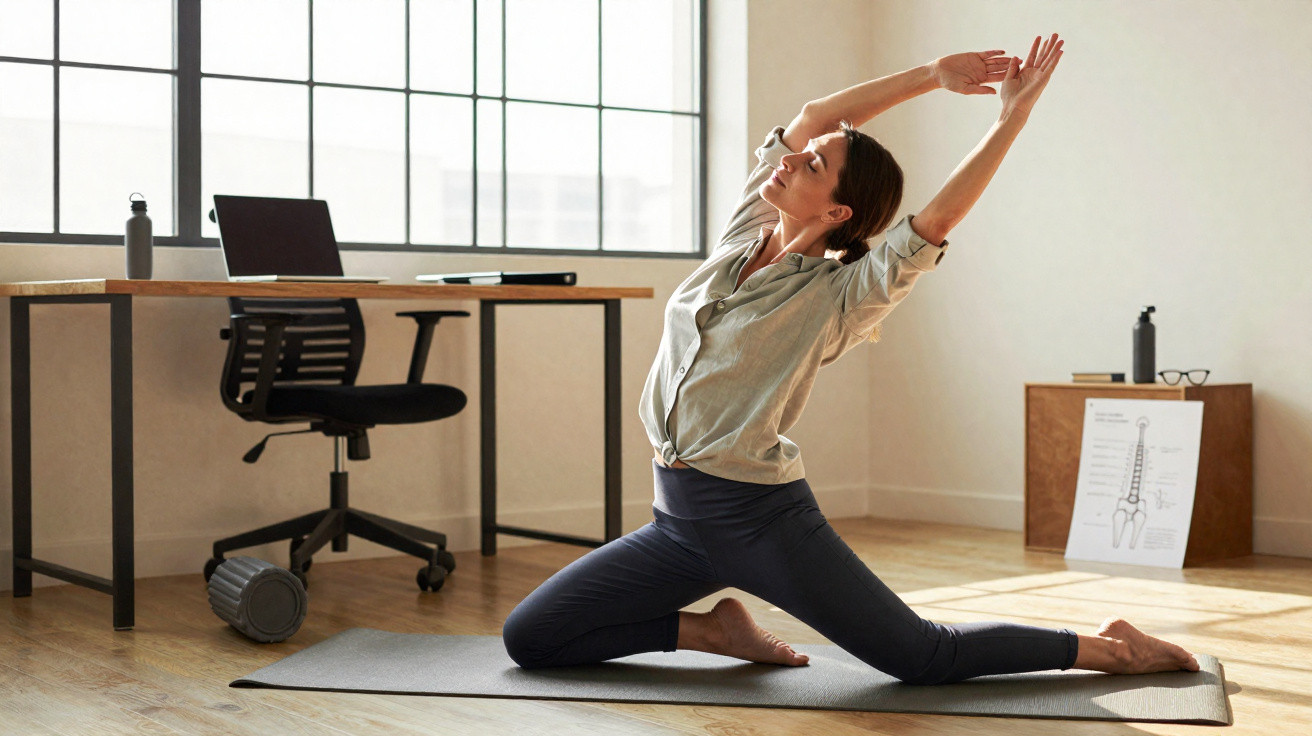
- Add one mini stretch: Reach slowly to one side while the kettle boils, or do a gentle twist in your chair. Small, frequent doses are more useful than heroic 30-minute sessions once a month.
- Spot your “default pose”: Notice how you stand when stressed or tired. Altering that one usual position can ease a surprising amount of day-to-day discomfort.
Listening differently to the body’s quiet signals
Daily discomfort rarely begins by shouting. At first, it whispers: a pull here, a pinch there, or the feeling that your body seems older in the evening than it did that morning. Most of us know the moment when we groan while rising from a chair and think, “Since when did this become hard?”
That is usually not the day your body “went wrong”. It is the day you finally became aware of the accumulated backlog.
When you begin experimenting with slight movement changes, the difference is less dramatic than a before-and-after photograph. You may feel a little less depleted at 4 p.m. Your shoulders might no longer spend quite so much time up around your ears. You may start adjusting your position without being prompted.
These are easy wins to overlook, yet they affect how you turn up at work, with your family and in your own mind. Less pain can mean more patience, better focus and more room in the day for something besides simply coping.
The simple reality is that no single stretch, chair or trick will remove every ache. Bodies are complex, and some pain requires medical support rather than posture adjustments. For many people, however, this idea has real value: alter a few of the small movements repeated throughout the day, and your “normal” level of discomfort may alter too.
You may already be doing this without labelling it as an experiment - standing during calls, stretching while streaming, or changing the way you carry your bag. That is the beginning.
The next step is both simple and, oddly, radical: pay attention. Identify the small movements that hurt and those that help, then share what you find. Someone you care about may be only one subtle adjustment away from a kinder day in their own body.
| Key point | Detail | Value for the reader |
|---|---|---|
| Micro-adjust your head and shoulders | Gently pull your chin back and lower your shoulders whenever you are using screens | Cuts neck and upper-back strain that quietly builds during the day |
| Hinge from the hips, not the waist | Use a small hip hinge and bent knees when reaching or lifting from low surfaces | Reduces lower-back pressure during everyday jobs such as cleaning or picking things up |
| Prioritise movement variety over “perfect posture” | Change position regularly instead of forcing a rigid way of standing or sitting | Keeps pain prevention realistic, sustainable and easier to fit into real life |
FAQ:
- Question 1: How long does it take to feel a difference from these small movement changes? Some people notice slight relief on the same day, particularly around the neck and shoulders. For most people, the “background ache” begins to reduce after 2–4 weeks of repeating these small adjustments.
- Question 2: Do I need special ergonomic equipment for these adjustments to work? No. A reasonable chair and suitable screen height are helpful, but the main improvements come from how you sit, stand and move within the set-up you already have.
- Question 3: Can subtle movement changes really replace exercise or stretching? Not quite. They complement each other. Small adjustments lower daily strain, while exercise and stretching build capacity. Combined, they are much more effective than either on its own.
- Question 4: What if I forget to adjust my posture most of the time? That is normal. Think of it as learning a new language: every time you remember is a “repetition”. Even a few resets per day can begin teaching your body a new default.
- Question 5: When should I stop experimenting and see a professional? If pain is sharp, worsening, wakes you at night or affects daily activities for more than a couple of weeks, it is worth speaking to a doctor or physio instead of relying solely on self-adjustments.
















Comments
No comments yet. Be the first to comment!
Leave a Comment