The man standing in front of me at the traffic lights was perhaps in his mid-forties. Jeans, trainers, headphones. When the light turned green, it took him two steps longer than the pensioner beside him to get properly moving. His hips tipped slightly forwards while his upper body stayed rigid. Nobody noticed apart from me. And probably him too, when he is on the sofa in the evening and senses that “something with his back” is no longer the way it used to be.
We all know that moment when stairs suddenly seem longer. When the walk to the station feels like a miniature hike. We blame stress or “too much office work”. Yet sometimes there is far more behind it: a quiet record of daily life, written into every step.
That record begins with ordinary walking. And it reveals more about you than you might think.
What your gait reveals about your daily life
If everyday walking is becoming increasingly difficult, it is rarely a coincidence. In effect, your body is holding up a mirror. Stiff hips can point to long hours spent sitting. A tense neck can reflect screens positioned at eye level – or too low. Tired calves may be linked to shoes chosen more for style than function.
Watch people walk for a few minutes and you can often see their routine: the constant rushing, prolonged standing, the lack of breaks. Your gait is rather like an unedited physical biography, with no filter and no autocorrect.
At a rehabilitation clinic near Cologne, a physiotherapy team films patients as they walk along a narrow corridor. One woman in her mid-thirties, a project manager, says: “I sit a lot, of course, but I’m still young.” In the video, her right foot turns slightly outwards, her left step is shorter and her shoulders drop subtly forwards. Nothing dramatic. But it is a pattern.
These tiny deviations often emerge years before terms such as “slipped disc” or “knee osteoarthritis” enter the conversation. Studies on walking speed show that people who become noticeably slower for no obvious reason often carry a combination of inactivity, stress and poor recovery. None of this immediately calls for A&E. It is more of a whisper: “This will not work well in the long term.”
The interesting part is that walking is an exceptionally complex form of full-body coordination, yet most of us treat it as a dull default setting. When particular muscles are hardly challenged in daily life, other parts take over. The hip flexors quietly protest, the glutes go to sleep and the foot muscles are, internally, throwing their hands in the air.
This compensation uses energy. Eventually, ordinary walking begins to feel demanding because you are actually getting about with an internal emergency team. Your pace, stride length and even your arm swing are like live commentary on your everyday movement habits.
How to walk more easily again – with exercises from a professional
The encouraging news is that you can restore a surprising amount of ease to your gait quite quickly. An experienced physiotherapist would first ask you to walk barefoot for a few metres, looking at three things: how your foot lands, what your hips do and whether your arms move with you. You can try this yourself, in the hallway, in the park or even along a supermarket aisle when nobody is watching.
Next comes the practical part: walk more slowly than usual. Notice deliberately how your heel touches down first, how the foot rolls through and how your toes maintain contact briefly. Let your arms swing loosely by your sides. At first, this can feel strange, almost exaggerated. It is a kind of reset for the way you move through everyday life.
Many people begin exercises full of motivation, then stop precisely when things become interesting: when unfamiliar muscles first make themselves known. Let’s be honest: nobody really does this every day in the way advice guides recommend. Nor do you need a perfect training plan.
A more useful approach is a realistic mini-framework: two, or at most three, short movement breaks each day. For example, 3 minutes of foot mobility in the morning, 10 deliberate slow steps in the office corridor in the afternoon, and a 5-minute routine for the hips and back in the evening. Small building blocks that fit into your real daily routine, not the one fitness influencers portray.
A sports physiotherapist I meet at a practice in Munich puts it this way:
“When normal walking feels difficult, it is often not a sign of weakness, but the result of clever yet unhelpful adaptations by the body. We are simply teaching it that there is another way.”
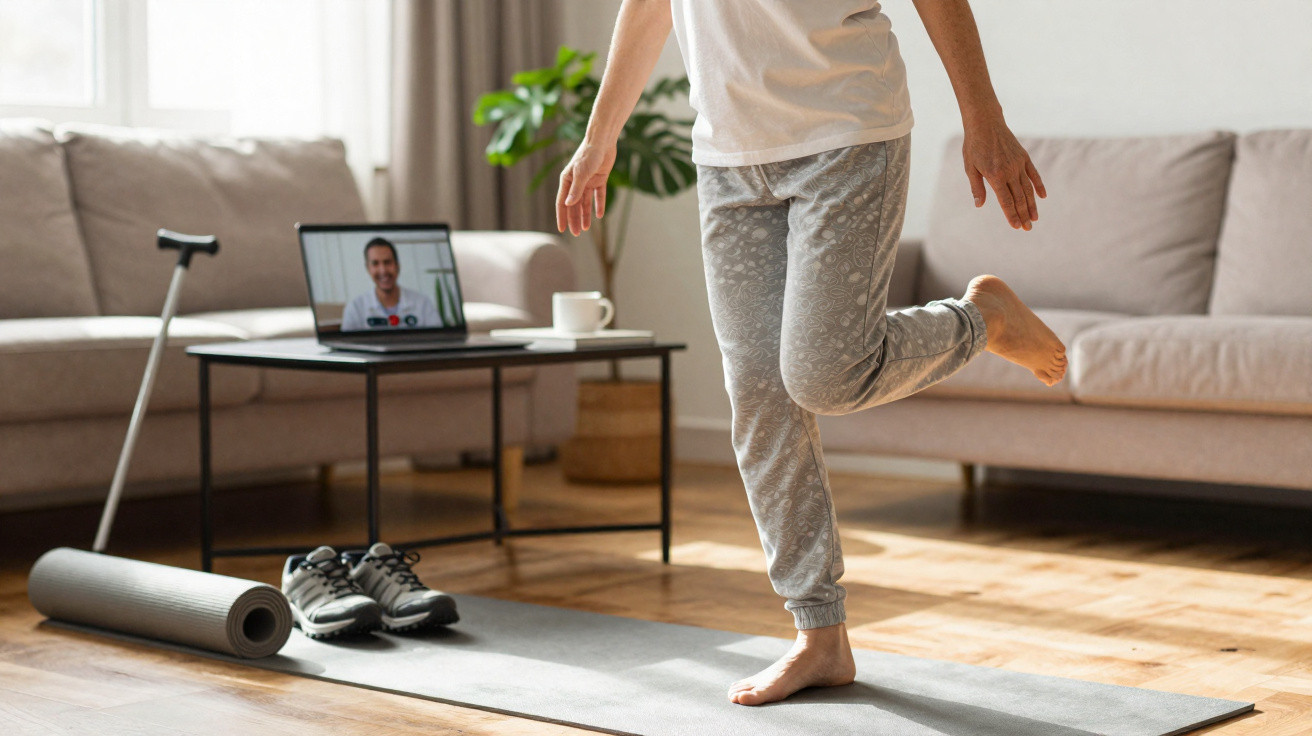
He recommends three basic exercises that almost anyone can try at home:
- 1. Foot wake-up
Stand barefoot on a towel, grip it with your toes and slowly gather the towel towards you. Do 2–3 rounds per foot. This wakes up the small foot muscles that stabilise your gait. - 2. Hip release
Stand side-on to a wall, lift one leg and swing it slowly forwards and backwards without arching your lower back. Repeat 10–15 times on each side. It gives the hips room to move again, particularly after lots of sitting. - 3. Walking reset
On a straight stretch, take 20 steps as slowly and deliberately as possible, allowing your arms to swing and keeping your gaze forwards. Once a day is enough to offer your nervous system a new pattern.
Why your daily life changes when your gait changes
Something shifts when people begin walking more easily again. Journeys suddenly feel shorter. Taking the car for a single stop becomes less automatic. Some say they feel more confident in a crowd because they know: “My feet will carry me, even when it gets tight.” It may sound trivial, but it is a genuine piece of everyday independence.
People who move steadily and smoothly make different choices. They are more likely to say, “I’ll just walk over,” rather than, “I’ll wait until someone drives.” Over weeks and months, all those small walks add up to a different feeling in the body.
The sobering reality is this: with every hour spent sitting, every missed walk and every night of insufficient sleep, your body renegotiates how much it can give you when you walk. It is remarkably honest about that. No filter, no excuses.
If you notice that even the usual walk to the station has become difficult, you can treat it as a quiet warning or as an invitation. Not to take on the next hardcore fitness challenge, but to gradually reshape your routine: hold a meeting standing up, take one flight of stairs instead of the lift, or take the short detour on foot simply because you can.
Perhaps that is the unremarkable turning point: not when you run a marathon, but when your completely normal walking starts to feel like “your” walking again.
When you sense that your body no longer has to negotiate with every step about whether it can still manage. Then every journey – to work, to the bakery, to a friend around the corner – becomes a small trial run for a life that does not feel like one long protective posture. And yes, it can begin very quietly: with one deliberate first step outside your front door.
| Key point | Detail | Benefit for the reader |
|---|---|---|
| Gait as a reflection of daily life | Pace, stride length and posture reveal time spent sitting, stress levels and movement habits | The reader spots personal patterns earlier and can take action before pain becomes chronic |
| Simple everyday exercises | Foot activation, hip mobility and deliberate walking stretches without equipment | Practical steps that can be used straight away, without a gym or a major time commitment |
| Mindset shift instead of drill | Small movement breaks and realistic routines rather than perfect training plans | Less pressure, greater everyday practicality – and a better chance of sticking with it long term |
FAQ:
Question 1: When should I be concerned if walking feels difficult?
If you notice that your usual pace has slowed considerably, you need to stop more often, or pain in your knees, hips or back keeps returning, it is worth arranging a check with your GP or a physiotherapist – particularly if it continues for several weeks.Question 2: Can more conscious walking really “repair” anything?
Not every structural injury can be reversed, but you can reduce unhelpful movement patterns, activate muscles and ease the load on your musculoskeletal system. This can make many symptoms noticeably milder.Question 3: How often should I do the exercises before noticing an effect?
Even 3–4 times a week, for a few minutes at a time, can bring noticeable changes after a few weeks. Consistency matters more than the duration of an individual session.Question 4: What if I sit almost all day because of an office job?
Then mini-breaks are invaluable: stand up briefly every 60–90 minutes, walk around the room twice and do a few hip and foot movements. It may not sound like much, but it breaks up the long, unbroken blocks of sitting in your day.Question 5: Do I need special shoes to walk better?
Not necessarily. Comfortable, flexible shoes with enough room for your toes are often sufficient. If you already have problems, a professional running or gait analysis and, where appropriate, advice on insoles may be useful.














Comments
No comments yet. Be the first to comment!
Leave a Comment