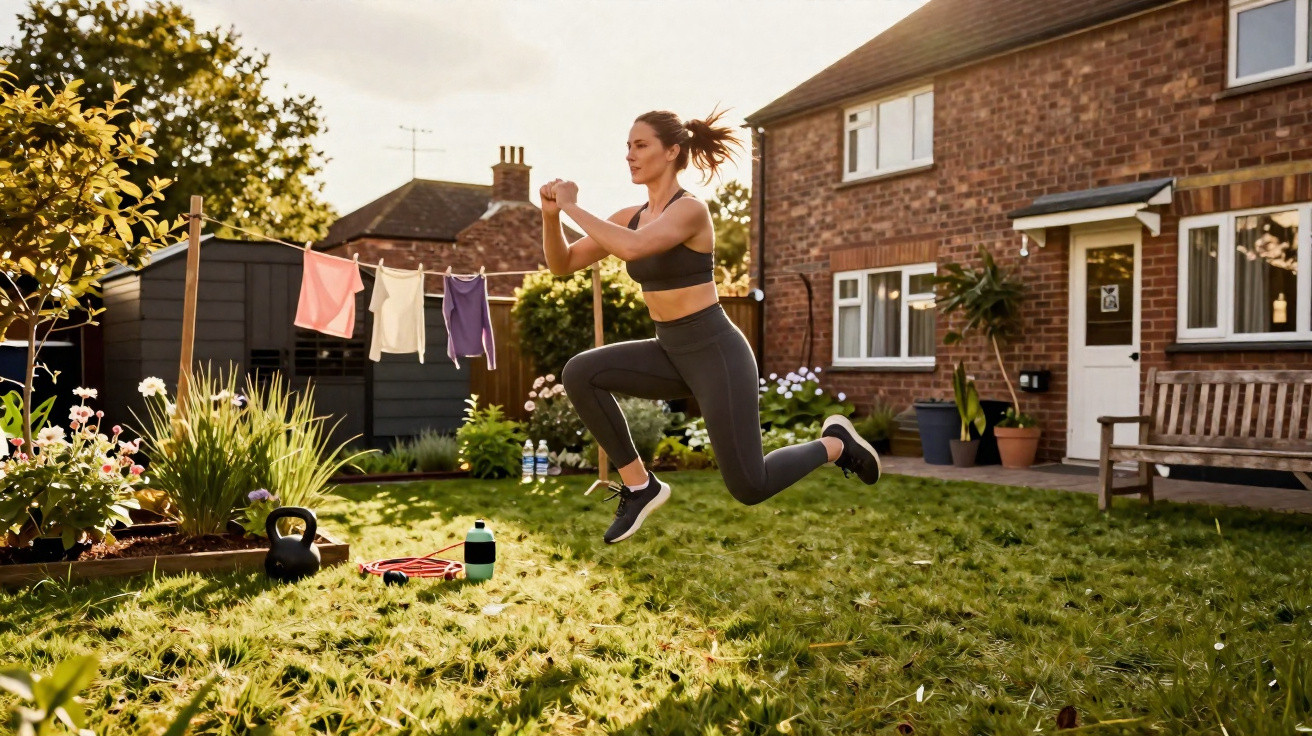
Across Britain, the pattern is familiar: a swift coffee, a hoodie pulled over pyjamas, and two square metres of lawn transformed into a workout space before the emails begin or the school run starts. Membership cards are left in drawers to collect dust, while the garden gate has become the entrance to a fresh routine. Neighbours are stretching on patios, skipping ropes are slicing through the air, and wheelbarrows are serving as sleds. It is not glamorous, but it feels free. It feels like taking back time. Why pay to exercise indoors?
The great British garden gym: what’s really happening
Stroll down any terraced street at 7am and you may see it: someone doing lunges beside a compost bin, a mat laid out next to geranium pots, resistance bands tied around a washing-line post. This is not a polished, staged trend; it is everyday people fitting exercise into the gaps in their schedules. The quiet revolution is about convenience rather than kudos. There is no journey, no queue for a bench and no locker combination to remember - only fresh air, a timer and whatever equipment can be taken outdoors.
Consider Hannah, 34, from Bristol, who emailed us a photograph of her “lawn circuit” written on a chalkboard beside the shed. She paused her £45-a-month membership, spent £20 on a skipping rope and bought a second-hand kettlebell, then began doing 20-minute workouts before her daughter gets up. “We’ve all had that moment when the bus is late and your workout evaporates,” she told me, laughing as her spaniel ran off with a resistance band halfway through a set. Her fitness routine is now five steps from the kettle, and her dog has learnt the difference between playtime and push time.
The more significant change is behavioural rather than purely financial. Lower the barriers - make the gym your lawn - and people exercise more regularly, including in brief bursts that build up over time. Micro-sessions can be slotted between Teams calls, while sunshine can make effort feel like a pleasure instead of a task. Time, rather than motivation, is fitness’s real currency. British weather can certainly challenge commitment, and privacy is not always straightforward, but the reward is a sense of autonomy that is impossible to miss.
The garden workouts that burn the most calories on your lawn
If you want to know which exercises genuinely burn energy, focus on straightforward intensity zones rather than complicated gym terminology. At a fast pace, skipping rope can burn approximately 12–15 calories per minute for a 70 kg person. Shuttle runs and hill sprints can rise even higher during the active phase. Burpees come in at around 9–12 per minute, kettlebell swings at 10–13, and rapid step-ups using a backpack at roughly 8–10. Each works well in a garden and can be adapted to the space available and the condition of your knees.
Choose four exercises, combine one cardio-focused movement with one strength-based carry, and rotate through them in brief, energetic rounds. A useful format is 30 seconds of work followed by 30 seconds of rest for 16–20 minutes: jump rope, kettlebell swings, shuttle runs to the fence, and farmer’s carries with two water cans. Realistically, hardly anyone does that every single day. The aim is to be consistent on most days, not flawless indefinitely, and exercising on grass can make it easier to lose track of the clock and simply continue.
Treat your garden as a circuit while being considerate of your joints and neighbours. Damp grass can be deceptively hazardous, so wear trainers with good grip, check the surface first and replace jump squats with step-ups when it is slippery. When in doubt, trade height for speed and keep moving.
“Your garden is a brutally honest coach,” says PT and run coach Aisha Malik. “It rewards effort, not equipment. Ten hard minutes of shuttle runs beat an hour of good intentions.”
- Jump rope: 120–150 calories per 10 work minutes (70 kg baseline)
- Shuttle runs/hill sprints: 140–180 per 10 work minutes
- Burpees: 90–120 per 10 minutes
- Kettlebell swings: 100–130 per 10 minutes
- Weighted step-ups: 80–100 per 10 minutes
- Mountain climbers: 80–100 per 10 minutes
- Bear crawls: 70–90 per 10 minutes
- Farmer’s carries: 60–90 per 10 minutes
Where the garden gym trend is heading
A wider cultural change sits behind those grass stains. People are opting for workouts that fit around their lives instead of requiring their lives to be rearranged, and for sessions that feel like fresh air rather than the buzz of fluorescent lighting. The garden does not judge. It accepts a five-minute effort and overlooks a session you miss.
Some people will alternate between garden sessions and gym sessions to get the benefits of both. Others will commit further to outdoor training, using the money saved for a good kettlebell, a reliable rope or perhaps a plan created by a coach. The idea gaining ground is that fitness is somewhere you create, rather than a place you hire. That is a worthwhile conversation to have over the fence, with two towels drying between you and both of you a little breathless.
| Key point | Detail | Benefit for the reader |
|---|---|---|
| Garden beats friction | No commute, no queues, and micro-sessions fit into everyday life | More workouts genuinely get done |
| Calorie crushers | Jump rope, shuttle runs, burpees and swings lead the pack | Pick exercises that produce strong results quickly |
| Safety and sanity | Grippy shoes, dry ground, noise-conscious routines and sensible substitutions | Avoid injury and stay considerate of neighbours |

















Comments
No comments yet. Be the first to comment!
Leave a Comment