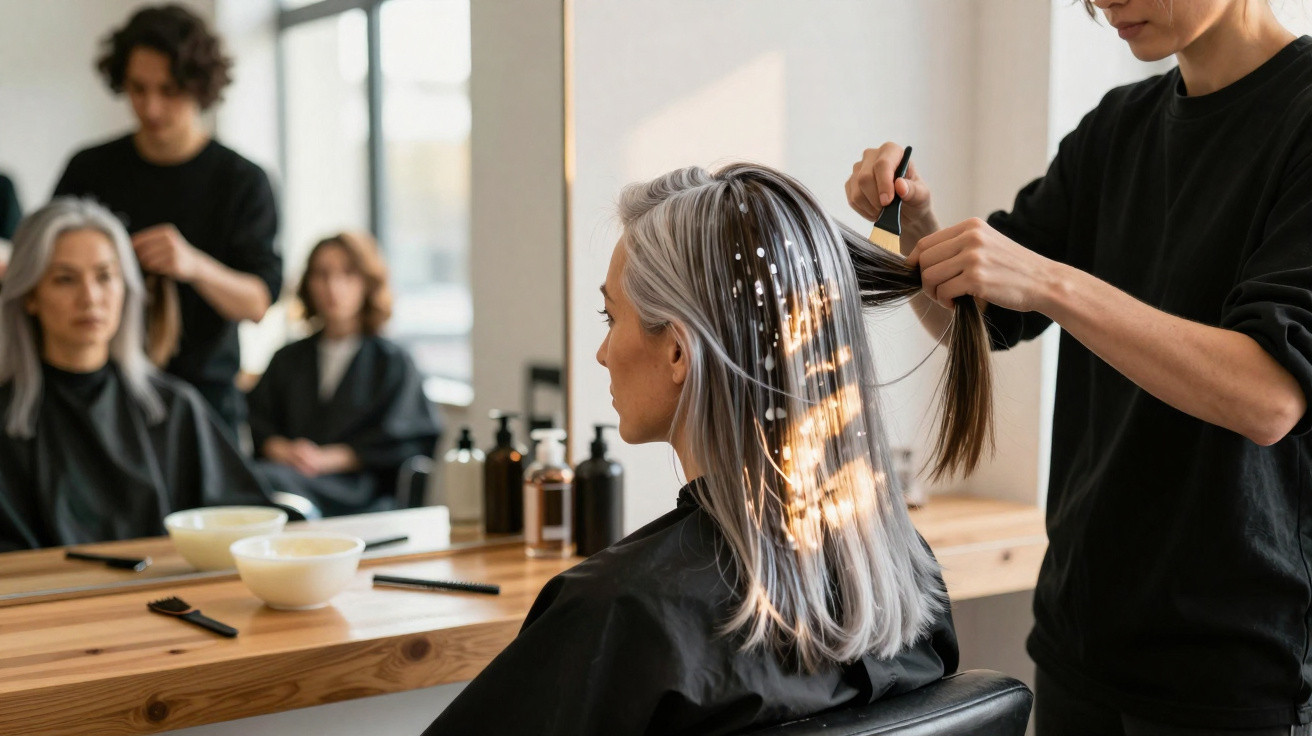
A slightly too-white light, a lock falling in the wrong place… then comes the shock: the grey hairs you were still “managing” yesterday suddenly seem to be taking over. In the salon, the standard answer was balayage – that veil of brightness designed to soften, blur and almost conceal everything. But a new trend is upending the rules without asking permission. It is a more forthright, almost defiant approach that no longer tries to hide grey hair, but puts it on display. Some colourists love it; others loathe it. The argument goes beyond technique and touches something far more personal. Could balayage already belong to the past?
From soft balayage to hard truth: the shock of the new grey method
I first saw it in person at a small London salon on a rainy Tuesday. A woman in her late forties arrived with a classic caramel balayage, the sort once pinned across every Pinterest board. Two hours later, she left with crisp silver panels running through her hair like precise brushstrokes. There was no soft melt, no babylights and no attempt to make it look “natural”. Instead, there were striking grey sections with an almost graphic quality. Everyone in the salon stopped looking at their phones. You could sense the hairdressers judging it silently – or perhaps making mental notes.
This striking approach has acquired several names in some circles: “grey framing”, “reverse contouring” and even “anti-balayage”. Its principle is straightforward: rather than blending grey hair away, it makes it more prominent. Picture strong grey or silver face-framing panels, deliberately deeper lowlights beneath them, and contrast in place of gentle graduation. It is the complete opposite of the creamy, seamless finish that made balayage Instagram’s reigning look. The figures tell a similar story: over the past year, TikTok and Instagram hashtags linked to “grey blending” and “grey framing” have surged, while traditional balayage content has quietly slowed. Something is changing.
In practical terms, the shift is logical. Balayage was created to imitate sun-kissed hair with little contrast, making it ideal for people in their twenties and thirties seeking softness. Natural greys, however, are not subtle. They are naturally sharp, reflective and high-contrast. Trying to disguise them with endless warm highlights can create a murky in-between colour and leave the ends dry. This newer approach reverses that logic, treating grey as a design feature rather than a flaw. That is why certain stylists call it “graphic grey”. It does not pretend you are a different age; it highlights your age and challenges you to embrace it.
How the “grey-shaming” method works in the salon chair
Technically, this transformation begins in a very different way from balayage. There is no dreamy talk of “sunlight” or “beach hair”. First, the stylist assesses where grey hair is naturally most visible, usually at the temples, along the parting and around the crown. They then isolate bold, intentional sections in those areas, often preserving the natural grey or enhancing it with a cool silver toner. Around these brighter areas, they add darker neutral lowlights to deepen the base. The result works rather like make-up for hair: highlight, contour and contrast.
This is where the reality of the process emerges. Many clients arrive asking to “cover everything”, as they did a decade ago, but leave with a look far bolder than expected. A 52-year-old executive I spoke to in Paris came in for “a subtle refresh” and walked out with a cool grey halo around her face over dark chocolate lengths. Her initial response to the mirror was silence, followed by laughter. Then she said quietly, “I look like my mother, but expensive.” Two weeks later, she messaged her stylist to say that three colleagues had requested her colourist’s number, while one had whispered, almost enviously, “You’re brave. I could never wear my grey like that.”
Many hairdressers have mixed feelings about it. On one side, the method feels fresh, creative and genuinely enjoyable to produce. On the other, it can subtly “shame” grey hair by turning it into something that must be styled, curated and dramatised. Grey hair is permitted only when it looks intentional and fashionable. Some colourists see that as progress: a bridge between complete coverage and going fully natural. Others believe it creates another aesthetic trap, where greys are acceptable only if they resemble a campaign image. That tension divides salons. This is not merely a debate about technique; it is an ideological disagreement about how ageing hair should look.
Adopting grey framing without losing yourself
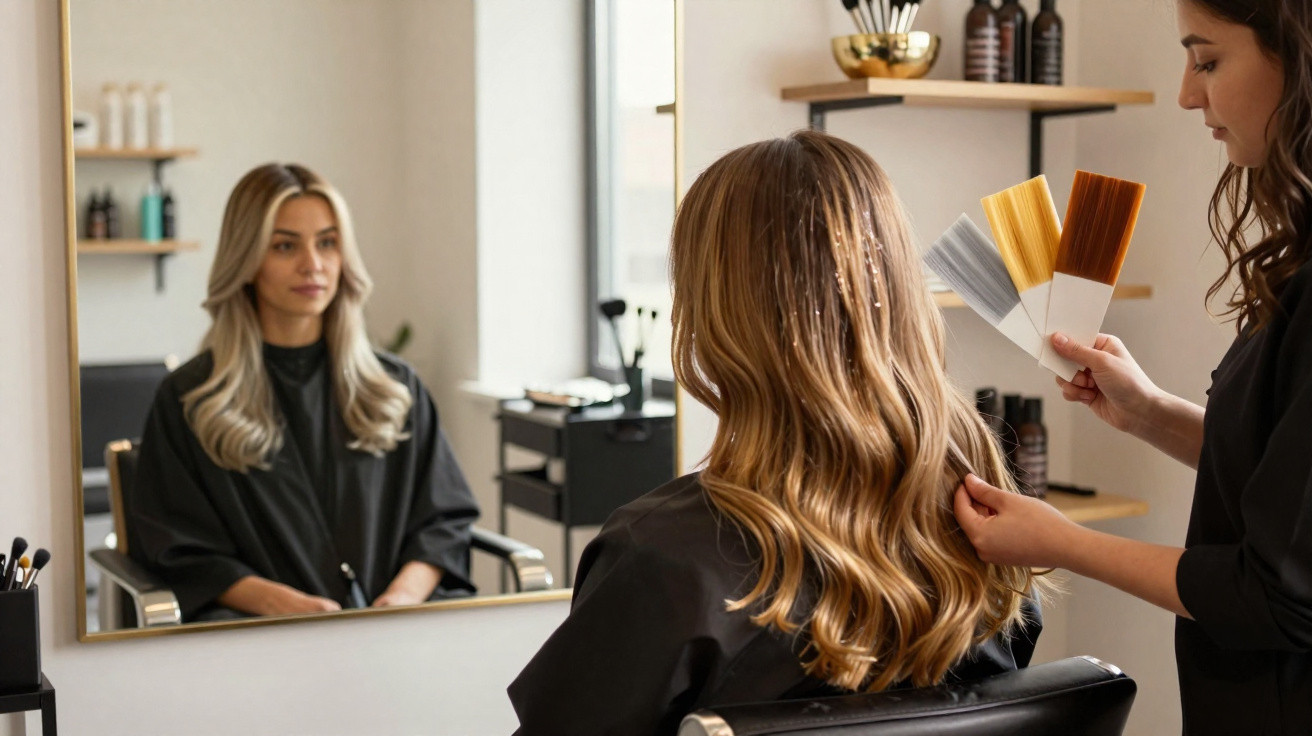
The key to this dramatic method is learning to negotiate with your own reflection. The most thoughtful stylists begin with a softer version rather than committing immediately. They may add only two or three noticeable grey panels around the face, while making the surrounding hair slightly darker for contrast, without changing the whole head. They then test how you feel about it in the mirror: changing the parting, tucking hair behind the ear or gathering it into a loose bun. You are not simply testing a colour; you are trying out a different story about who you believe yourself to be.
Problems often arise when clients bring photos of fully silver influencers but have no discussion about daily life. Are you prepared for additional toning appointments? Are you comfortable with the moment when supermarket lighting makes the grey appear harsher than it does on Instagram? That is the conversation that matters. Let’s be honest: nobody really keeps up the masks, serums and miracle glosses every day. Most people want hair that can withstand poor lighting, late nights and missed salon appointments. If your routine is already demanding, ask your colourist for a more blurred version of the trend, with lower contrast, more lived-in roots and fewer defined lines.
Some hairdressers speak bluntly about the split this has caused within their own profession.
“Half my colleagues think this grey-framing trend is genius, the other half think it’s a crime against softness,” a London colorist told me. “They say it’s too harsh, too editorial, too aging. But my clients keep asking for it because they’re sick of pretending their greys don’t exist.”
For anyone trying to make sense of the noise, these practical checks can help:
- Ask for photos of this precise technique on women your age, rather than models alone.
- Start with a test zone around the face before altering your entire head of hair.
- Trust your instincts in the mirror, not only your stylist’s enthusiasm.
- Plan a “regrowth plan” so that you understand how it will appear in three months.
An argument about age, not just hair
What makes this new method so divisive is that it does not remain a surface-level choice. It challenges the unspoken rule that grey hair should either be completely hidden or fully embraced with saintly confidence. This strong, graphic look sits in the uncomfortable space between those two positions. It says: I am not ready to give up colour, but I no longer want to fight every silver strand either. That middle ground unsettles some people. Is it liberation, or simply a more polished form of denial? The answer depends on who is looking.
Ask three people and you will hear three different stories. One woman in her thirties uses the technique as a pre-emptive move, adding artificial silver panels before her natural greys even appear because she likes its visual impact. Another woman, in her sixties, uses it as a transition away from thirty years of full-coverage dye, allowing her to “meet” her natural hair gradually rather than all at once. Somewhere between them is an exhausted mother of two who simply wants fewer root touch-ups, while privately hoping that the bold contrast makes it appear as though she chose the look rather than ran out of time.
Perhaps that explains why the trend is rising so quickly on social media. It is not only a hairstyle; it is an open confession. It says: I am ageing, I am visible and I am still playing with my image. Grey hair is no longer a quiet fact; it’s a design decision. Whether hairdressers adore or reject the method, it draws them into a deeper discussion with clients about control, vanity, exhaustion and power. Once that conversation begins, it becomes difficult to return to the idea that balayage alone can fix everything.
| Key point | Detail | Why it matters to the reader |
|---|---|---|
| The end of restrained balayage | The new method relies on contrast and confidently visible grey panels | Understand why salons are offering alternatives to classic balayage |
| A technique that divides professionals | Some colourists describe it as art, while others consider the result too harsh | Identify the right people to speak to and ask better questions at the salon |
| An identity choice as much as an aesthetic one | The method changes how people see themselves as they age | Consider your own relationship with grey hair before following the trend |















Comments
No comments yet. Be the first to comment!
Leave a Comment