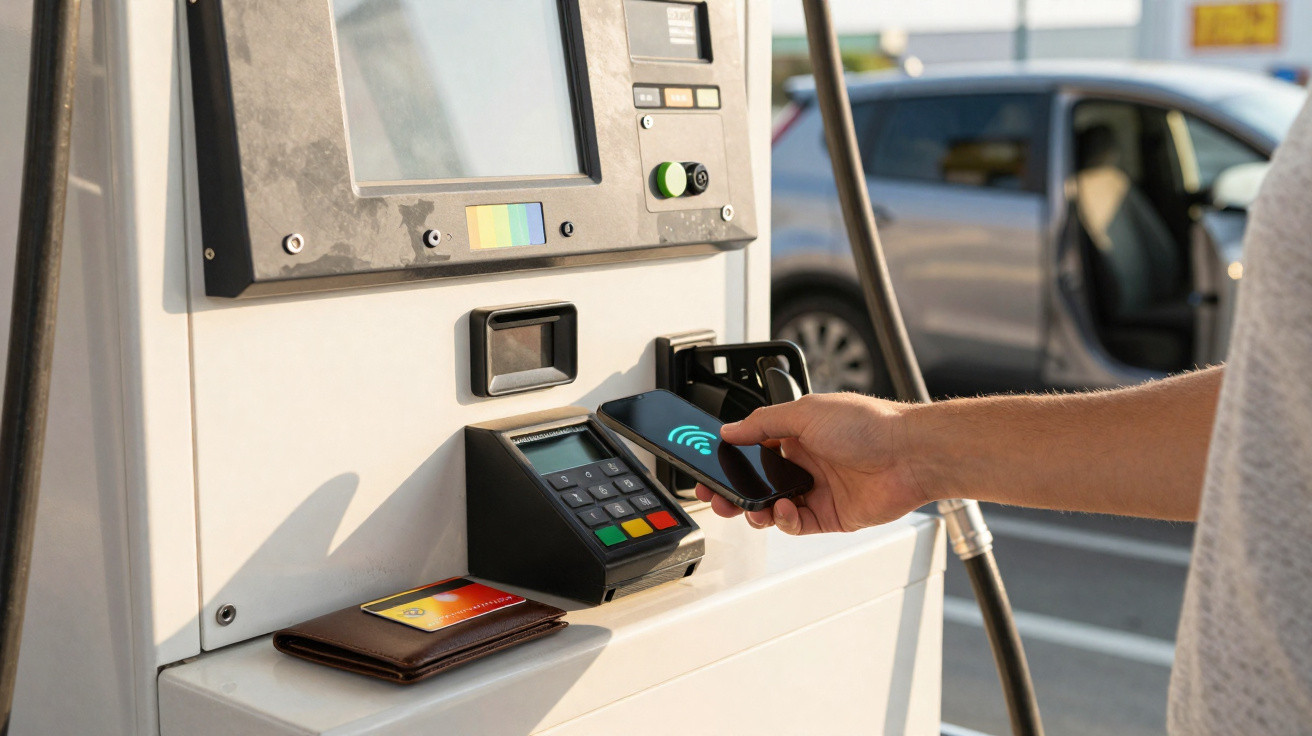
You push your debit card into the petrol pump, key in your PIN, and start doom-scrolling while the tank fills. Two minutes later, it’s already vanished from your mind - just another quick stop in a packed day.
Then, a few hours on, your banking app won’t stop buzzing. Small payments at odd stations, an online order you didn’t place, and your available balance shrinking for no clear reason.
Nothing has gone missing from your wallet. Nothing was “hacked” on a website.
It happened right there at pump number 6, in full view of everyone.
And the quiet culprit was the perfectly ordinary-looking reader that “ate” your card for a couple of seconds.
That small routine of using your debit card at the pump can be the most expensive convenience in your day-to-day life.
Why petrol station pumps are a playground for skimming thieves
Walk up to a petrol station pump and actually take it in: it often feels oddly dated. Sun-bleached stickers, misty plastic screens, a card slot that’s been abused by thousands of rushed hands. Criminals love that sort of wear and neglect. Older, lightly supervised machines are ideal for slipping in tiny skimming devices that copy card details in moments.
A busy forecourt makes it even easier. Cars queueing, drivers impatient, everyone trying to pay and go. Nobody stops to notice a slightly loose panel or a reader that doesn’t sit quite right.
Imagine this: a driver in Florida fills up on a Friday evening and pays with their debit card at an outdoor pump. By Saturday morning, their current account is empty - cleared out by a run of cash withdrawals made hundreds of kilometres away. The criminals never needed the actual card. A hidden skimmer grabbed the card number and PIN, and a cloned card handled the rest.
Later, police discovered a tiny device hidden just inside the pump door. It contained information from hundreds of cards - all taken from that single site.
Skimmers are alarmingly straightforward. A fake reader or thin overlay is placed over the genuine slot, silently copying whatever the magnetic stripe reveals. In some setups, a pinhole camera or a counterfeit keypad records your PIN as well. With outdoor pumps - often older and checked less frequently - those rigs can stay in place for days.
With a credit card, thieves run up your available limit and the bank is fighting over its own funds. With a debit card, they’re taking your rent money, your food budget, your emergency savings. That’s the difference that matters.
Why your debit card is the worst victim - and your credit card is the shield
At first glance, a debit card can feel “safer”. It’s your own money, no bill to clear later, just direct access to your current account. That’s precisely why fraudsters go after it. When a skimmer captures debit card details, they aren’t borrowing from a lender - they’re dipping straight into your everyday finances.
As soon as they start spending, your real cash is gone. That can set off overdraft fees, failed payments, and a slow, paper-heavy process to put things right.
A friend once described the month her debit card was skimmed at a motorway petrol station. She didn’t notice anything unusual at the pump. Days afterwards, her rent payment bounced because her account was suddenly short by hundreds of pounds. Her bank did investigate and did refund her - but “eventually” meant three stressful weeks of explaining the situation to her landlord, juggling bills, and counting every penny.
That’s the hidden price you won’t see in the tidy “fraud protection” slogans on posters. The time. The anxiety. The knock-on effects.
Credit card fraud is still unpleasant, but you’re standing on firmer ground. Your liability is usually limited, your main money remains separate, and disputed transactions sit on the provider’s account while they look into it. You can buy petrol, spot a suspicious payment, and contact the card issuer before it touches your day-to-day cash.
Debit doesn’t give you that buffer. It’s like walking into a dodgy area with your entire savings visible in a transparent backpack. You may be absolutely fine - but if it does go wrong, it escalates quickly.
That’s why choosing a credit card at the pump isn’t about being flashy - it’s about putting a small, sensible barrier between criminals and your current account.
How to pay at the pump without handing thieves your bank account
The safest rule is surprisingly straightforward: treat outdoor petrol pumps as credit card only territory. Where possible, use a credit card with strong fraud alerts and an app you actually check. Better still, pay inside with a chip-and-PIN terminal, particularly at older sites with battered pumps.
If you tend to use one particular brand, think about paying via their app or using contactless instead of swiping anything. A phone tap or QR-based payment sends encrypted information rather than a plain card number, which is far harder to skim from the outside of a machine.
Of course, real life isn’t neat. You’re late, you’re travelling, your preferred card is close to its limit. That’s when people slip back into the easy habit: “I’ll just use my debit this one time.” And honestly, nobody intends to do it every day - we just tell ourselves the rushed exception won’t matter.
If you genuinely have to use a debit card, try not to enter your PIN at the pump. Process it as “credit” so it routes differently and you’re not giving away the PIN. It isn’t foolproof, but it’s still safer than handing over both the card number and the PIN in one go.
We’ve all been there, that moment when you’re tired, low on gas, and just want the pump to start so you can get home. That’s exactly the moment scammers are counting on - when convenience quietly wins over caution.
- Pick a credit card with real-time alerts for every transaction.
- Pay inside at the till if a pump looks old, damaged, or strangely “repaired”.
- Give the reader and keypad a gentle tug; if anything moves or feels wrong, don’t use it.
- Prefer pumps closest to the cashier window or main entrance - criminals tend to avoid them.
- Review statements weekly, not “whenever you remember”, and challenge unknown charges quickly.
The small habit shift that can quietly protect your future self
This isn’t really a story about petrol stations. It’s about the gap between how we assume money moves and how it actually moves. One tiny choice - debit or credit at the pump - can be the difference between a small nuisance and a month-long financial headache.
You don’t need to become paranoid or spend ten minutes examining every pump like a TV detective. You just need one default: use a credit card at outdoor pumps, not a debit card. If you’re unsure, go inside or tap your phone instead.
What’s on the line isn’t only the money. It’s being able to sleep without wondering why your balance dropped overnight. It’s not having to ring your landlord or your child’s nursery to explain a strange banking problem. It’s the quiet reassurance that, if a card does get skimmed, the argument is with your card provider - not your household budget.
Next time you pull up to a pump, notice what your hand reaches for. That tiny reflex could be the smartest money habit you build this year.
| Key point | Detail | Value for the reader |
|---|---|---|
| Prefer credit over debit at pumps | Credit card fraud hits the provider’s money first, not your current account | Protects rent, bills, and everyday cash from sudden loss |
| Use safer payment methods | Chip-and-PIN inside, contactless payments, or station apps | Reduces the chance of card data being skimmed from older pumps |
| Adopt quick visual checks | Tug readers, choose pumps near the cashier, monitor alerts | A simple routine cuts risk without slowing you down |
FAQ:
- Question 1 Is using a debit card at a petrol pump always unsafe? Not always, but it is riskier than using a credit card. Outdoor pumps are common targets for skimmers, and debit details can give direct access to your bank account. Credit adds separation and typically stronger protections.
- Question 2 How can I tell if a petrol pump has a skimmer? Check for card slots that look misaligned or sit oddly, wobbly keypads, broken security seals, or parts that look newer than the rest of the pump. If something feels off when you tug it, use a different pump or pay inside.
- Question 3 Is tapping my phone or card safer than swiping? Yes. Contactless payments use encrypted tokens rather than your actual card number, which makes them much harder to skim from the outside of a machine.
- Question 4 What should I do if I suspect my card was skimmed? Contact your bank or card provider straight away, lock or freeze the card in your app if you can, dispute any suspicious transactions, and ask for a replacement with a new card number. Then keep a close eye on the account for the next few weeks.
- Question 5 Are some petrol stations safer than others? Sites with newer pumps, visible security seals, good lighting, and pumps near the cashier are generally safer. Larger, well-maintained chains often inspect equipment more often, but nowhere is completely risk-free.














Comments
No comments yet. Be the first to comment!
Leave a Comment