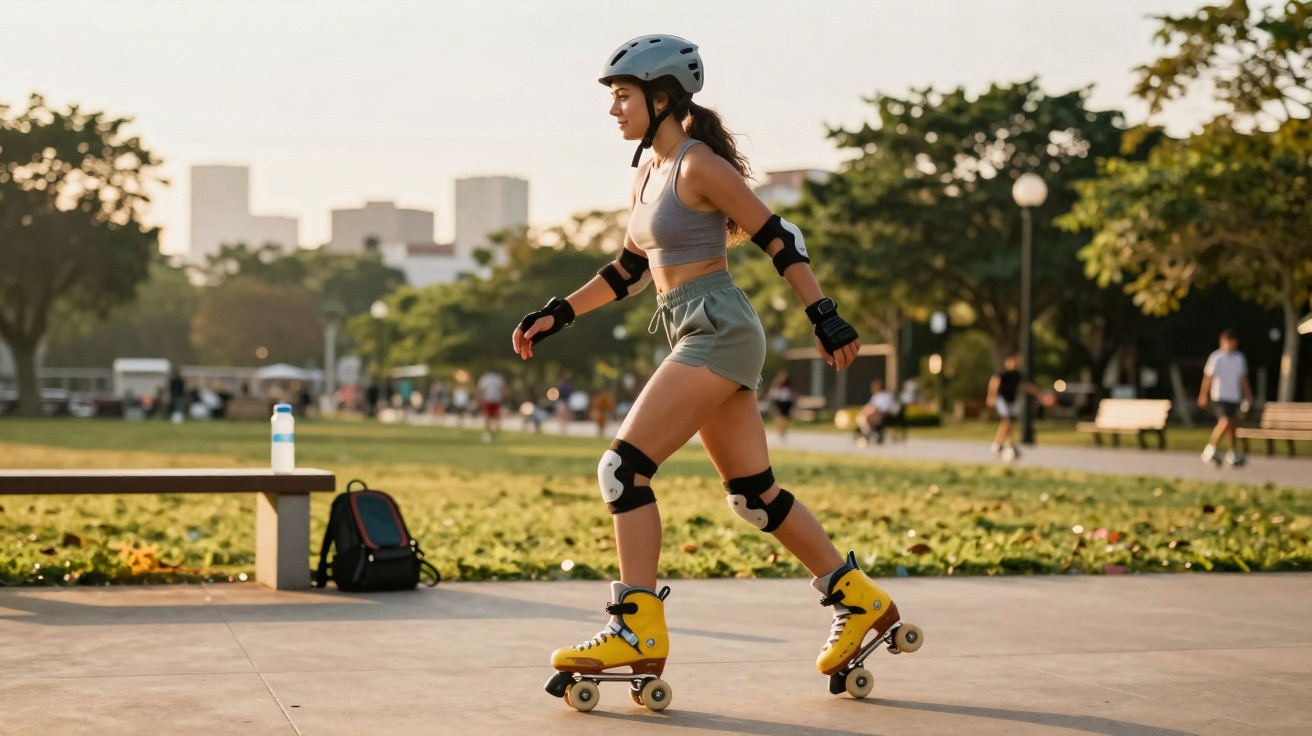
Along the promenade, a group of teenagers rolls past: headphones on, slightly unsteady knees, loud laughter. A few metres away, a man with grey at his temples circles with focused ease, as if he has done nothing else all his life. His skate wheels hum steadily over the ground, his upper body relaxed and his gaze calm. An older woman stops and quietly says to her friend: “That is how I want to be moving at 70, too.” We all know that moment: someone seems to glide effortlessly past, and you think, why am I not doing that as well?
Roller skating as a secret endurance booster
Anyone who does a few laps on skates soon notices that this is more than a childhood memory: it is cardio in disguise. Your heart beats faster, you breathe more deeply and your cheeks grow warm, yet it feels more like play than exercise. Many people who inwardly switch off at the word “jogging” suddenly manage 45 minutes on wheels. Quite simply because time passes differently when you are gliding rather than running. Your brain is occupied with balance, bends and little forward pushes. Movement becomes a flow.
A University of Massachusetts study compared the energy expenditure of roller skating with jogging. Its finding was that 30 minutes of moderate skating burns roughly as many calories as an easy run, while placing considerably less impact stress on the joints. People with chronic knee pain often describe the difference as “finally being able to move again without fearing the next stab of pain”. One 40-year-old IT worker told me that he took up skating again after years of desk-based work: first five minutes, then ten, then half an hour. All at once, his lunch break was no longer just the canteen and a phone screen.
From a physiological perspective, roller skating does something interesting: the steady, rhythmic leg action challenges the cardiovascular system without overwhelming it. The glide phase provides relief, while the push-off phase demands effort. Joints such as the knees and hips experience less impact than they do when running because the movement is lateral and fluid. That combination makes roller skating an endurance workout that can be maintained for a long time, especially by people who do not see themselves as “sporty”. It is precisely in this grey area between play and sport that the real effect emerges.
Leg muscles and coordination: strength training you barely notice
Anyone standing on skates for the first time in years will discover within minutes which muscles have been waiting to make themselves known. The legs work constantly: thighs, glutes, calves and even the small muscles around the ankles. They are working continuously because every slight unevenness has to be balanced out. Your core also makes almost imperceptible adjustments to stop you from tipping sideways. It is like full-body strength training running quietly in the background.
A friend of mine who had never enjoyed going to the gym impulsively bought a pair of retro-style roller skates. “Just for fun,” she said. After four weeks of skating twice a week, she told me that her jeans suddenly fitted differently. Not tighter, as she had first assumed, but firmer around the thighs, with her bottom more lifted. She had not done a single squat in front of the mirror, no leg presses and no programme. She had simply gone round the park, practised braking, fallen over once or twice, laughed and got back up. Meanwhile, her body had started to build muscle.
The effect on coordination is almost more fascinating than the effect on muscle. When roller skating, the nervous system works at full speed: the eyes, the balance organs in the inner ear, and proprioception in the joints and muscles all need to work together within milliseconds. Every push-off is a miniature balance test, and every bend invites fine coordination. Over time, something like “movement intelligence” develops, becoming noticeable in everyday life: climbing stairs feels easier, you stumble less often and your body responds more skilfully. That may sound abstract until you realise you can suddenly balance a full cup of coffee and a shopping bag without thinking about it.
How to start without overdoing it
The first step is often unspectacular: put on your skates, hold on to something and take a breath. A realistic beginning does not look like the Instagram videos in which everyone dances backwards. Realistic means 10–15 minutes on a smooth surface, such as an empty car park in the evening or a quiet path in the park. Start simply by rolling off, stopping and rolling again. A small goal is 3–4 sessions by the end of the week, each short but regular. Let us be honest: nobody truly does it every day.
The most common mistake is doing too much, too quickly and with too much ambition. Your inner voice whispers, “Make it 45 minutes straight away, otherwise it is pointless” – and that is exactly where many people stop. The body becomes overloaded, your legs burn, your ankles ache the next morning and the dream of better endurance ends up abandoned. It is far wiser to act like a curious child: playfully, without performance pressure. Skate two laps, pause briefly, breathe, laugh, then carry on. Another classic error is ignoring protective equipment. Yes, wrist guards do not look particularly cool. But a broken wrist looks far less cool.
A coach at a roller skating rink in Cologne put it like this:
“Anyone who skates trains three things at once: courage, muscles and balance. The muscles build up relatively quickly, balance comes with time – and every small fall you get through helps with courage.”
If you want to build a routine gradually, a simple structure can help:
- Week 1: 3 sessions of 10–15 minutes, focus: setting off, braking and relaxed rolling
- Week 2: 3–4 sessions of 20 minutes, focus: gentle bends and varying the pace
- Week 3: 3 sessions of 25–30 minutes, focus: fluid movement and longer stretches without stopping
- From week 4: duration according to how you feel and your energy that day, with one rest day between longer sessions
This allows your endurance to develop gradually without you labelling it “training”. Your leg muscles quietly complete their strength programme in the background.
Why roller skating feels different from “exercise”
Roller skating has a curious effect: movement suddenly stops feeling like a duty and starts feeling like a small escape from everyday life. Anyone who spends the day moving between a screen, meetings and the supermarket finds a brief sense of lightness on wheels. You are not merely getting from place to place; you are gliding. The city, the park and the river all look different when you roll instead of walk. Many people say that skating clears their head more effectively than running because concentrating on balance and surroundings interrupts the brain’s loops of overthinking.
At the same time, it contains a quiet kind of rebellion against the conventional fitness routine. No counting repetitions, no app tracking every second and no “No pain, no gain” mantra. Instead, there are small moments of success: the first clean bend, the first longer distance without fear, the first time you notice that your breathing is fast but no longer panicked. For some, it feels almost like reclaiming a piece of childhood – only with better body awareness and perhaps a little more caution.
And yes, there are days when your legs feel heavy, the tarmac seems rough and you wonder why you are putting yourself through it. The sober truth is that those days are part of it. They belong to the quiet resolve to make your body your own again, step by step – or rather, roll by roll. When you eventually realise that you can keep going for 30 minutes without thinking about it, that your calves look more defined, your knees feel steadier and you generally feel more alert, it becomes clear: this seemingly easy hobby can be a remarkably effective health ritual that does not feel like a “programme”.
| Key point | Detail | Benefit for the reader |
|---|---|---|
| Endurance | Moderate roller skating challenges the heart and lungs in a similar way to light jogging, but with lower impact stress | Suitable for anyone wanting to strengthen their cardiovascular system without overloading their joints |
| Leg muscles | Continuous push-off and stabilising work strengthens the thighs, glutes, calves and foot muscles | Visibly firmer legs and more everyday strength, without conventional strength training |
| Coordination | Constant balancing improves equilibrium, responsiveness and body awareness | Fewer stumbles, a more secure sense of movement and greater confidence in your own body |










Comments
No comments yet. Be the first to comment!
Leave a Comment