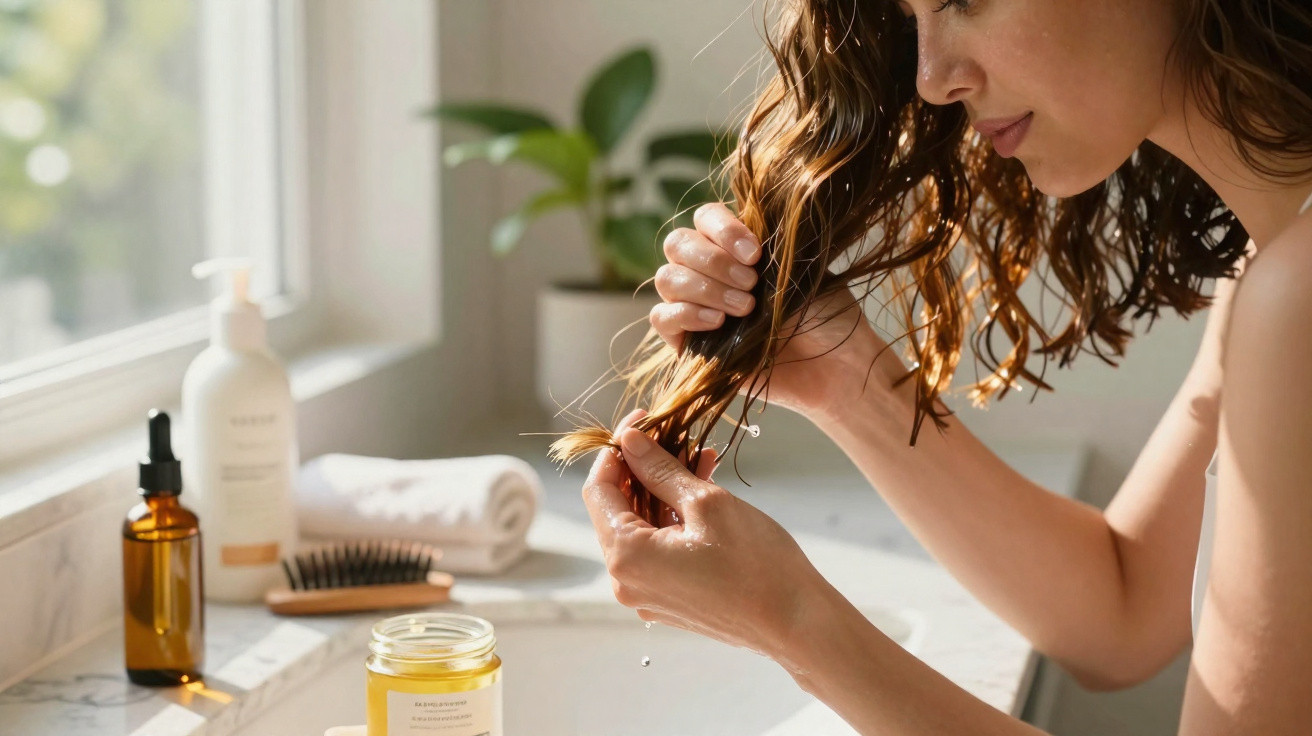
Many people still have dull, brittle hair despite using treatments, masks and expensive shampoos. A prominent Los Angeles hairstylist therefore relies on a surprisingly simple pre-wash routine, reportedly used on celebrities too: oil first, then shampoo, then conditioner. When applied correctly and with a suitable oil, the method promises visibly softer, smoother hair within just a few weeks.
What the OWC method involves
OWC stands for “Oil – Wash – Conditioner”. Rather than being a complicated treatment, it simply changes the order of a hair-washing routine. The principle is that hair receives a protective layer before shampoo and conditioner are applied.
“Applying oil before washing is intended to stop shampoo from unnecessarily drying out the lengths and stripping proteins from the hair.”
Although the process is straightforward, it targets a specific result: helping hair retain more moisture and structural integrity, particularly when the lengths are already damaged.
The routine step by step
- Oil: Work a small amount gently through the mid-lengths and ends.
- Wash: Apply shampoo mainly to the scalp rather than rubbing it through all of the lengths.
- Conditioner: Once the shampoo has been rinsed out, apply conditioner to the mid-lengths and ends, leave it on briefly, then rinse again.
This routine differs only slightly from a standard wash. The key changes are applying oil first and using shampoo more deliberately.
Why oil before washing may make sense
On social media, the method can initially look like the latest trend. However, some dermatological and cosmetic expert sources offer plausible reasons for it.
In a frequently cited study published in a medical research database, coconut oil significantly reduced protein loss from hair. The effect appeared in both damaged and undamaged hair, whether the oil was used before or after washing. In the same study, sunflower oil and mineral oil did not produce this result.
Protein loss is one of the main causes of breakage, split ends and lacklustre lengths. This is precisely where the OWC method comes in: the oil is intended to shield hair from contact with shampoo and slow the loss of structural components.
Coconut oil in focus – but not every hair type enjoys it
One oil appears repeatedly in reports: coconut oil. Expert sources describe it as an oil that can penetrate deeply into the hair fibre and bind proteins. A long-term study of the scalp microbiome also suggests that coconut oil could improve conditions on the scalp, for example by supporting a more balanced interaction between bacteria and fungi.
That said, coconut oil is not automatically suitable for every hair type. It can weigh very fine hair down quickly, while thicker, drier hair may initially feel hard if too much is used.
Oils to consider and what they suit
| Oil | Property | Suitable for |
|---|---|---|
| Coconut oil | penetrates deeply, protects proteins | damaged, porous, thick hair |
| Argan oil | lighter, smooths the surface | medium to thick hair, frizz |
| Jojoba oil | similar to the skin’s natural oils, relatively light | finer hair, sensitive scalp |
| Olive oil | rich, heavy | very dry, strong hair |
The important thing is to begin with small amounts. For medium-length hair, an amount ranging from pea-sized to almond-sized is often entirely sufficient.
Who may benefit most from this washing routine
The approach does not work equally well for every hair type. Yet it can make a noticeable difference for severely dehydrated lengths in particular.
“Anyone with coloured, bleached or naturally curly hair puts its structure under strain with every wash. A layer of oil beforehand can be very helpful here.”
Hair types that may benefit especially
- coloured or bleached hair
- hair with visible frizz or persistent breakage
- very dry, curly or wavy hair
- hair that is frequently heat-styled with straighteners, curling tongs or a hairdryer
Anyone who already notices that shampoo dries out their lengths every time may find the OWC method a relatively easy countermeasure.
When the method is more likely to cause problems
For extremely fine hair or a scalp that becomes oily quickly, the effect can be counterproductive. Too much oil can leave hair flat and roots greasy, making more frequent washing necessary. This increases the strain on both hair and scalp again.
Dermatological guidance stresses that washing frequency should always match the individual hair type. An oily scalp generally needs washing more often, while dry or strongly textured hair usually needs it less frequently. Working completely against your hair type can lead to irritation or dull-looking lengths.
How to use the OWC method in practice
Anyone wanting to try the routine should not begin with an elaborate “deluxe oil treatment”. A practical starting point looks like this:
- Divide dry or slightly damp hair into two to four sections.
- Rub a small amount of oil between your palms.
- Smooth it only over the mid-lengths and ends, not the scalp.
- Leave it on for 10 to 30 minutes, depending on hair thickness.
- Distribute shampoo mainly over the scalp, allowing only the foam to coat the lengths.
- Rinse, then apply conditioner to the mid-lengths and ends before rinsing once more.
For many people, using the routine once or twice a week is enough. Those who wash daily can use oil only on every second wash to avoid over-conditioning.
How quickly can results be seen?
Some users report noticeably softer lengths after the first two or three applications. From a professional perspective, several weeks is a more realistic timeframe. Structurally damaged hair cannot be completely rebuilt, but reduced protein loss and less friction can make it look significantly more cared for.
With bleached or heavily chemically treated hair in particular, it is worth making a comparison: before-and-after photographs over four to six weeks reveal changes more clearly than everyday observation does.
Risks, limitations and useful additions
Despite the positive feedback, this method does not replace basic hair care. Anyone who regularly bleaches their hair, uses intense heat or wears very tight hairstyles will still damage the hair structure. Applying oil before washing may reduce that damage, but it does not reverse it.
Scalp irritation is rarely caused by the oil layer itself. It is more likely when the oil requires excessively thorough washing afterwards. Aggressive rubbing or harsh shampoos can encourage dandruff and itching. In this case, it is worth choosing mild surfactants and using lukewarm water rather than taking hot showers.
Useful additions include heat-protection sprays before blow-drying or straightening, microfibre towels or cotton T-shirts for drying instead of rough towels, and soft hair ties without metal parts. Combined with the OWC method, these measures create a routine that places considerably less stress on hair and scalp.
It is also helpful to understand the basic terms on shampoo and conditioner bottles: “moisture” mainly aims to make hair feel soft and lightweight, while “repair” focuses more on compensating for structural loss through film-forming ingredients and proteins. Using too much protein care alongside the oil routine can make hair feel hard and brittle; in that case, switching temporarily to more moisture-focused products can help.
Anyone who is curious can incorporate the OWC method into their routine for a trial period of four weeks. With phone photographs, a small amount of product and an honest assessment of their own hair type, it is fairly easy to find out whether this Hollywood trick makes a difference in the bathroom at home too.















Comments
No comments yet. Be the first to comment!
Leave a Comment