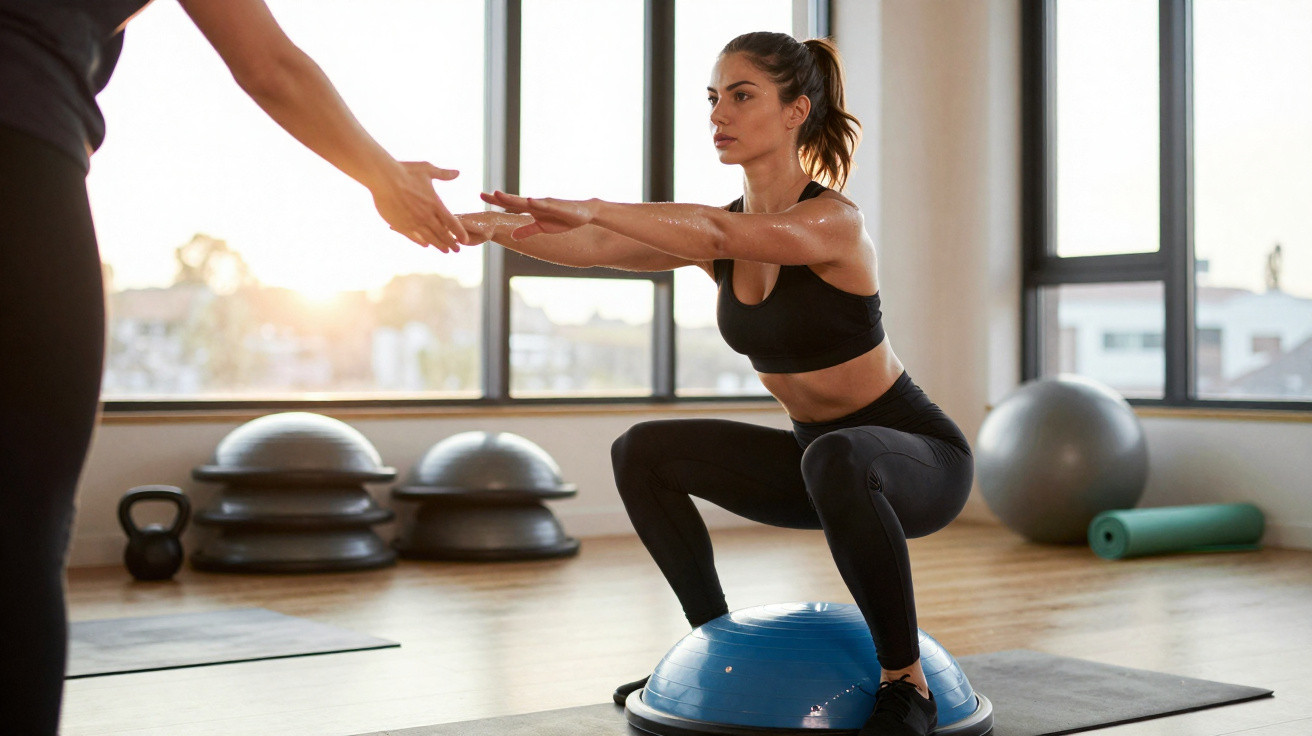
Between tired faces and half-hearted curls, a young woman stands on an unsteady blue balance pad. Her knees are trembling, while the dumbbell above her head sways alarmingly. Two mats away, a man methodically lifts weights on solid ground, with perfect control but an almost mechanical quality. The contrast is nearly tangible: clean, linear strength on one side; nervous, vibrating effort running through the entire body on the other. We all know that moment when it becomes clear that more is happening than meets the eye. The trainer leans towards me and whispers: “Every muscle really is working on that thing.”
Why unstable surfaces create a little chaos in the body – and why that is beneficial
Anyone stepping onto a balance pad, BOSU ball or unstable roller for the first time notices it within seconds: the body has to fight. The muscles in the feet grip reflexively, the calves fire up and the core braces, even though you are supposedly “just” standing still. This quiet alarm in the nervous system is exactly why experts are so enthusiastic about unstable training. Suddenly, it is not only the large, visible muscles doing the work, but an entire army of smaller helpers that are often dormant in everyday life. Let’s be honest: conventional machine training can sometimes feel like working on autopilot. An unstable surface abruptly pulls us out of that state.
A sports scientist from Cologne told me about a straightforward experiment involving her students. Group A performed squats conventionally on the floor. Group B did the identical exercise on a slightly unsteady pad. After four weeks, EMG measurements of muscle activation showed that the deep muscles around the knees and hips were considerably more active in Group B, even once they had returned to solid ground. This was not magic, but measurable data. Another gym in Munich reports that clients with recurring knee pain while cycling mentioned discomfort less frequently after targeted training on unstable surfaces. No surprise, say the physiotherapists there, because the joint learns to stabilise itself in microseconds.
From a scientific perspective, something interesting is taking place: unstable surfaces push balance beyond its comfort zone. The nervous system continuously receives small disruptive signals from joint receptors. Every disturbance triggers an automatic response – muscles switch on, counteract and adjust. As a result, more muscle groups are activated simultaneously, in a constantly changing sequence. It is an entirely different proposition from a guided leg press. Anyone wanting to climb stairs more confidently in everyday life, react faster to a stumble or move more nimbly in sport can benefit from this “organised chaos”. The body learns not only to be strong, but also alert and adaptable.
How to add unstable training to your workout without overdoing it
Getting started does not need to be dramatic. A basic balance pad or a rolled-up towel is enough at first. Stand on it barefoot, with your knees slightly bent and your eyes looking ahead. Hold the position for 20 to 30 seconds without holding onto anything. Notice what is happening in your feet. Then perform a few slow squats, making sure your knees do not collapse inwards. Once you can stand securely, you can move familiar exercises such as shoulder presses, biceps curls or light lunges onto unstable surfaces. The key rule is this: learn the movement properly first, then introduce instability – never the other way round.
Many people make the same mistake at the beginning: they choose surfaces that are far too wobbly and weights that are too heavy. The ego wants spectacular moves for Instagram, while the body needs a clear learning progression. Unstable training should challenge you, not frighten you. If you completely topple over or tense up on the first repetition, the setup is too difficult. Trainers often tell me about people who jump onto a BOSU once in an overenthusiastic moment, fall, get frightened and then abandon the whole idea for months. That is a shame, because when the difficulty is increased gradually, instability feels more like an engaging game than a test.
An experienced physiotherapist from Berlin shared her rule of thumb with me:
“An unstable surface is like a good espresso: perfect in a small dose, but in too large a quantity it only makes your hands shake.”
She advises her patients to focus on three points:
- Stability first, then intensity – If your basic position is unsteady, every additional kilogram is too much.
- Use only enough instability to keep you focused, not panicked.
- Take at least one or two calm breaths per repetition – otherwise, you are training stress rather than muscles.
Let’s be honest: nobody really does this every day. But anyone who includes a few minutes on unstable surfaces two to three times a week is quietly creating a reliable safety belt for their knees, hips and back.
More than muscle soreness: how unstable training affects everyday life
People who spend longer training on unstable surfaces often describe small, unglamorous yet very specific changes. One person says she no longer loses her balance as easily on a crowded bus. Another notices that his lower back complains less quickly when lifting boxes. These are the small successes that are difficult to package into personal-best figures or before-and-after photos, yet they are what keep most people training. Unstable training acts like a fine-tuning programme for the connection between mind and body. It gives you the sense that you are more quickly “online” in your own body.
Those who spend long hours at a desk often initially notice only tired eyes and tension in the neck. Unstable training operates at a different level. It directs attention down into the feet, the centre of the body and the space around you. Suddenly, you become aware of how you step, land and take corners. Many experts tell me they would ideally establish unstable exercises in PE lessons before teenagers start handling heavy dumbbells. A stable body is not created by strong muscles alone, after all, but by a nervous system that reacts with alertness and curiosity.
Whether you compete in sport, play energetically with your children in the park or simply want to twist your ankle less often, the underlying logic remains the same. You are not merely training how much weight you can move, but how quickly your body makes sensible decisions. A tiny tilt at the ankle, a rapid response from the hip, a reflexive brace through the torso: all of this happens in the background while, outwardly, you are “just” standing on a wobbly pad. Perhaps that is the subtle appeal of this form of training: it feels unspectacular, yet works on fundamental qualities that you only notice once they are absent.
| Key point | Detail | Benefit for the reader |
|---|---|---|
| Greater muscle activation | Unstable surfaces activate numerous small stabilising muscles alongside the larger muscle groups | Better full-body training in less time, without unusual equipment |
| Training the nervous system | Balance and coordination are developed through continual micro-corrections | More confident everyday movement and lower risk when stumbling or changing direction quickly |
| Easy starting point | A towel, cushion or simple balance pad is enough for initial exercises | Can be put into practice immediately, including at home and without a large budget |













Comments
No comments yet. Be the first to comment!
Leave a Comment