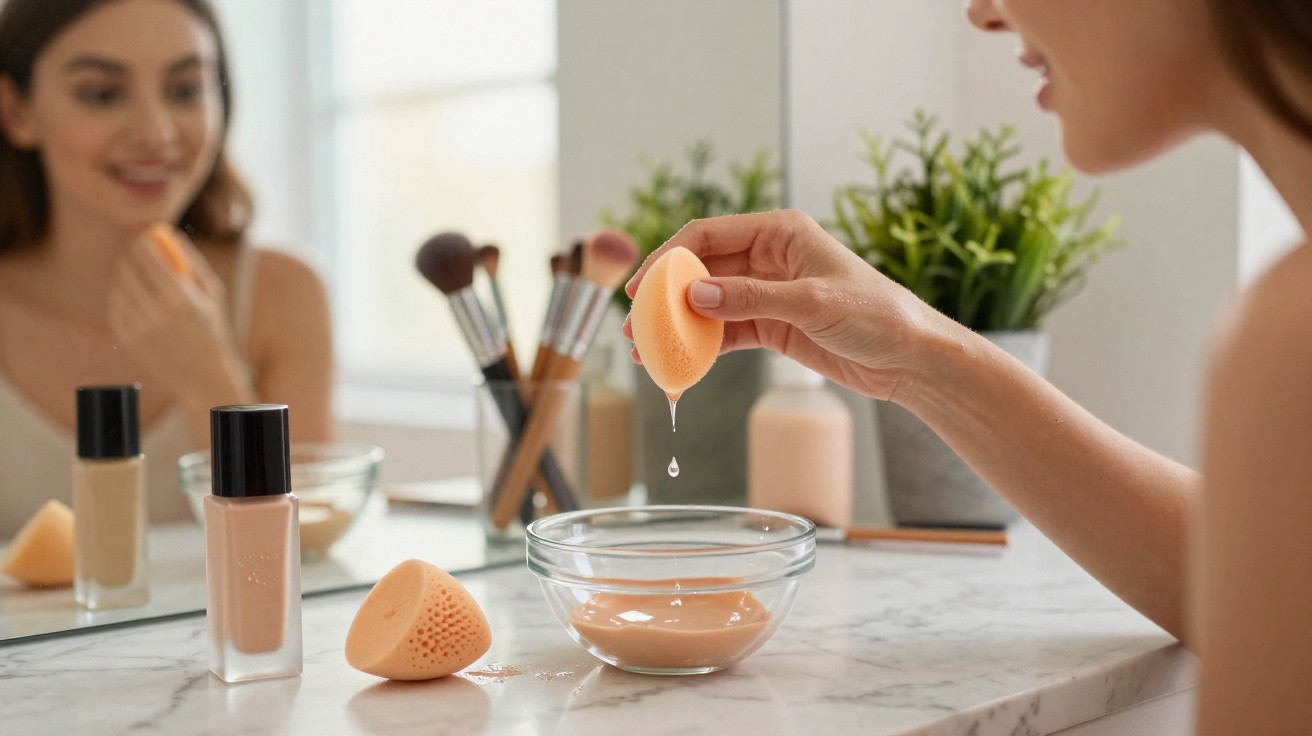
The girl in the mirror is doing everything “right”.
The ring light is on. A viral TikTok sponge is in her hand. £40 worth of radiant foundation is lined up beside the sink. She dots it onto her cheeks, picks up the sponge… and begins bouncing it around her face like a tennis ball. Two minutes later, her skin looks… fine. The back of her hand is covered in smears, the sponge is totally saturated, and her brand-new bottle already seems noticeably lighter.
You have probably felt that same little flash of frustration. Your makeup looks decent, but not amazing, while the expensive products somehow disappear at speed. There is no satisfying glimpse of the pan or moment of reaching the bottom. Just a sponge that appears to drink more quickly than you do on a Friday night.
Here is the catch: the issue is usually not your foundation, or even your skin type. It is one quiet, instinctive step that nearly everyone repeats without a second thought.
This small makeup sponge habit is draining your foundation budget
Most people use a makeup sponge as though it were a paint roller: large bouncing movements, sweeping across the whole face, beginning in the centre and working outwards. It looks pleasing, creates a blurred finish and feels rather professional.
But in reality, the sponge behaves like a tiny thirsty cushion. Each time you drag it or press it firmly over your skin, it retains more product than it leaves behind. Your complexion may look soft, yet the sponge is getting the better glow.
The most frustrating part is that this error does not look like an error. It simply appears to be “doing your makeup”. That is exactly why it can become so expensive.
Imagine a Monday morning in a small bathroom with unflattering lighting. You are running late, so you dispense extra foundation onto the back of your hand “just in case”. The first few taps with the sponge seem alright, but redness is still showing through.
So you apply more, then more again. By the time the coverage is nearly where you want it, your sponge has a heavy stain on it and barely any product remains on your hand. A month later, the bottle is alarmingly close to empty.
Now apply that to concealer, contour and cream blusher. A single tool absorbs all of them in tiny layers. One beauty retailer estimated that frequent sponge users can get through base products up to 30–40% faster. That is more than irritating: over a year, it is genuine money disappearing into foam.
There is a straightforward physical reason for this gradual waste. Sponges are designed to be porous. Dry foam acts like a vacuum for liquid and cream formulas. When you press hard or swipe, you increase the contact between the wet makeup and all those minute openings, allowing product to travel inwards instead of staying on your skin.
Your skin, meanwhile, has slight texture, natural oil and uneven areas. It does not hold product as consistently as sponge material does. So when both are effectively competing for the foundation, the sponge generally wins.
That is why so many people think they “need” full-coverage formulas. Frequently, they do not. They are simply giving more product to the sponge than to their face. The solution is to change which one gets first claim.
The simple change that puts your skin back first
The main solution is almost absurdly easy: always use your sponge damp, and apply product to your skin before it touches the sponge. Treat the tool as a blender, rather than a container.
Hold the sponge under water and soak it properly, then squeeze it firmly several times in a towel until it feels springy and slightly cool rather than wet. This fills its pores with water in advance, leaving less room for it to absorb makeup.
Next, place foundation exactly where you want coverage: dots on the cheeks, chin and forehead, with perhaps a little around the nose. Only then should you use the sponge, with gentle bouncing motions and the lightest grip you can manage. You are diffusing the product, not mopping it up.
Let us be honest: nobody really does this every day, at least not initially. We have all had that rushed moment when we jab the sponge directly into the bottle cap like a stress ball. That is the habit you are gradually teaching yourself to change.
Begin with less product than you expect to need: half a pump. Then tap it out using the damp sponge, concentrating on the centre of the face, where most of us have greater redness or uneven tone.
If you need extra coverage, add a very small amount only where it is lacking. Do not reload the sponge itself. Let the product meet your skin first. This minor change in order keeps the sponge as a blending helper rather than turning it into a black hole.
There is another subtle mistake: applying too much pressure. You are not trying to force the product “into” your skin as though it were dough. The aim is to allow it to sit and meld.
Picture bouncing a balloon on the back of your hand. That is roughly the level of gentleness you need. Any firmer, and you are effectively squeezing product into the sponge while lifting away what you have just applied.
“Most clients don’t actually need more coverage,” says London makeup artist Rhea Patel. “They just need to stop feeding their sponge before their face. Once we change that, suddenly their favorite foundation ‘mysteriously’ starts working.”
Three quick checks before your next base routine:
- Is the sponge evenly damp, rather than merely sprinkled with water, and has it been squeezed in a towel?
- Did the product touch your skin before the sponge each time?
- Are you bouncing gently instead of pressing or dragging?
Turn a product-hungry sponge into a skin-friendly routine
The real difference comes from viewing your sponge as one stage in a sequence, not the main event. Hydrated skin, a light layer of moisturiser or primer, followed by a modest amount of base product will help the formula glide over the skin rather than cling to the sponge.
If your skin is especially dry, combine a tiny drop of serum or moisturiser with your foundation on the back of your hand. First apply this sheer layer with your fingers, then use the sponge as a finishing tool to soften the edges around the nose, jawline and hairline.
Ideally, your sponge should be following the product at the end, rather than leading the entire application from the beginning.
There is also the subject nobody enjoys discussing: sponge hygiene. A dirty sponge filled with old makeup and oil will grip new layers even more readily. It will not blend cleanly; it will catch hold of the product.
Wash yours with gentle soap or brush cleanser until the water runs mostly clear. It does not need to be perfect, but if you use it every day, do this at least a couple of times a week. Your skin will thank you with fewer breakouts and smoother application.
If your sponge has become stiff, smells strange or is beginning to tear, replace it without feeling guilty. Foam does not last indefinitely, and keeping one too long is like using a kitchen sponge well beyond its usable life.
There is one further factor: your skin’s mood. On days when your face is irritated, breaking out or peeling, a sponge can still work brilliantly, but your approach needs to be gentler. Do not pursue full coverage across the entire face. Apply it strategically.
Use your fingertip to tap a fuller-coverage concealer directly onto blemishes or dark spots. Leave it for a few seconds, then barely touch those areas with the pointed end of the damp sponge.
This means you are not lifting product away from the areas where you need it most. You are only softening the edges while letting the rest of your skin breathe.
Why this tiny foundation tweak feels like more than makeup
There is something unexpectedly empowering about recognising that the problem was not your face, your “bad skills” or the need for another £40 foundation. It was merely a small tool habit carried out automatically every morning.
Change it, and you alter how long your products last, how your base looks by lunchtime and even how you feel when watching yourself apply makeup. Less struggle, more purpose. Less scrubbing, more tapping.
Perhaps you will not make your sponge routine into a sacred ritual every day. There will still be mornings when you are in a rush and over-tap. Even so, understanding what is truly happening inside that soft, springy foam cube gives you back control. That alone can make your next pump of foundation feel different.
| Key point | Detail | Benefit for the reader |
|---|---|---|
| Damp, not dry | Always wet and squeeze the sponge before use | Reduces product absorption and saves foundation |
| Skin first | Place product on skin, then blend with sponge | More coverage where you want it, less waste |
| Light bounce | Tap softly instead of pressing or dragging | Smoother finish, less streaking, better comfort |















Comments
No comments yet. Be the first to comment!
Leave a Comment