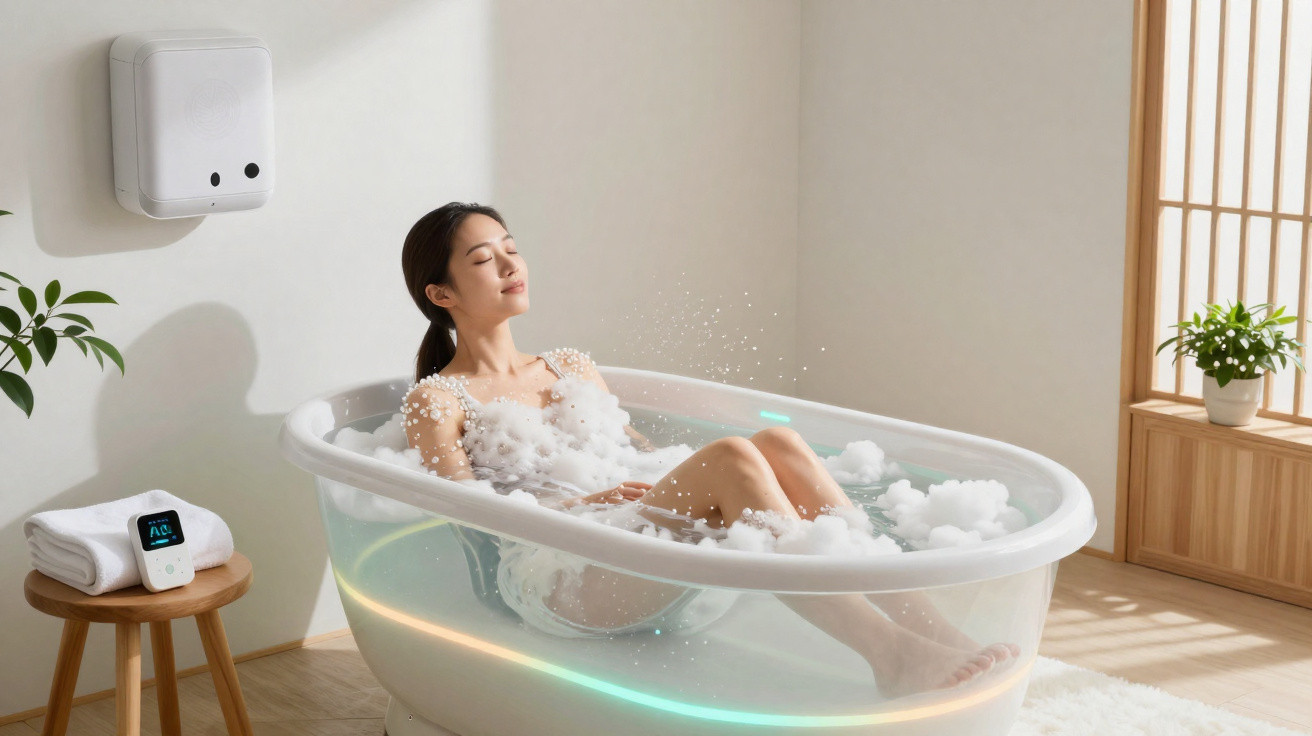
What sounds like a scene from a science-fiction film is already operating as a working prototype in Osaka: a fully automated washing capsule for the entire body. Rather than relying on a shower screen and shampoo, a sealed cylinder takes care of the whole cleansing process, creates a spa-like setting and monitors key health indicators at the same time. Many experts believe it could signal the end of the conventional shower cubicle as we have known it for decades.
From shower cubicle to body capsule
At the centre of the development is a Japanese company based in Osaka. Its device is called “Mirai Ningen Sentakuki”, which roughly translates as “washing machine for the people of tomorrow”. The concept is to make daily body care as simple and automated as a laundry cycle.
The capsule is large enough for one person to sit inside comfortably. Once the door closes, water flows in, sensors start the programme and the machine handles everything else. There are no shower controls, shower screens or tiles requiring scrubbing. This could fundamentally transform the entire bathroom set-up.
The vision: a bathroom without a conventional shower cubicle, where a smart washing capsule combines body care, relaxation and health monitoring.
How the “human washing machine” works
Microbubbles instead of a flannel
The cleansing process uses so-called microbubbles: tiny air-and-water bubbles that are considerably smaller than those in an ordinary shower. This technology is already used in wellness facilities and medical applications.
- The capsule fills with water and microbubbles.
- The ultra-fine bubbles settle against the surface of the skin.
- Dirt particles and sebum are loosened without harsh friction.
- The skin is cleansed gently, which may be particularly appealing for people with sensitive skin.
As a result, there is no need for vigorous scrubbing with a sponge or flannel. This could offer a real advantage for people with skin conditions, older people and those with reduced mobility.
AI adapts water, light and sound to the body
Several biometric sensors are built into the capsule. They measure, for example, pulse rate and other physical parameters. An AI assesses this information in real time and adjusts the programme accordingly.
Specifically, the machine can:
- vary the water temperature dynamically;
- regulate the pressure of the water and air jets;
- change the interior lighting from bright and energising to warm and calming;
- tailor background sounds or music to the user’s mood.
The result is an experience closer to a private spa cabin than a standard shower. Anyone entering the bathroom feeling stressed is intended to emerge as relaxed as possible.
Cleansing, drying and relaxation – all in 15 minutes
According to the manufacturer, the complete process takes around a quarter of an hour. When cleansing is complete, the same capsule begins the drying stage: warm air flows and directed airflow remove water from the skin, eliminating the need for a towel.
| Phase | What happens? | Special feature |
|---|---|---|
| 1. Entry | The person sits in the capsule and the door closes | Sensors start up |
| 2. Cleansing | Water and microbubbles flow around the body | Gentle removal of dirt |
| 3. Wellness | Light, temperature and sounds are adjusted | Spa-like atmosphere |
| 4. Drying | Warm air dries the body completely | No towel required |
The company aims to merge three previously separate areas: body cleansing, relaxation and health checks. The capsule provides an enclosed setting in which these processes take place one after another, and in some cases simultaneously.
A health monitor in the bathroom
One especially interesting aspect for medical professionals, care providers and hospitals is that the system continuously collects data during the washing cycle. Over time, this could make trends in a person’s health status easier to identify.
Possible examples include:
- signs of persistent stress caused by a consistently raised heart rate;
- changes in circulatory stability among older people;
- programme adjustments for people with cardiovascular conditions.
The capsule brings together hygiene, wellbeing and potential health monitoring – directly in one of life’s most everyday places: the bathroom.
In the longer term, such data could be incorporated into digital patient records or combined with wearables. This inevitably brings data protection and data security to the forefront.
Will the “washing machine for humans” come to Europe too?
Japan has traditionally shown strong enthusiasm for futuristic bathroom solutions. As early as the 1970s, the World Expo in Osaka presented an early predecessor to an automated washing cabin. At that time, it remained a concept. Today, modern sensors and AI have brought mass production within realistically close reach for the first time.
Opportunities for everyday use
Several applications could be conceivable in German-speaking countries:
- Care homes and hospitals: Gentle body care for people who cannot stand or grip safely.
- Luxury hotels and spas: A new wellness experience that serves as a distinctive selling point.
- Private homes focused on smart technology: Tech-minded users seeking to radically modernise their bathrooms.
- Rehabilitation centres: A combination of hygiene and relaxation therapy.
At the same time, architects and bathroom planners could reconsider the traditional bathroom layout. If the shower cubicle disappears, it could create new open areas or alternative room concepts – for instance, a bathroom in which the capsule stands like a piece of furniture.
Unanswered questions and risks
It remains unclear how much such a system will ultimately cost or how demanding installation and maintenance will be. Equally sensitive is the handling of the health data collected.
The most critical issues include:
- Who stores the body data, and for how long?
- May health insurers or employers access it?
- How securely are the systems protected against hacking attacks?
Particularly in Europe, where data protection rules are strict, this technology will only stand a chance if manufacturers provide highly transparent solutions.
What the term “microbubbles” means
Microbubbles are gas bubbles in water with diameters in the micrometre range. Their large combined surface area allows them to bind dirt and oils especially effectively. They can help clean wastewater in rivers, for example, while the cosmetics industry uses them in care baths.
They offer several benefits for skin care:
- They can reach small indentations in the skin and pores.
- They work mechanically, without heavy use of chemicals.
- They generally irritate the skin less than vigorous rubbing.
For children, older people and those with sensitive skin in particular, this approach may be more pleasant than a hot shower with a strong shower gel.
How everyday bathroom routines could change
The “human washing machine” fits into a wider trend: more and more aspects of domestic life are being automated. Dishwashers, robot vacuum cleaners, smart heating systems – and now, perhaps, fully automated body care as well.
Future scenarios such as these are conceivable: the capsule recognises the person, retrieves their preferred programme, connects to a smartwatch, adapts the washing cycle to their condition that day and, if desired, alerts their GP to unusual readings. Many people may find this appealing, while others will immediately think of surveillance and dependence on technology.
One thing is clear: if this concept takes hold, the familiar image of a bathroom with a shower cubicle, fittings and tiled wall will come under pressure. In its place, a piece of equipment would take centre stage, cleansing, relaxing and monitoring the person within an enclosed, protected space – part wellness facility, part medical laboratory.
Whether this development will genuinely reach the mass market in German-speaking countries remains uncertain. However, the Japanese capsule demonstrates how radically even something as everyday as showering can change when AI, sensor technology and design work together.






Comments
No comments yet. Be the first to comment!
Leave a Comment