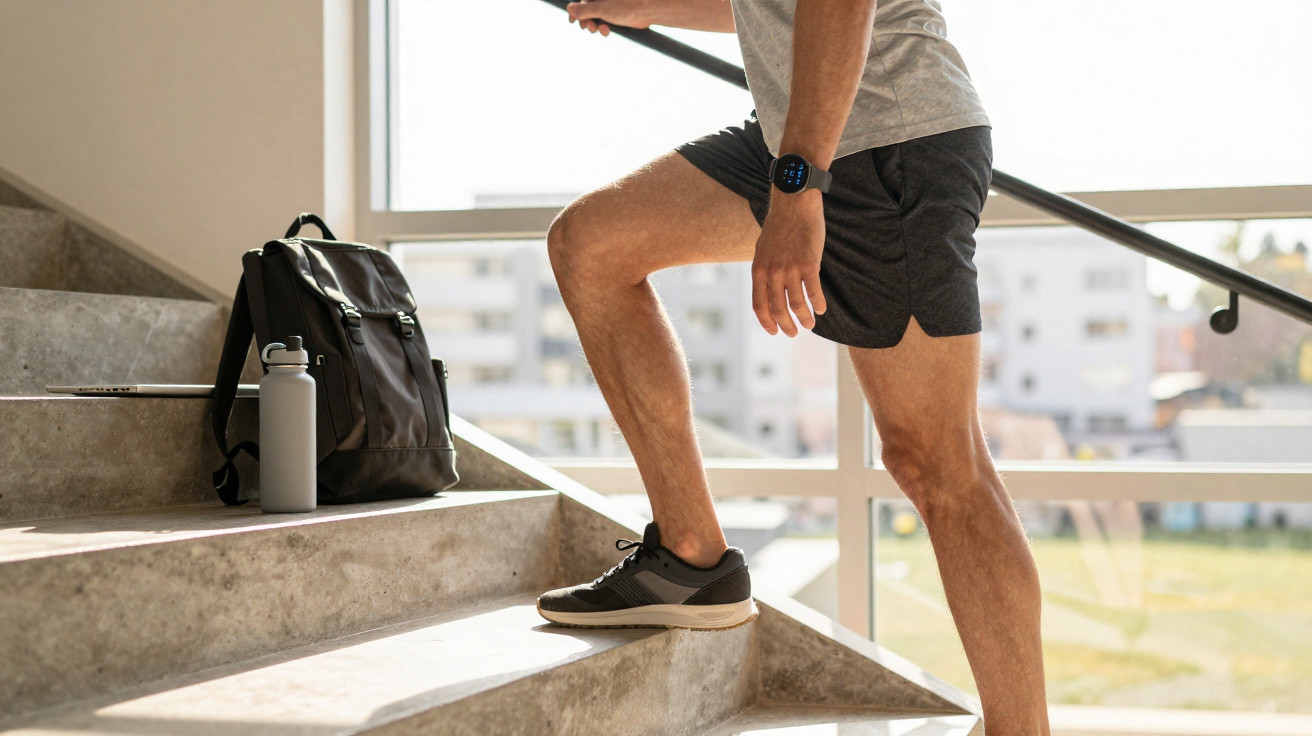
Climbing stairs for 10 minutes a day provides a demanding stimulus for the legs, glutes and cardiovascular system, although it does not fully replace weight training when the aim is hypertrophy or progressively increasing load. Comparing it with 3 weekly sessions is a useful practical illustration: across 7 days, it amounts to 70 minutes of work against gravity, engaging the quadriceps, glutes, calves and core on every step.
Why does climbing stairs work the legs so effectively?
Every step upwards requires the knee and hip to extend, in a movement similar to repeatedly performing a step-up. The quadriceps drive the body upwards, the glutes help overcome the height of the step, and the calves stabilise the ankle during the push-off.
The key difference from walking on level ground is the incline. When climbing, the body must lift its own weight vertically, increasing muscular demand and raising the heart rate within just a few minutes.
How can you make stair climbing a proper workout?
It is best to begin on familiar, well-lit stairs with a handrail available. The goal is not to run on the first day, but to maintain a steady pace, a stable posture and controlled foot placement, without using the arms to pull the body upwards.
- Start with 3 to 5 minutes if you have been inactive for a long time.
- Climb at a consistent pace and come down carefully to reduce strain on the knees.
- Use the handrail for safety support rather than as the main source of pulling force.
- Keep the torso slightly forward without rounding your back.
- Place the whole foot on each step if you want greater glute activation.
What routine can fit at home, work or in a block of flats?
To reach 10 minutes each day, split the time into shorter blocks. Two 5-minute sessions, one in the morning and another in the late afternoon, can lessen the effect of fatigue and make the habit easier to maintain.
At work, choose the stairs instead of the lift for 2 or 3 floors at quieter times. At home or in a block of flats, complete controlled climbs by time rather than speed; the descent serves as recovery and should be slower than the ascent.
What are the benefits beyond the legs?
Reviews of stair-based interventions indicate improvements in cardiorespiratory fitness, energy expenditure, glycaemic profile, lipids and vascular function. Research involving short, vigorous stair climbs also suggests that this type of effort can improve fitness in little time when performed regularly.
- Heart rate rises quickly, exercising the heart in short sessions.
- Calorie expenditure per minute is usually higher than during level walking.
- Balance improves because every step requires hip and ankle control.
- Leg power can develop through firmer, progressively more challenging climbs.
- The routine cuts down sitting time without requiring gym equipment.
Stair climbing works with progression and respect for your limits
Climbing stairs every day can be an excellent workout for the legs and cardiovascular fitness, provided intensity increases gradually. Anyone experiencing pain in the knee, hip, ankle or lower back, or unusual breathlessness, should start at a lower level and, if needed, seek professional assessment.
Stairs deliver results by combining relative strength, muscular endurance and cardiovascular effort in one movement. With 10 minutes a day, controlled posture and a gradual increase in pace, the habit becomes more than simply getting from one place to another: it turns into a straightforward, accessible workout strong enough to change the legs, balance and fitness over the weeks.














Comments
No comments yet. Be the first to comment!
Leave a Comment