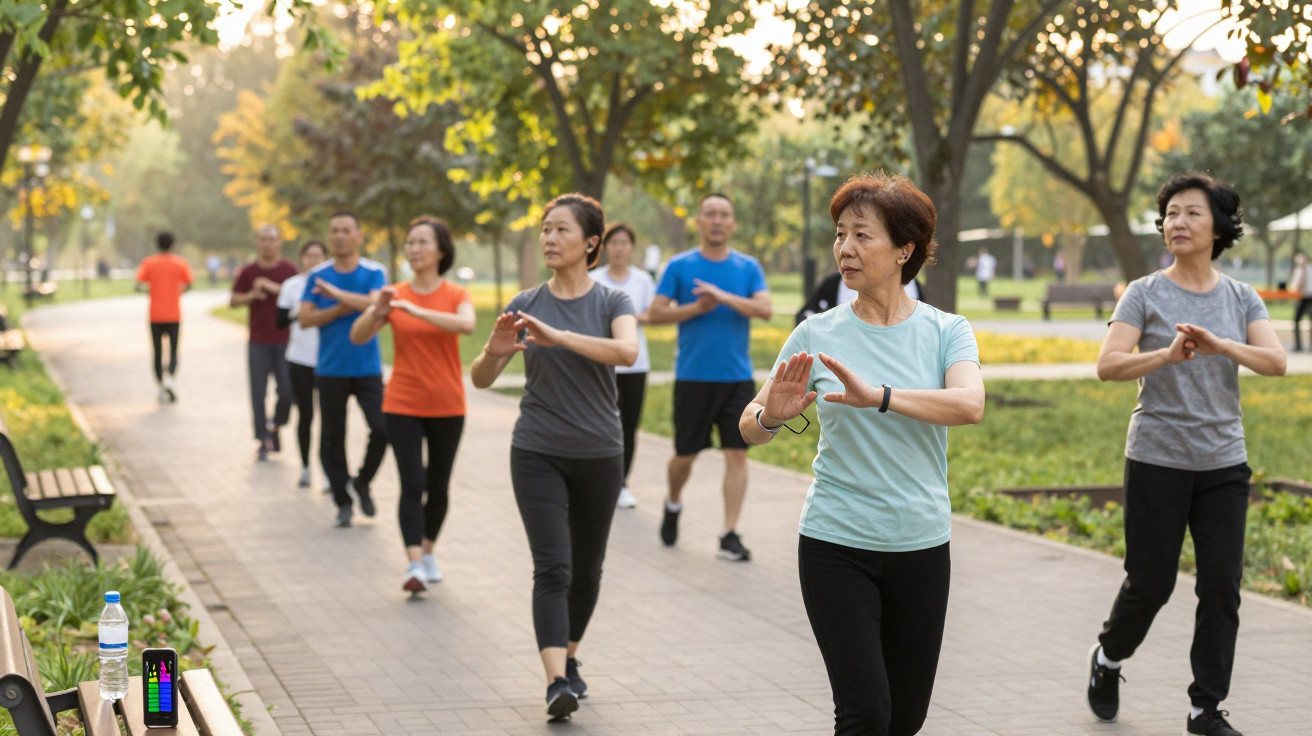
For years, the target of walking 10,000 steps a day has dominated conversations about physical activity. Now, a new trend gaining traction on social media suggests a different approach: rather than concentrating on the number of steps, it encourages people to consider how those steps are taken.
Known as Tai Chi walking, the practice has prompted a growing number of videos and accounts from people who say they feel more relaxed, balanced and connected with their bodies after just a few minutes of exercise.
What is Tai Chi walking?
The method is rooted in Tai Chi Chuan, an ancient Chinese martial art often characterised as meditation in motion. It brings together gentle movements, controlled breathing and mindfulness, producing an experience that engages the body and mind at the same time.
In the walking adaptation, the emphasis is on the heel-to-toe walking pattern. Practitioners move slowly, placing the heel on the ground first before consciously shifting their weight through the rest of the foot.
As well as foot movement, posture, breathing and body alignment are given particular attention throughout the practice.
What benefits do specialists highlight?
Tai Chi is recognised for offering a range of physical and mental benefits. Studies and health organisations point to its potential to improve balance, flexibility, motor coordination and muscular strength.
Although its movements are gentle and low impact, they call for ongoing body control, engaging the muscles of the abdomen, back and upper limbs.
Concentration is another distinguishing feature. By focusing attention on every step, a person can limit outside distractions and create a period of presence and bodily awareness.
Why has the practice attracted so many people?
Part of Tai Chi walking's appeal lies in its simplicity. Unlike workouts that require equipment or a high level of fitness, it can be done in parks, on pavements, in gardens or even indoors.
Because it is a low-impact exercise, it is also generally particularly popular with older adults and with people looking for gentler ways to remain active.
On social media, many influencers say that short sessions of around seven minutes are enough to introduce the practice into a daily routine. While results differ from one person to another, specialists stress that consistency tends to matter more than the length of a single session.
An alternative to the 10,000-step target
The growing popularity of Tai Chi walking has also revived debate around the well-known target of 10,000 daily steps.
Researchers now explain that the figure did not originate from a specific scientific discovery. Instead, it became widely known following a pedometer marketing campaign in Japan during the 1960s. Over time, the target became a widely used benchmark in fitness apps and activity-tracking devices.
However, specialists argue that there is no universal step count that can guarantee good health for everyone. What matters most is keeping the body moving regularly in a way that suits each person's individual physical condition.
In this context, Tai Chi walking offers a shift in perspective: less concern about numerical targets and greater attention to the quality of movement.
How to get started
Anyone wishing to try it can begin by setting aside a few minutes each day to walk slowly, focusing on posture, breathing and the feeling of their feet meeting the ground.
The advice is to avoid distractions and notice every stage of the movement, turning a walk into a moment of presence and connection with the body.
In a world shaped by haste and an excess of stimulation, Tai Chi walking stands out precisely because it brings back something simple: the act of walking mindfully.














Comments
No comments yet. Be the first to comment!
Leave a Comment