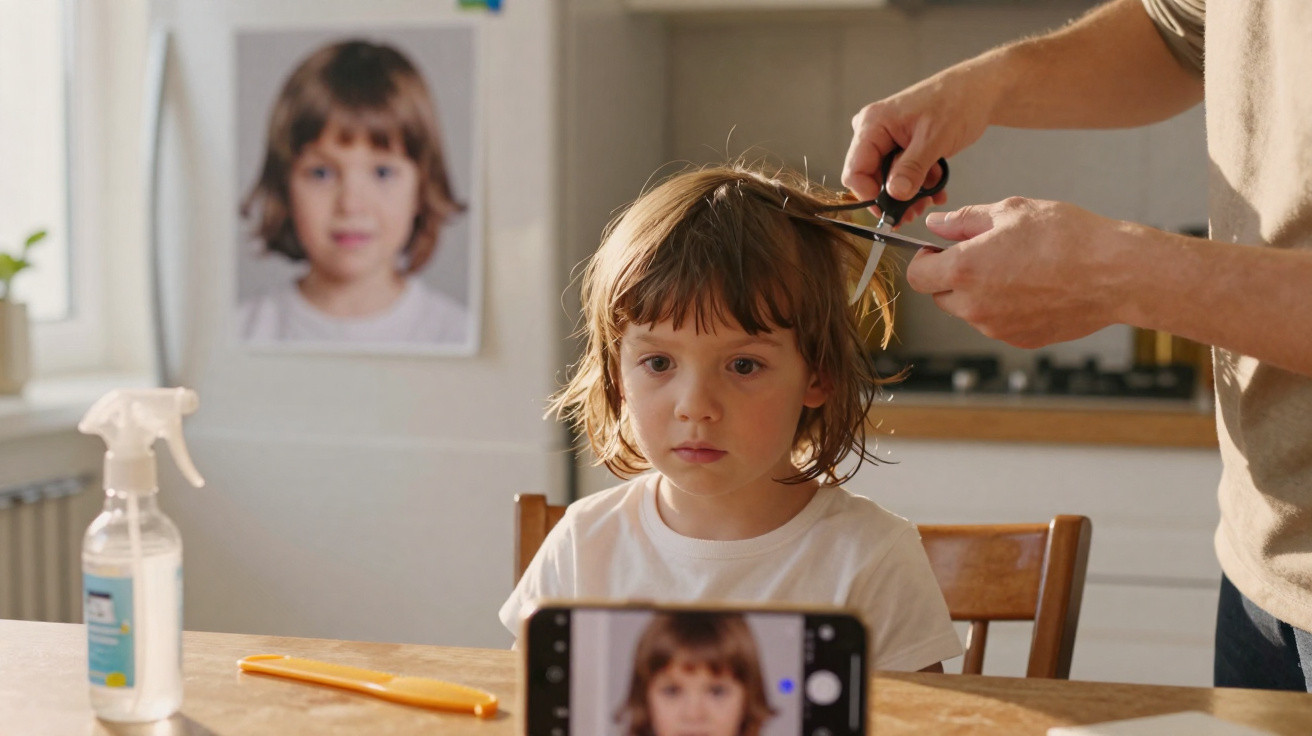
A tiny “snip” of the scissors, your child looking up at you with wide eyes, their hair stuck to their forehead after bath time. You judge the length, hold the fringe between two fingers and cut just above the eyebrows. It seems almost perfect. Then you reach for a towel, dry their hair… and see the bangs spring upwards in slow motion. Up. And up. And up. In an instant, your child looks less like an adorable Pinterest toddler and more like they lost a wager at hairdressing school.
You laugh, they scowl, and the two of you look at the mirror with quiet dismay. You go over the moment again, trying to work out how half a centimetre became a fully fledged micro-fringe. Nobody told you about the baffling “shrinkage factor” that makes damp bangs leap upwards as they dry.
Then comes the truly awful bit: there is no undoing it, apart from waiting. Long days. Lots of photographs.
Why wet bangs always let you down
The problem begins with one straightforward fact: wet hair is deceptive. When your child’s hair is damp, each strand elongates and falls further down their forehead. It appears longer, weightier and easier to manage. You feel in charge. You believe you are being cautious - perhaps even restrained - with the scissors.
As soon as the hair dries, however, that impression vanishes. The strand’s natural bounce returns. Hair fibres contract, roots rise and the fringe that appeared “just right” abruptly ends halfway up the forehead. The shrinkage factor is real rather than mythical: it is normal hair behaviour, and it is more pronounced with short hair.
The shorter the bangs are, the more striking that upward jump becomes. This is why a “small tidy-up” on wet hair can quickly become a severe and obvious error.
Hairdressers discuss this constantly, though many parents discover it through experience. In an informal poll circulated in a US Facebook group for children’s stylists, over 70% said at-home bang mishaps were caused by parents cutting hair immediately after a bath or shower.
They know the scenario by heart. A parent arrives wearing an embarrassed smile, with a child clinging to them and a fringe ending somewhere in the middle of the forehead. The reason is invariably identical: “It looked longer when it was wet.” There is no ill intent - only a misunderstanding of the way hair responds.
Social media is full of before-and-after threads in which wet bangs looked spot-on, while the dried result appeared almost cartoon-like. Some parents rely on headbands or hats for weeks. Others embrace the humour and preserve the pictures as part of family folklore.
Beneath the comedy is a basic physical fact. Hair is a fibre that expands and stretches when saturated, before contracting as the water evaporates. With long hair, the reduction is distributed across many centimetres and is therefore subtle. For a fringe measuring just two or three centimetres, the same contraction represents a large share of its overall length.
Curls and waves intensify the result. A child with fine, straight hair may find their bangs lift by a few millimetres once dry. For a child with wavy or curly hair, a whole centimetre or more can disappear. That is how bangs intended to brush the eyebrows can end up hovering well above them.
On a little face, that small gap alters everything: the expression, the balance of the features and the appearance of the eyes. Cutting wet bangs is rather like drawing a line with a ruler that is about to change size without telling you.
How to cut kids’ bangs without regret
The most reliable approach may seem counterintuitive: trim bangs when hair is dry, or only barely damp, rather than drenched. Allow your child’s hair to rest in its natural position. Let the roots rise, the cowlicks reveal themselves and the waves form. You need to work with the fringe’s real shape, not the sleek, stretched version created by water.
When the hair is dry, comb the bangs directly down and choose a “safety length”. That is your guide. Next, cut at least 3–5 millimetres below the length you ultimately want. A second pass can always remove more, but you cannot stick hair back on. Small vertical cuts made with the scissor tips provide far more control than one large horizontal chop.
Think of it not as “giving a haircut”, but more as pruning a plant: proceed slowly, make small adjustments and observe the response.
Many parents hurry because their child is wriggling, or because it is late and they want the task finished. That is when hair tends to be cut straight from the bath, dripping over the nose. The reasoning feels obvious: “They’re already wet, let’s do it.” But this is precisely the point at which the shrinkage trap begins.
Instead, reverse the routine. Run the bath, dry the hair completely and then leave it for a little while. Let your child play, watch a cartoon or move about. Their hair will then “settle” into its usual form. Afterwards, sit them in front of a mirror, give them something to hold and make two or three tiny passes over the fringe rather than one dramatic cut.
Let’s be honest: nobody really manages that every single time. The goal is not salon-level perfection, but avoiding the sort of mistake that needs months to grow out.
A children’s stylist I spoke to in London summed it up with a laugh and a warning:
“Parents always say ‘I only cut a little bit.’ On wet bangs, a little bit is already too much. If you’re not a pro, cut them almost too long on dry hair, then sneak up on the length over two or three mini-sessions.”
To help you remember amid the chaos of family life, keep this simple checklist in mind:
- Never cut soaked bangs – wait until the hair is completely dry or only lightly misted.
- Leave the hair longer than seems necessary, then refine the length gradually.
- Watch the natural bounce – curls and cowlicks create additional shrinkage.
- Choose small, pointed scissors and make tiny snips instead of one large horizontal cut.
- Pause between passes – look, take a breath, and then decide whether it genuinely needs to be shorter.
Living with the fringe - and the photo evidence
Once you understand the shrinkage factor, it starts appearing everywhere: school photographs, old family albums and memes featuring toddlers with startlingly high bangs. More broadly, it is a small lesson in how something as innocent as water can distort what we see and lead to rushed choices.
Trimming bangs while dry makes you slow down. It encourages you to respect the way your child’s hair naturally falls and the way their features are naturally framed. A hurried Sunday-night job may become a small ritual in which you actually look at them face to face - scissors in hand, yet somehow more present.
Even if you still misjudge it one evening and the fringe bounces higher than intended, it is not a disaster. Hair grows. Photographs turn into stories. The next time you feel tempted to pick up scissors for wet bangs, the memory will sting just enough to make you wait another ten minutes.
| Key point | Detail | Why it matters to the reader |
|---|---|---|
| Cut dry hair | Bangs are at their true length, without the stretching effect | Prevents fringes becoming too short once dry |
| Allow for “shrinkage” | Leave an extra 3–5 mm | Makes it possible to adjust without regret or panic |
| Make small touch-ups | Use several mini-cuts instead of one big chop | Lowers the chance of a visible mistake lasting for weeks |















Comments
No comments yet. Be the first to comment!
Leave a Comment