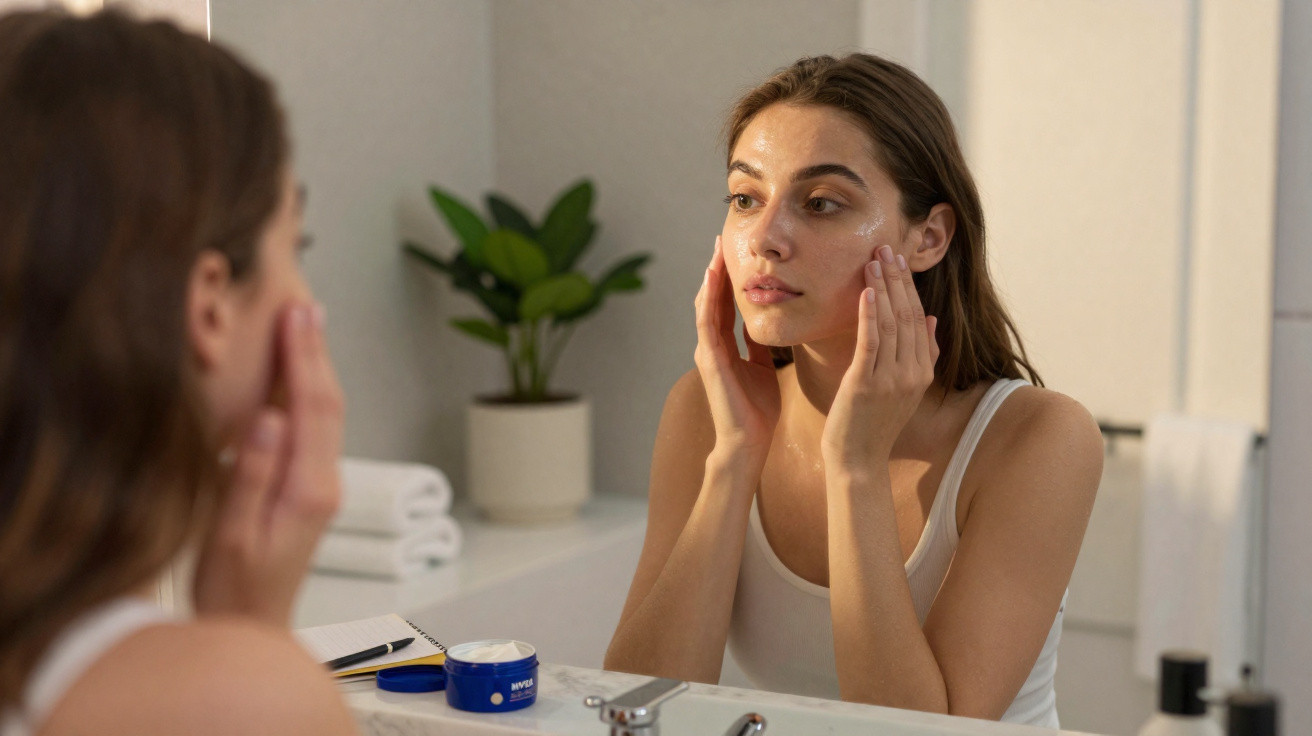
Almost everyone knows the classic Nivea Cream in its blue tin from their parents’ or grandparents’ bathroom shelf. Many people use it as an all-rounder for elbows, hands or dry patches. But how does it perform when used specifically on the face – every evening, in a thick layer and on just one side? This small self-experiment offers revealing clues about how intensively the cream moisturises and where its limitations lie.
The idea behind the self-test with blue Nivea Cream
Nivea Cream has been considered a classic for decades. Its fragrance is unmistakable, its tin is iconic and its promise is straightforward: rich care for skin and body. Countless online tips suggest ways to use it, from an after-sun substitute and a mask for dry hair ends to post-shave care.
It becomes particularly interesting when returning to its original purpose: retaining moisture in facial skin. In an age of serums, retinol, niacinamide and complicated skincare routines, the question is whether this thick, traditional cream is still needed – or whether it can do more than many people assume.
The test: for one week, the blue cream is applied every evening to only one half of the face – over the usual skincare, as a kind of occlusive overnight mask.
How the experiment was carried out
The tester first continued with their usual evening routine, which included:
- thorough two-step cleansing
- a facial serum
- an eye treatment
- a light, regular moisturiser
Only then came the crucial step: a substantial layer of Nivea Cream was applied to one half of the face – almost like a mask left on overnight. The other half received the usual skincare without the “Nivea seal”.
The aim was to compare both sides carefully in the mirror each morning, looking at hydration, smoothness and how the skin felt.
Initial effects after only a few nights
A distinct pattern emerged after the first few nights. On waking, the side treated with the blue cream appeared:
- visibly plumper
- softer to the touch
- smoother overall, especially where there were fine dehydration lines
The cream’s rich texture formed a protective film over the skin. It reduced the amount of moisture evaporating overnight – something many people underestimate, particularly during the heating season or when indoor air is dry.
The treated half of the face felt noticeably more hydrated in the morning, while the other side seemed more “normal” – not dramatically dry, but not as deeply nourished either.
As the skin’s natural overnight renewal process is especially active at this time, such a protective layer may enhance the effect of the skincare beneath it. This is essentially how many modern “sleeping masks” work – Nivea performs a similar role, but in a much simpler and less expensive way.
Slugging with Nivea: effective, but not for every night
Known in skincare terminology as “slugging”, this approach describes precisely that principle: applying a very rich, sealing layer over the rest of the routine to lock moisture into the skin. Nivea appears to work surprisingly well for this purpose – the immediate nourishing effect was unmistakable in the test.
However, a drawback emerged after several days. With daily use, the T-zone in particular – the forehead, nose and chin – began to develop small blemishes on the Nivea-treated side. The skin there felt somewhat “clogged”.
The method works, but on the face it should be used as a treatment rather than as a new everyday standard routine.
How often makes sense?
Based on the test, the following is a practical schedule:
- for normal skin: around once a week as an overnight mask
- for dry skin: once or twice a week, depending on tolerance
- for oily or blemish-prone skin: no more than once every two weeks on selected areas, preferably dry parts of the cheeks
Anyone noticing more small spots or blocked pores should extend the intervals between uses or apply the cream only to very dry areas of skin.
What Nivea Cream can – and cannot – do
The test makes one point clear: the blue cream is not a miracle solution for wrinkles or pigmentation marks. Its main benefit is intensive occlusion – effectively a “covering” that keeps water within the skin. This creates several effects that can be useful in everyday life.
Strengths of classic Nivea
- A protective shield against dryness: Wind, cold and central-heating air can dehydrate the skin – a thicker layer of Nivea in the evening can help counterbalance this.
- Ideal for rough patches: The edges of the lips, the sides of the nose after a cold or chapped cheeks can benefit greatly.
- An affordable booster: Anyone with a good serum can enhance its effect by “sealing” it in with Nivea, without purchasing an expensive specialist product.
Limitations of the cream
- It does not contain modern active ingredients such as retinol, vitamin C or niacinamide.
- It may put pressure on pores in people prone to blemishes, especially when used thickly every day.
- It is not a replacement for a well-balanced skincare routine tailored to an individual skin type.
Who is the Nivea overnight mask really suited to?
People with dry or mature skin and a weakened skin barrier are likely to benefit most. For them, the cream can act like a coat, limiting water loss and leaving the skin looking fresher in the morning.
Anyone more prone to blackheads and blemishes should take greater care. In that case, it may be sensible to use Nivea only on selected areas – for example, dry parts of the cheeks – while avoiding the forehead and nose.
| Skin type | Recommendation for Nivea overnight |
|---|---|
| Dry skin | 1–2 times per week over the whole face (avoid the eye area) |
| Normal skin | Around 1 time per week or as needed, especially in winter |
| Combination skin | Only on dry areas; avoid the T-zone |
| Oily, blemish-prone skin | Use very sparingly, preferably only on dry patches |
What to consider when applying it
Anyone wishing to try this method should bear a few points in mind to avoid overwhelming their skin:
- always apply it to clean, thoroughly cleansed skin
- do not rub the cream into the eyes, as the formulation is not intended for this area
- the layer can be visibly thick, but it should not drip
- stop using it if the skin stings, feels very tight or develops many new spots
Sensitive skin in particular can react differently from person to person. Beginning cautiously – perhaps over a weekend when there is no important event planned – can help assess individual tolerance.
Why the old bathroom-cabinet cream is making a comeback
While social media channels continually promote new, expensive products, this small one-sided Nivea test reveals something more down to earth: sometimes a classic is enough to create a visible skincare effect. The cream does not replace a considered facial skincare routine, but it can complement one in a targeted way.
Those who already follow a solid basic routine with a gentle cleanser and skincare suited to their skin type can experiment with Nivea as an occasional overnight mask – particularly in colder months or after days with lots of sun and wind. The key is not to overdo it and to take the skin’s own reaction seriously.
The comparison of the two halves of the face after one week shows that, yes, the blue tin can make a difference when used on the face. What matters is using it as a tool – not as an all-purpose answer that replaces every other skincare product.











Comments
No comments yet. Be the first to comment!
Leave a Comment