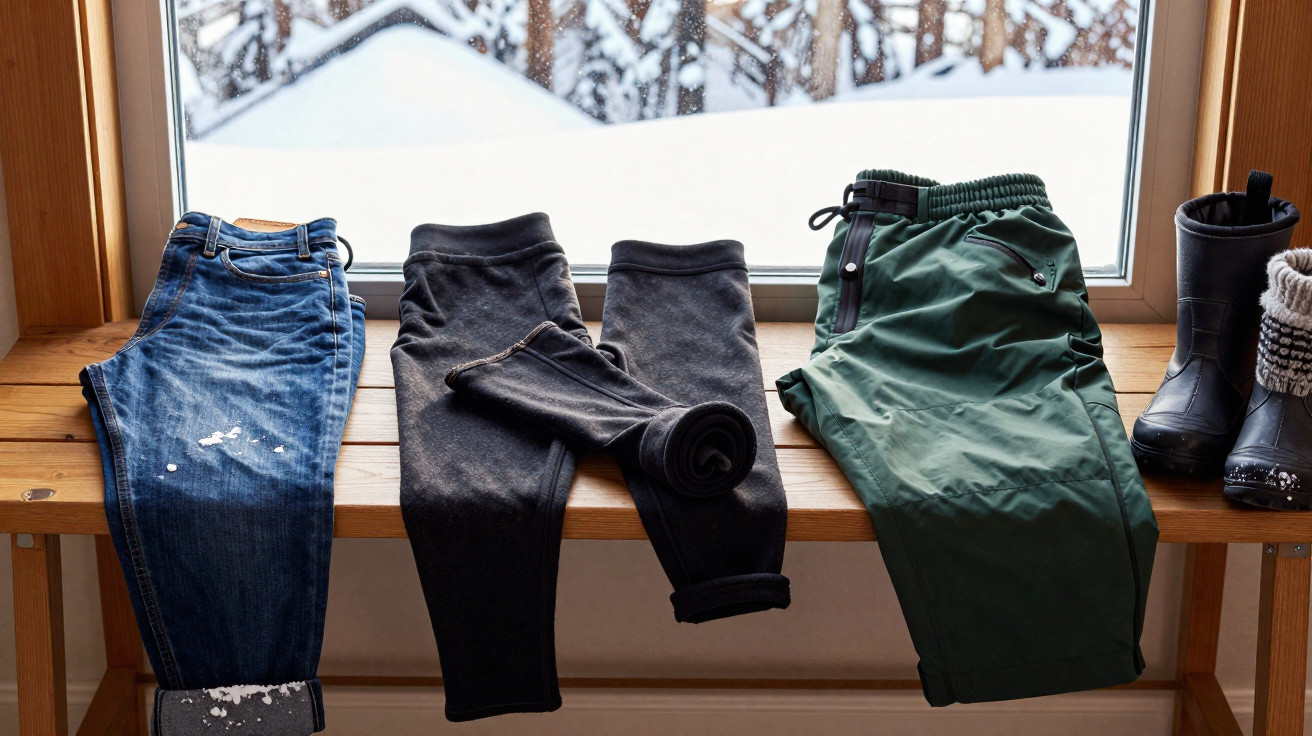
The bus doors slide open, and a sharp gust slices through the waiting crowd. People recoil, pull up their collars and draw in their shoulders. You get off wearing your favourite jeans-the pair that sees you through office hours and late-night drinks alike. Within 15 seconds, the cold has pushed through the denim and wrapped your thighs in something like an icy sheet. You speed up, yet it makes no difference. The wind lashes at you; your legs first ache, then become strangely numb. That is when it hits you: your smart, dependable jeans have been letting you down all along. Cars stream past, your breath hangs white in the air, and a single question keeps repeating.
Why does this fabric feel even colder than the air?
Why jeans turn against you when the temperature drops
On an ordinary autumn day, jeans seem like the obvious choice. They are durable, thick and timeless. They appear warm and sensible. But when proper winter weather arrives-minus ten, high winds and damp air-that tightly woven cotton can feel like cold-soaked sandpaper. Your thighs begin to sting, feeling disappears from your knees, and the denim sticks to you as though it is chilling your body from the outside inward. This is more than simple discomfort. Your body is quietly reprioritising to protect vital organs, with your legs among the first areas to lose out.
Remember the last time you walked across a frozen car park in jeans after freezing rain. At first, the denim was rigid but tolerable. Then perhaps you brushed a snowbank or a passing car sprayed you with slush. In minutes, the damp patch spread and darkened the fabric, while the cold shifted from irritating to vicious. That wet, chilled section remained pressed against your skin and would not warm up, however much you moved. Once indoors, your legs were vivid red and almost painful as blood flow returned. You probably thought, “Next time, I’ll dress properly.” But then you did not.
Most jeans are made from heavyweight cotton denim. Cotton has one major flaw: it absorbs moisture, retains it and stops insulating effectively when it becomes even a little damp. Perspiration, melting snow or light rain can all be absorbed by the material, which then holds that moisture against your skin like a cold compress. Dense denim also transfers body heat more quickly than fabrics designed to retain air. Without air pockets, there is no meaningful insulation. Add wind, and the material acts as a cold outer shell, giving escaping heat an easy route out through your legs. Your body keeps your core warm first and sacrifices your extremities, including your thighs, long before you feel “really” in trouble.
What to wear instead of jeans when the cold is real
The easiest improvement for winter is not particularly glamorous, but it is effective: layering. Begin with a slim, close-fitting base layer in merino wool or synthetic fibres such as polyester or polypropylene. This layer moves sweat away from your skin while holding a first pocket of warm air. Then add insulated trousers, whether softshell ski trousers, lined walking trousers or fleece-lined leggings beneath looser outer trousers. If you cannot give up your jeans, use them as an outer shell rather than your main protective layer. Everything changes once denim is no longer directly against your skin.
There is a familiar sight on icy pavements: a substantial winter coat, scarf, beanie and thick gloves above the waist, with bare blue jeans below it. The upper half looks ready for a ski holiday; the lower half looks dressed for early October. People tell themselves, “My legs don’t get cold, I’m fine.” Yet they later question why they are exhausted after 20 minutes outdoors or cannot shake a deep chill for the rest of the day. That contrast produces an odd imbalance: a warm torso paired with underprotected legs steadily losing heat. In truth, almost nobody checks the thermal rating of their trousers before leaving home, even for a lengthy commute.
We spoke with a mountain guide who spends more than 150 days a year outside in freezing conditions. “The number one mistake I see in cities,” he said, “is people treating jeans like winter gear. They’re not. They’re a fashion uniform. In the cold, legs need the same attention as the torso. When your thighs freeze, your whole body pays for it.”
Picture a compact winter wardrobe with only a handful of straightforward choices:
- Base layer: Merino wool or synthetic long johns that manage moisture and retain warmth.
- Insulating mid-layer: Fleece-lined leggings or lightly insulated trousers.
- Outer shell: Windproof, water-resistant trousers for snow, wind or slush.
- Emergency layer: Lightweight packable overtrousers to pull over city trousers when a cold snap arrives.
- Home comfort: Warm joggers or wool-blend lounge trousers that allow your legs to thaw properly indoors.
The quiet power of dressing your legs like they actually matter
After spending a genuinely cold winter day in suitable legwear, wearing jeans alone can feel much like leaving home without gloves. You may walk more slowly, but your shoulders carry less tension. Your thighs remain warm, your knees move freely and the wind becomes background noise rather than a physical assault. You may also find that you arrive at work or return home with more energy. There is a quiet sense of ease in not shivering from within. You might wonder why nobody mentioned sooner that trousers can be as technical and protective as a good jacket, simply without the same fanfare.
| Key point | Detail | Value for the reader |
|---|---|---|
| Avoid jeans as primary winter pants | Cotton denim retains moisture, transfers cold and provides minimal insulation in wet or windy conditions | Less painful leg numbness and a lower risk of deep chills outdoors |
| Prioritize layered leg systems | A base layer + insulating layer + windproof shell, selected according to weather and activity | Consistent warmth and greater comfort during commutes, walks and outdoor work |
| Choose technical or wool-based fabrics | Merino, synthetics, softshell and fleece-lined garments hold warmth and wick away sweat | More energy, reduced fatigue and clothes that genuinely work with your body |
FAQ:
- Question 1 Are jeans ever acceptable in winter if I’m not outside for long?
- For short journeys-such as walking from the car to a shop or spending a few minutes outside-jeans can be suitable, particularly with thermal tights underneath. The risk increases with exposure time, wind and moisture. If it is below freezing and you will be outdoors for more than 10–15 minutes, add better leg layers.
- Question 2 Are thicker “winter jeans” warm enough on their own?
- Heavier denim or flannel-lined jeans are more comfortable than standard pairs, but they still rely on cotton. They perform reasonably in dry, mild cold, but become less effective with sweat, snow or rain. Consider them an improvement on ordinary jeans rather than a complete winter solution.
- Question 3 What’s the single best fabric for really cold legs?
- Merino wool stands out for base layers because it is warm, breathable and less prone to smelling over time. For outer layers, softshell or insulated synthetic trousers are effective because they offer wind resistance, flexibility and some water repellency.
- Question 4 Can I wear leggings under jeans without feeling bulky?
- Yes, provided you choose slim merino or synthetic thermal leggings. They are made to sit close to the body, so paired with slightly roomier jeans, they can suit everyday city wear while delivering a substantial warmth boost.
- Question 5 Is it really dangerous, or just uncomfortable, to wear jeans in extreme cold?
- Brief exposure is mainly uncomfortable. Extended exposure to wet, windy, sub-zero weather carries genuine risks, including reduced circulation, possible frostbite in the extremities and a deeper chill to the core. Your clothing can be the line between “I’m cold” and “I can’t feel my legs anymore.”
















Comments
No comments yet. Be the first to comment!
Leave a Comment