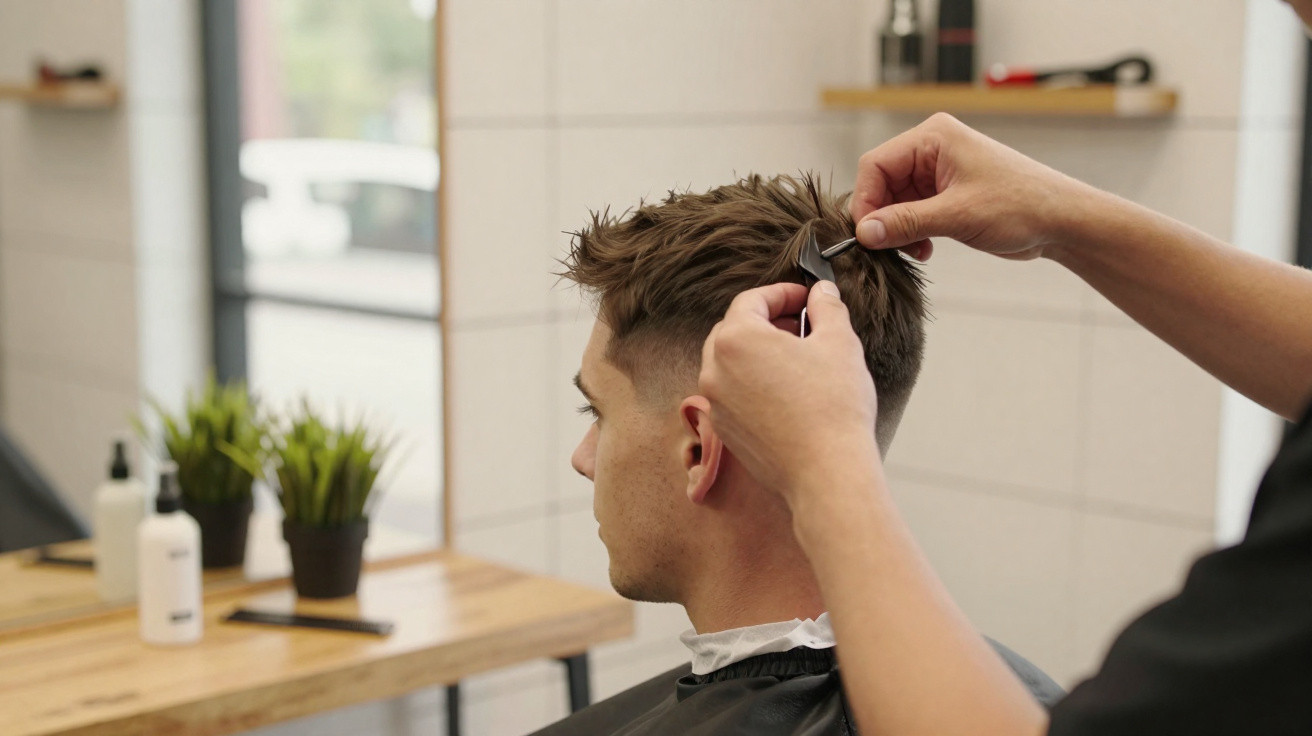
The man ahead of you in the barbershop lets out a sigh as the barber reaches for a tub of pomade. “Can we skip all that?” he mutters. Brush in hand, the barber pauses. Clearly, he is not the first customer that day who recoils at the thought of daily styling, blow-drying or carrying a hair-salon scent for the next six hours. He simply wants to leave, wash his hair, towel-dry it in the morning and still look presentable for a 9 a.m. video call. No stiff gel. No carefully sculpted quiff. No 12-step routine.
The barber nods, smiles and offers a straightforward answer: “Then we’ll go for a textured crop.”
At last, the tension leaves the man’s shoulders.
The low-effort haircut that does the job quietly
There is one particular style that repeatedly appears on men who insist they “don’t do anything” with their hair, despite looking consistently well put together. Its sides are short and tidy rather than shaved, while the top is left slightly longer and cut into choppy sections instead of smooth, slick layers. It seems to settle naturally, as though it already understands where it belongs.
Barbers call it the textured crop. For many men, it is the closest thing to the holy grail of wash-and-go but still sharp.
Think of the colleague who never carries a comb, arrives at work with a rucksack and an old hoodie, yet somehow always has deliberately styled-looking hair. The front sits a little forward, almost forming a fringe; the crown stays flat rather than springing up; and the sides do not balloon beneath headphones. Look closely and his entire “routine” is probably a brisk towel-dry, perhaps followed by one pass of his hand through his hair while the coffee machine is running.
No tub of product, no mousse and no foam requiring you to emulsify it “between the palms” as if you were hosting a cookery programme. It is simply a haircut created for ordinary lives and realistic mornings. That is where the style’s understated strength lies.
This haircut works for men who dislike products because its foundation is shape rather than styling. The barber takes away volume in the areas where hair is prone to misbehave, while retaining length where it falls naturally at its best. Gravity becomes the primary product. The finished result comes from your hair’s shape, not a layer of sticky paste.
In truth, almost nobody follows those flawless styling tutorials every day, complete with round brushes and three separate sprays. This haircut acknowledges that fact, working with it rather than against it. That is why it can remain neat even when you put in almost no effort.
How to ask for a textured crop - and what to avoid
The most important moment comes in the chair, before the barber has cut a single strand. Rather than asking for “short back and sides”, explain: “I don’t want to use products, I just want a clean, low-effort look.” Then use the key phrase: “Can we do a textured crop, short but not shaved on the sides, with a bit of length and texture on top?”
You could also bring along a photograph. Look for men with natural, slightly untidy tops that remain neat around the ears and neckline. You are aiming for defined edges with a softer top. Your barber will generally understand immediately, then plan how to thin, chop and shape the hair so that you do not need to do the work yourself.
One common error is taking the sides too short “because it lasts longer”. It may sound sensible in theory, but after a week’s regrowth it can leave your head looking as though it is wearing a helmet. The contrast between shaved sides and a fluffy top becomes severe, particularly if you are not using styling products to soften the transition.
There is another pitfall: requesting a “fade” when you secretly dislike frequent barber visits. Crisp fades can look brilliant - for roughly seven days. Afterwards, they require upkeep. If minimal effort is the priority, choose a neat taper and scissor work rather than a skin-tight buzz. It will grow out more gently, look less dramatic and be much easier to manage.
“Tell your barber honestly how lazy you are with your hair,” laughs Louis, a Paris-based barber who specializes in low-maintenance cuts. “If you say you’ll style it and then never do, the haircut will betray you in a week. I’d rather design something that forgives you.”
- Keyword to use: Ask for a “textured crop” or “messy crop with natural finish”.
- Length on top: Around 3–5 cm, enough length for movement without allowing it to flop.
- On the sides: A clipper guard of approximately #1.5 to #3, or short scissor work for a gentler outline.
- Fringe direction: Forward or slightly to one side, rather than straight upwards.
- Finishing request: Tell your barber: “I want it to work with just a towel dry.”
Living with a cut that works harder than you do
Once you leave the barbershop, the arrangement is straightforward. Wash your hair - ideally not every day if you have a sensitive scalp - and towel-dry it afterwards. Avoid vigorous rubbing; a firm pat followed by a quick scrunch with your hands is enough. While the hair remains a little damp, guide the fringe softly forwards or to the side, allow the crown to settle as it wishes, then leave it alone.
Wait ten minutes. Most textured crops look best once they have air-dried and the hair has forgotten that it was wet.
Some men feel mildly guilty about not “doing more” with their hair, particularly when social media insists that proper grooming means five products arranged along the bathroom shelf. That guilt serves no purpose. If your mornings are already full - with children, a commute or simply the everyday struggle with the snooze button - you do not need another ritual that you will fail to maintain. You need a haircut that accommodates your actual habits.
The biggest mistake at home is thinking too hard about it. That means blasting it with high-heat air, brushing as though you are polishing a shoe, or battling every wave and cowlick in sight. The textured crop is intended to soften those natural quirks, not eliminate them. Let your hair’s natural direction take the lead.
The simple reality is that a good lazy-man’s haircut relies less on “styling” and more on small maintenance tasks that do not feel like chores. This may involve a quick trim every 5–7 weeks, a good shampoo that does not dry out your scalp and an honest five-second glance in the mirror to make sure nothing is sticking out wildly.
For men who would still like a fallback option, there is one final trick. Keep a tiny, pea-sized amount of lightweight cream or matte paste tucked away in the cupboard for job interviews or weddings. You will not need it every day. Yet knowing it is there makes a no-product lifestyle feel like a preference rather than a compromise.
| Key point | Detail | Value for the reader |
|---|---|---|
| Textured crop cut | Tidy, short sides paired with a choppy, structured top that settles naturally | Creates a clean, modern appearance without using styling products every day |
| Honest talk with your barber | Explain that you will not style it, and request a cut that works with towel-drying alone | Stops you ending up with a high-maintenance haircut that you will not maintain |
| Low-effort routine | Towel-dry, guide the hair with your hands and have occasional trims every 5–7 weeks | Keeps you looking polished while suiting a busy, real life and a “no product” preference |












Comments
No comments yet. Be the first to comment!
Leave a Comment