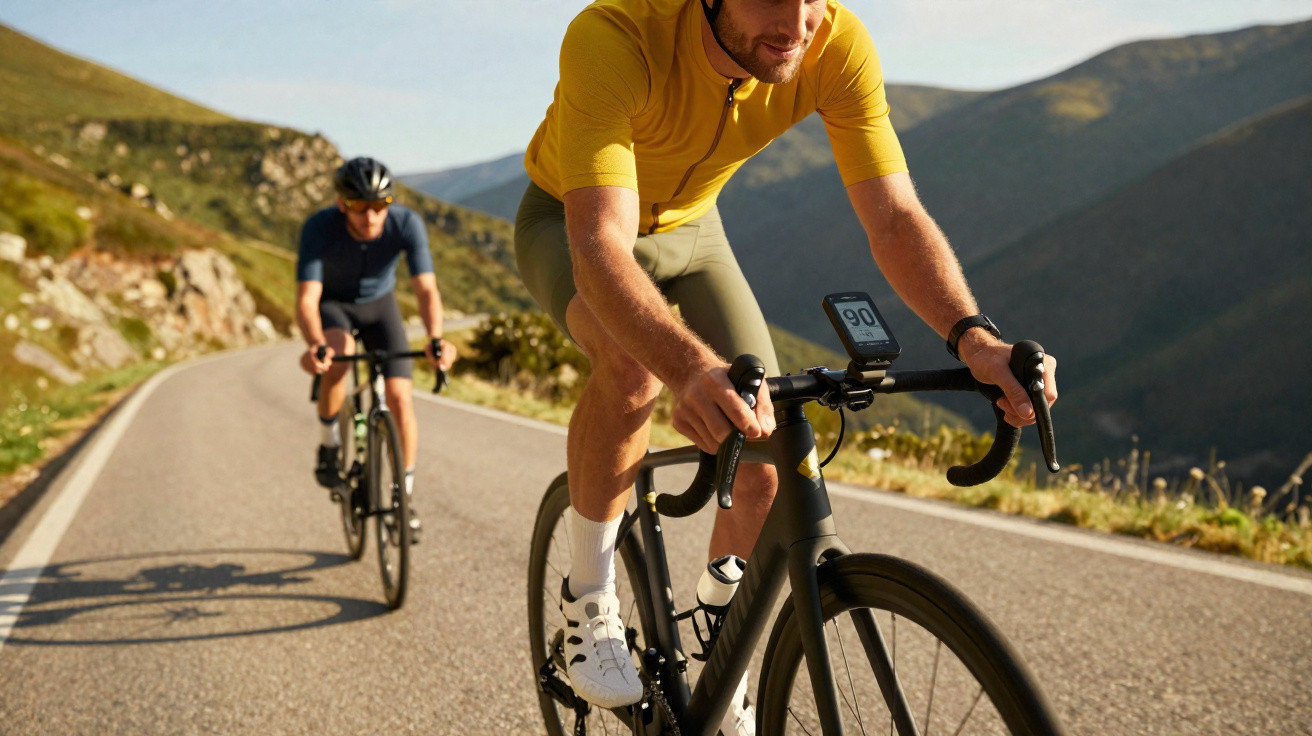
You glance at your bike computer: 58 revolutions per minute. The gradient is biting, your heart is pounding and your legs suddenly feel as heavy as concrete. Every pedal stroke becomes a small battle. Yet you are glued to the wheel ahead, determined not to be dropped. A few metres up the road, the other rider pulls away effortlessly, selects an easier gear and spins their legs – while you crack. At the top of the climb, you are spent. They look as if they have only just set off.
We often talk about watts, body weight and aerodynamics. Far less often do we discuss what you genuinely notice once fatigue sets in: cadence. And why so many of us pedal far too slowly.
Why we instinctively pedal too slowly – and why it tires us out
At first glance, slow, forceful pedalling seems entirely logical. You choose a big gear, push firmly through the pedals and automatically feel strong. That sense of “I’m getting through this on pure muscle power” flatters the ego. Particularly on climbs, many riders do not shift down until it is almost painful. Until then, they grind away in the big gear as though they are trying to set a leg-press record.
We also carry those old images in our minds: professional riders in the 1990s powering over Alpine passes at 60–70 rpm. They have stayed with us. Then there is the quiet worry that a high cadence somehow looks “embarrassing” – a little fidgety, as if you are not in control of the bike. The outcome is that we ride gears that are too hard, pedal too slowly and let pride get in the way.
A friend of mine, let’s call him Marc, is a perfect example. He has an office job, two children, has ridden a road bike for years, is highly motivated and follows a training plan from the internet. He was always proud of his “climbing strength”. His Strava times were respectable, until we rode together with a power meter. His uphill cadence? Between 55 and 62 rpm. His heart rate sat permanently in the red, and after 40 minutes he was completely finished. On a 90-minute ride, the second half became an ordeal every time.
We changed nothing except cadence. Same climb, same power output in watts, but with a target of at least 80 rpm. He had to shift two gears easier, and his ego did not enjoy it. After a few rides, something interesting happened: he did not reach the summit any faster – but he was less wrecked. On the final climb of the route, he could suddenly accelerate again. No magical training plan and no miracle nutrition. Just a different balance between force and cadence.
The explanation is fairly straightforward. A low cadence means you must produce more force with every pedal revolution. Your muscles work as if you are strength training; muscle fibres fatigue quickly, and muscle pain dominates the sensation. At a higher cadence, some of the workload shifts more towards the cardiovascular system. Your heart works harder, while each individual muscular effort is less brutal. At first, that can feel unfamiliar, and sometimes even “uneconomical”, because you are breathing faster.
Over time, however, this preserves your muscles and lets you stay close to your performance limit for longer. Studies involving professional and amateur riders repeatedly show that a range of roughly 80–95 rpm tends to settle as an efficient pedalling range for longer rides for many people. Not because it is a magic number, but because it strikes a useful balance between sparing the muscles and using the cardiovascular system. The right cadence is not a rule; it is more of a personal sweet spot – and it is almost always higher than most people initially dare to try.
How to adjust your cadence without completely changing your riding style
The most practical approach starts with simply checking your bike computer. Many cycling computers already display your current cadence; otherwise, an inexpensive sensor will do the job. First, measure what you actually ride, rather than what you think you ride. Complete your usual route without changing anything, then review the average afterwards. If it is below 80 on the flat and often below 70 on climbs, you know where you stand.
On the next ride, choose just one section rather than trying to change an entire outing. For instance, pick a climb lasting 5–10 minutes. There, aim to pedal consistently at 5–10 rpm more than usual. Do not increase your speed; use an easier gear instead. It is perfectly fine if your pace feels identical. You are not training for a personal best – you are practising a new movement pattern. Only move on to the next section once that higher cadence starts to feel normal.
Many people make the same mistake at the beginning: they increase their cadence but keep the same gear. Their heart rate then shoots up, their breathing becomes frantic, and they conclude: “High cadence isn’t for me.” That is where frustration sets in. You are not merely changing a number on the display; you are changing the relationship between gear selection, rhythm and expectations. It is absolutely normal for things to feel slightly awkward at first.
Let’s be honest: nobody truly practises this every day. Most of us get on the bike, ride our usual loop and call it a day. That is exactly why a deliberate block of two or three weeks is worthwhile, during which you include one small “cadence experiment” on each ride. Do 5 minutes at 90 rpm on the flat once. Ride one hill consistently at 80 rather than 60 another time. This is not about perfect discipline; it is about being curious about your own body. You will quickly notice the point at which you begin to struggle – and that is precisely where it becomes interesting.
A coach I spoke to about the subject put it bluntly:
“Most recreational riders climb as if they have only one heavy gear left in the gearbox – then wonder why they are empty after an hour.”
If you want to change that, three simple guide rails can help:
- On the flat, target a cadence of around 85–95 rpm without forcing yourself to ride faster at all costs.
- On climbs, deliberately shift down one gear earlier and try to remain above 75–80 rpm.
- Once a week, ride short 1–2-minute blocks at a very high cadence (100–110 rpm) to familiarise your nervous system with quicker movements.
These three points are not rules, but rather a handrail to hold on to. Your ideal cadence is ultimately as individual as your sleep pattern. But anyone who never experiments will remain stuck with comfortable, yet tiring, grinding.
What changes when your pedal stroke gets lighter – in body and mind
Anyone who has deliberately ridden at a higher cadence knows the feeling: suddenly, the bike feels “lighter”, even when your speed remains unchanged. Your legs spin more smoothly, the load on your joints drops, and your muscles no longer scream with every stroke. Instead, you mainly notice your heart and breathing. Yes, that can be intimidating at first. It exposes, without mercy, how fit your cardiovascular system really is.
At the same time, something reassuring happens mentally. You no longer have to battle through every slight rise just to force the heavy gear around. You give yourself permission to shift into an easier gear in good time, without interpreting it as weakness. Distance becomes less of a battlefield and more a sequence of rhythms. On good days, it all comes together: you can almost hear your body working in time with the chainring.
After a few weeks of purposeful cadence work, many riders report an unexpected side effect: they feel less destroyed after longer rides. The classic “concrete-leg” fatigue after 80 kilometres gives way to a more manageable, general tiredness. You notice it that evening on the sofa, when you are not silently swearing before walking upstairs. Or the following day, when you want to get back on the bike rather than avoiding it.
It becomes particularly interesting when you look at endurance performance objectively. Many riders who gradually raise their cadence suddenly manage the same average speeds with a slightly lower heart rate. Or they maintain the same pace uphill without dramatically fading in the final third. These are not Instagram miracles, nor are they +50 watts in two weeks. They are quiet, realistic improvements that pay off most clearly in the second half of the ride.
Perhaps that is the real point of the whole subject: the right cadence rarely feels spectacular. It is unspectacularly efficient. No heroics on the first climb and no world records in brute-force mode – just a better finish to your ride. And that is exactly what is most often underestimated. Riders who roll home with lighter legs go out more often. Riders who go out more often naturally become fitter. It is that simple, and that understated.
Next time you see someone pass you with a “sewing-machine cadence”, you can roll your eyes to yourself – or honestly ask whether they might be onto something. Pedal stroke by pedal stroke, revolution by revolution, your own comfort zone begins to shift. And eventually, you realise that you do not miss the grinding at all.
| Key point | Detail | Benefit for the reader |
|---|---|---|
| Cadence that is too low fatigues the muscles | More force per revolution, greater local muscular stress and faster fatigue | Understand why you “suddenly crack” even though the pace and route are familiar |
| Individual sweet spot usually between 80–95 rpm | Better balance between muscular and cardiovascular load | A practical reference point for consciously adjusting your own cadence |
| Gradual adjustment rather than a radical change | Small experiments on selected sections, targeted cadence blocks and deliberate gear choice | An everyday method that can be put into practice immediately without high-tech training |












Comments
No comments yet. Be the first to comment!
Leave a Comment