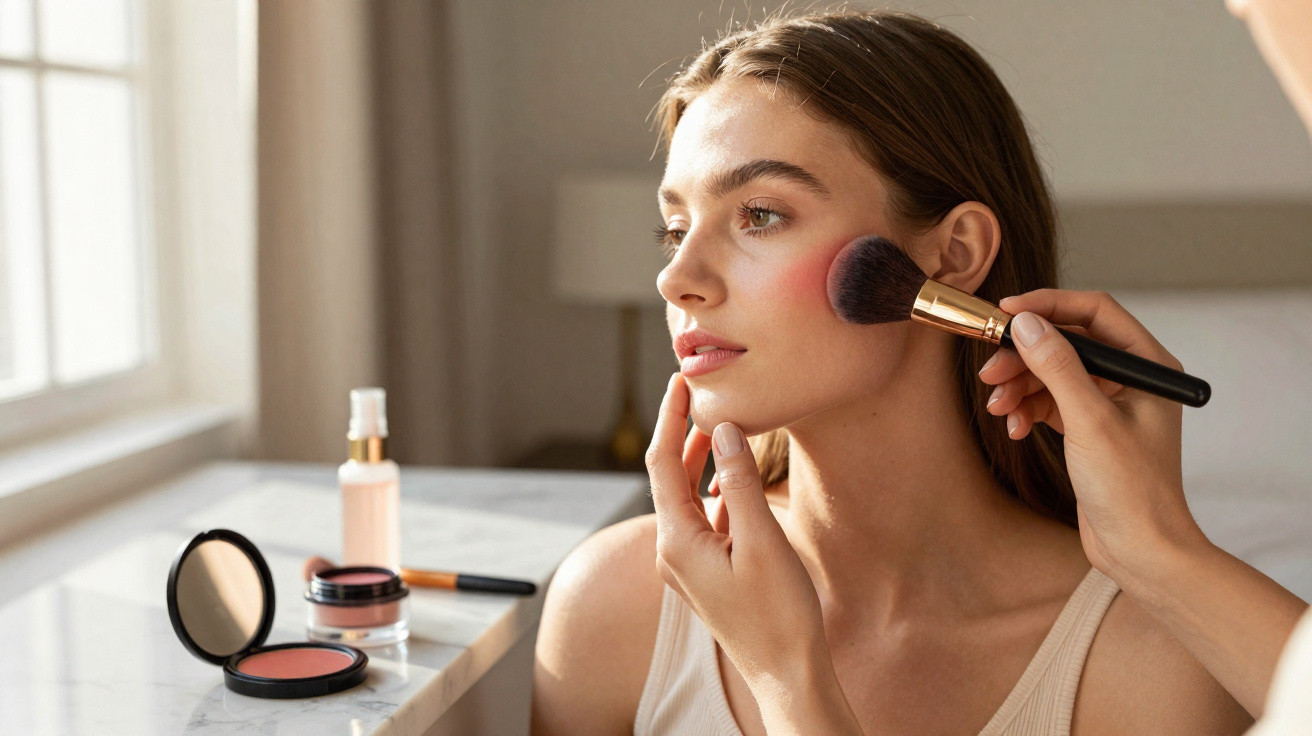
There is a simple trick.
Many fans of cream blush know the same problem: the colour looks fresh and natural at first, then everyday life makes it disappear in record time. Professional make-up artists have relied on one subtle extra step for years; it can dramatically extend wear without creating a mask-like finish or a heavy make-up feel.
Why cream blush fades so quickly
Cream formulas sit somewhere between make-up and skincare. Their oils and waxes bind with the skin, creating a fresh, naturally flushed-from-within look that appears especially soft and flattering in daylight.
Yet these same qualities can cause the colour to fade quickly. This is particularly common for:
- people with combination or oily skin
- anyone who touches their face often, whether through using a phone or resting their face on their hands
- people who perspire in warm offices or on public transport
- complexions with plenty of skincare underneath make-up
The colour can seemingly slip away, blend into sebum and skincare, or become muted when powder is applied. Many people respond by using far more product, only to find that the blush still disappears and the complexion starts to look patchy.
“The real game changer is rarely the product itself; it is almost always the order and combination of textures.”
The two-step method used by make-up artists
Make-up artist Haley Kim outlines a small routine that turns cream blush from a short-lived guest into a long-lasting companion. Rather than applying one cream layer alone, she uses an almost imperceptible “sandwich” technique.
Step one: place cream blush correctly
Start with the complexion: apply skincare, followed by a light foundation or correcting concealer, and blend everything thoroughly. Apply the cream blush over this smooth base, ensuring it is not overly slippery.
New York celebrity make-up artist Mario Dedivanovic recommends beginning with only a small amount of product:
- Pick up a small amount of blush using fingertips or a brush.
- Begin at the fullest point of the cheek, where you would naturally flush.
- Blend towards the temple instead of stopping too close to the sides of the nose.
- Apply two or three whisper-light layers rather than one thick layer.
The aim is a veil of colour that almost melts into the skin, with no harsh patch or streaks. If you are unsure, smile gently and place the product where the apple of the cheek forms, then softly diffuse it outwards.
Step two: invisible setting with powder blush
The second step is barely noticeable in photographs, but it can make a major difference to longevity: apply a powder blush in a very similar shade over the blended cream blush. Haley Kim’s tip is to choose a powder with a slight shimmer or mix it with a little highlighter.
“The fine shimmer pigments in highlighter practically grip the cream layer, setting the blush like a colour-magnet system.”
How to do it:
- Tap a soft brush into powder blush once, then tap away any excess.
- Dust it only where the cream blush has already been applied; do not create a broad cloud of powder across the entire face.
- Use light, circular motions so the cream layer is not disturbed.
If you already own a powder blush with a delicate satin finish, use it directly. If you only have a matte blush, mix it with a small amount of powder highlighter on the back of your hand before picking it up with the brush.
Skin preparation: the overlooked base
For the two-step technique to work, cream blush needs a surface it can grip without sliding away. The key is finding the balance between nourished and over-moisturised.
| Skin type | Suitable preparation | Avoid |
|---|---|---|
| Dry / mature skin | Rich moisturiser, allowed to absorb fully; a hydrating primer if needed | A thick layer of still-wet cream directly beneath blush |
| Combination skin | Lightweight skincare; optionally use a mattifying primer on the T-zone, while keeping cheeks more hydrated | Strongly mattifying products everywhere, which can make blush look dull |
| Oily skin | Gel or fluid skincare; use a mattifying base only where you become shiny | Oil-rich, occlusive creams on the cheek area |
Another common mistake is applying foundation in thick layers. The more dense the complexion product underneath, the more likely cream blush is to float on top. Thin layers worked well into the skin give it hold without causing pilling.
Fine adjustments for skin type and lifestyle
The basic method stays the same, but it can be adjusted easily depending on whether you are heading to the office, spending a long day out, or planning an evening with plenty of photographs.
Everyday wear: fresh cheeks without overload
For a subtle office look, soft peach or rosewood shades work well. The powder blush layered on top should be finely milled with almost invisible shimmer, so skin looks lively rather than glittery.
- Apply one sheer, well-blended layer of cream blush.
- Add an extremely thin layer of powder blush only to the highest point.
- Do not use additional setting powder on the cheeks; reserve it for the T-zone instead.
Anyone who wears a mask often or frequently rubs their face against a scarf or polo neck will benefit from using slightly more powder blush. The colour will then withstand repeated contact more effectively.
Evening looks: more intensity without heaviness
For evening events, use bolder shades and a slightly stronger satin finish. The base remains unchanged, while the amount of product increases.
A strategy for long nights:
- Use slightly more cream blush than during the day, while still blending it thoroughly.
- Apply a more generous layer of satin powder blush from the same colour family.
- Optionally add a touch of highlighter directly to the highest point of the cheek.
This keeps the face looking vibrant in photographs and artificial light. The complexion gains definition without the blush areas becoming overly shiny.
Common mistakes that ruin longevity
Several habits weaken the effect of this clever blush sandwich. Three pitfalls are particularly frequent:
- Too much skincare immediately beforehand: Skin may look beautifully luminous, but blush has nothing to cling to.
- Powder first, then cream blush: The cream texture becomes patchy and does not blend properly with the complexion.
- Setting spray applied in heavy mists: Excess moisture can dissolve the top powder layer again.
“Those who work in thin layers and allow every step a moment to ‘set’ gain significantly more hours of fresh colour without feeling their make-up.”
Which colours and textures work particularly well
Beyond technique, shade choice also affects how long blush remains visible. Very pale pastel shades often fade from view more quickly, especially on lightly tanned skin. Mid-tones with some warmth in their undertone preserve the impression of freshness for longer.
Reliable options include:
- peach and apricot for fair to medium skin
- rose shades with a hint of coral for neutral undertones
- terracotta and berry shades for medium to deep skin
Cream formulas that feel overly thick and silicone-heavy are more prone to slipping away. Lighter, gel-like textures blend into skin more effectively, particularly when topped with a layer of powder.
Realistic scenarios: how long does blush really last?
No product performs identically in every situation. However, the two-step method noticeably pushes the limit back. Here are a few broad indications of how the result may look during daily life:
- In an air-conditioned office, with minimal face touching: Colour generally remains visible from morning until the end of the working day, often only slightly softened.
- On busy city journeys, with lots of movement and frequent mask contact: It is still clearly visible after four to five hours, with a light touch-up optional.
- At events involving dancing, warmth and photographs: The colour base remains, and usually only shine in the T-zone needs to be powdered.
If you have very oily skin, you can also apply a transparent, ultra-fine powder only around the edges of the blush area. This helps prevent excess sebum from neighbouring areas migrating into the coloured section.
What to consider for sensitive or mature skin
Sensitive skin can react quickly to too many layers. In this case, choose powder blushes with the shortest possible list of well-tolerated ingredients. Fragrance-free mineral blushes are often the better option here.
Mature skin benefits particularly from the cream-and-powder combination. Cream blush brings fullness and freshness, while powder blush sets it without emphasising fine lines, provided the particles are fine enough. Heavily glittered textures settle into lines more easily; a silky, softly luminous finish looks more harmonious.
If you are prone to redness, you can use slightly fuller coverage around the nose and beneath the cheek, then apply colour only to the centre of the cheek. This makes the blush look intentional rather than like widespread flushing.
Practical combinations for a cohesive overall look
Blush rarely stands alone. Bronzer, highlighter and lip colour also contribute to the overall effect. A little coordination prevents the result from looking overdone:
- Warmer blush shades with a soft golden shimmer pair well with warm bronzer tones.
- Cool rose shades complement silver-toned or champagne highlighter.
- If you place significant focus on the cheeks, choose a subtler lip shade from the same colour spectrum.
This coordination ensures that even highly long-wearing blush does not look like “too much”, but instead appears to be a natural part of the complexion-just one that does not vanish without a trace after two hours.














Comments
No comments yet. Be the first to comment!
Leave a Comment